The coffee in the paper cup was already lukewarm by the time the boarding announcement crackled through the terminal. It was a familiar sound, the rhythmic cadence of departures and arrivals that keeps a metropolis breathing. Riyadh International Airport pulsed with its usual midnight energy. Suitcases rolled over polished tiles. Families embraced near the security gates. Business travelers stared down at glowing screens, calculating time zones and deadlines.
Nobody looked up when the sirens began. If you liked this piece, you should check out: this related article.
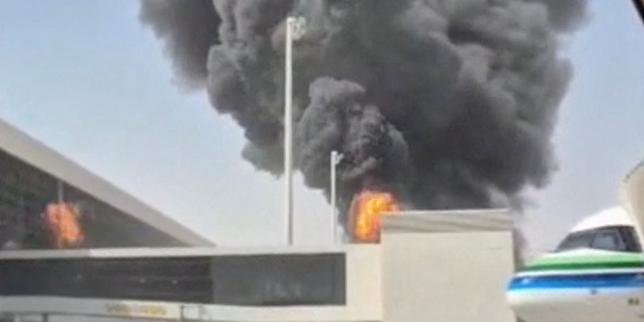
At least, not immediately. In a city accustomed to the hum of commerce and the vast, indifferent desert night, emergency signals often blur into the background noise of modern life. But Thursday night broke that routine with a violence that left no room for ambiguity. The sky over the airport did not merely flash; it cracked.
Three lives ended in seconds. Three men—citizens of Saudi Arabia whose names would soon fill the dry, formal bulletins of evening news broadcasts—became casualties of a conflict that too often feels distant until it lands directly on the asphalt. For another look on this story, see the latest update from The New York Times.
We talk about geopolitical conflict in statistics. We measure war in interceptor trajectories, launch coordinates, and diplomatic communiques. We treat the Middle East as a chess board where pieces move across a map, abstracted by distance and buffered by headlines. But the reality of a Houthi missile strike is not abstract. It smells of scorched aviation fuel and shattered glass. It sounds like a deafening roar that stops human hearts mid-beat.
Consider what happens in the control tower when the radar screens suddenly flare with hostile signatures.
For the air traffic controllers, time fractures. Decisions that usually require committee approvals and methodical checklists must be made in milliseconds. Do you ground the incoming flights from Dubai and London? Do you order an immediate evacuation of the terminal concourses where thousands of civilians are eating, waiting, and laughing? Every second spent hesitating is a gamble with human lives.
And then, the impact.
(Note: While the exact sequence of milliseconds inside the security perimeter can only be reconstructed through forensic investigations and official military reports, the human panic in those moments follows a universal, heartbreaking script.)
A terminal is designed to be a transparent bridge between nations, walled with glass to let the sunlight and hope in. Glass is a terrible shield against shrapnel. When the blast wave hit the perimeter near the airport facilities on Thursday, that architectural transparency turned instantly into a hazard. People dropped. Luggage scattered across the floor like spilled beads. The low murmur of transit turned into a chaotic scream of confusion.
Why Riyadh? Why now?
To understand the weight of Thursday’s tragedy, we have to look past the immediate flash of the explosion and trace the invisible fault lines that have destabilized the region for years. The Houthi movement in Yemen, backed by strategic maneuvers and regional proxy dynamics, has increasingly expanded the theater of war beyond its immediate borders. Airports, oil infrastructure, and desalination plants—the vital organs of civilian survival and economic connectivity—have become targets.
This is not accidental. Modern asymmetric warfare thrives on disruption. By striking an international aviation hub, the message sent is intended to echo far beyond the kingdom’s borders. It says: nowhere is safe. The airspace that links continents, the trade routes that supply millions, the mundane act of catching a red-eye flight—all of it is vulnerable to the reach of a drone or a ballistic projectile.
Yet, focusing solely on the strategy misses the human cost entirely.
Think of the families waiting at the arrivals gate. They were tracking a flight on a smartphone app, watching a little digital plane crawl across a digital map toward Riyadh. They were holding flowers or checking their hair in the reflection of the glass doors, preparing for the familiar joy of an embrace. Imagine the sudden, sickening realization when the digital tracker freezes, followed hours later by a knock on the door or a phone call that irrevocably shatters their universe.
The three Saudi citizens killed on Thursday were not politicians or generals. They were workers, travelers, men with routines, families, and futures. Their deaths are a grim reminder that war does not respect civilian status. It does not pause for international borders. It reaches into the mundane spaces of daily life and tears them apart.
Governments will issue statements of condemnation. Defense analysts will parse the capability of the Patriot missile batteries and debate whether the interception rate was eighty percent or ninety. Diplomats will draft new resolutions in air-conditioned rooms in New York and Geneva, using polite language to describe unspeakable violence.
None of that brings back the three men on the tarmac.
The cleanup crews have already swept up the glass at Riyadh International Airport. The flights have resumed their hypnotic rhythm of arrival and departure. Passengers once again stand in line for security, complaining about baggage fees and flight delays, eager to get to their destinations.
We are remarkably resilient creatures, we humans. We adapt. We normalize the abnormal because the alternative is paralysis.
But beneath that thin veneer of normalcy, the air is heavier now. Every time a jet engine roars overhead tonight, someone in the terminal will flinch. Someone will look up at the ceiling, wondering if the sky is about to break open again. And in that quiet, involuntary hesitation lies the true, uncounted cost of the conflict.