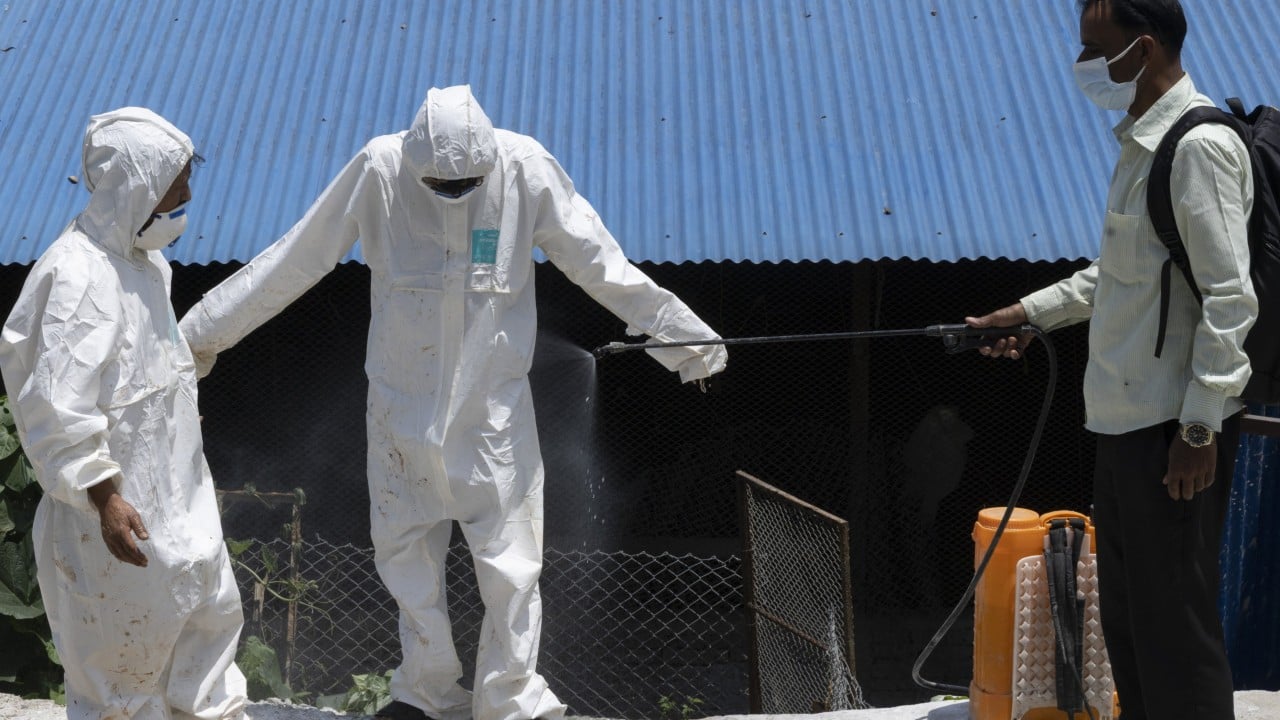
The feathers hit the dirt first. They do not drift down the way they do when a bird is preening or squabbling over feed. They drop heavy, weighed down by grease and sweat and the sudden, violent shudder of a body giving up.
If you stand in the valleys of Chitwan, the silence is what hits you. This is Nepal’s poultry heartland, a region that usually hums with the relentless, vibrating cluck and scratch of millions of birds. It is an industry that feeds families, drives local economies, and anchors the daily lives of thousands of farmers. But lately, that hum has been replaced by a tense, breathless quiet.
When the virus arrives, it does not knock. It sweeps through a shed like an invisible fire. Within forty-eight hours, a flock of ten thousand birds can transform from a thriving livelihood into a mountain of still, white bodies.
For the people who tend these sheds, the loss is immediate and devastating. But for the scientists watching from laboratories in Kathmandu and global health hubs across the world, the stakes are entirely different. They are not just looking at dead chickens. They are looking at the code inside the virus, watching for the one specific typo that could change the world forever.
The Microscopic Lottery
Every time a virus replicates, it copies its genetic blueprint. It is a sloppy copyist. It makes mistakes constantly, dropping letters, swapping sequences, blurring the lines of its own instruction manual. Most of these mistakes are fatal to the virus itself, rendering it useless.
But sometimes, the mistake is a lottery win.
Avian influenza, specifically the highly pathogenic strains making the rounds in Nepal’s farming provinces, is exceptionally good at the lottery. Right now, the virus is perfectly keyed to the lock of a bird’s respiratory system. Its surface proteins attach to avian receptors with terrifying efficiency. Human lungs, thankfully, have a different set of locks. The virus can occasionally force its way in—usually after intense, prolonged exposure to sick birds—but it cannot easily jump from person to person.
The fear keeping epidemiologists awake at night is a process called reassortment. Imagine two different viruses infecting the same cell at the same time. Inside that microscopic arena, they unzip their genetic jackets, throw the pieces into a pile, and grab whatever fragments are closest to re-clothe themselves. If a strain of bird flu mixes with a strain of common human seasonal flu inside a single host, the resulting hybrid could possess the lethality of the avian virus paired with the effortless transmissibility of a human cough.
It is a game of numbers. The more birds that become infected, the more chances the virus has to roll the dice. By spreading unchecked through dense poultry populations, the virus increases its evolutionary surface area. It turns a rare, catastrophic event into a statistical inevitability.
The View from the Dirt
To understand how a pandemic starts, you have to look past the sterile white walls of international laboratories and step into the mud.
Consider a hypothetical farmer named Ramesh. He is not a statistic. He is a man with three children, a mounting bank loan, and a shed containing five thousand layer birds. He notices a few hens looking lethargic. Their combs are turning a dark, bruised purple. By dusk, fifty are dead.
Ramesh faces a choice that no one should have to make. If he reports the deaths immediately, authorities will swoop in, quarantine his property, and cull his entire flock to contain the outbreak. The government offers compensation, but the bureaucracy moves slowly, and the payout rarely covers the true cost of rebuilding from scratch. If he waits, even just twenty-four hours, to see if the die-off stops, he might be able to salvage something. He might sell off the remaining birds to a middleman just to break even.
This is where the virus finds its bridge. In the gap between economic survival and public health policy, the disease hitches a ride on the back of a flatbed truck, traveling down dusty highways to new markets, new sheds, and new hosts.
The frontline of global health security is not guarded by high-tech sensors or border walls. It is guarded by the financial security of smallholder farmers. When we fail to protect their livelihoods, we break the circuit breaker that keeps avian pathogens contained in the wild.
The Geography of Risk
Nepal occupies a unique, precarious position on the map of global virology. The country sits at the intersection of major migratory bird flyways. Every year, wild waterfowl journey thousands of miles across Asia, carrying various strains of influenza in their guts without showing a single symptom of illness. They drop into wetlands, rivers, and rice paddies, sharing water sources with domestic ducks and backyard poultry.
Once the virus jumps from wild birds to domestic flocks, the dense, interconnected nature of modern animal husbandry takes over. Poultry farming in Nepal has exploded over the last few decades, transitioning from a backyard supplement to a massive commercial enterprise. This density is an evolutionary paradise for a virus. In a crowded shed, a pathogen does not need to worry about being subtle. It can mutate toward maximum virulence because its next host is always less than an inch away.
The international community often treats these outbreaks as localized agricultural crises. They look at the numbers—thousands of birds culled, specific districts locked down—and view it as a tragic but distant problem.
That is a profound misunderstanding of how our world is wired. A virus does not recognize borders, nor does it care about administrative districts. The distance between a rural poultry farm in Chitwan and a crowded international airport terminal in Kathmandu is a matter of hours, measured along a single paved road.
The Weight of the Unknown
We have lived through this script before, and the human mind is notoriously bad at assessing abstract threats until they are knocking on the front door. It is easy to dismiss the warnings as alarmism, to look at the decades of bird flu headlines and wonder why the big explosion hasn't happened yet.
But biology operates on a timeline that humans are poorly equipped to comprehend. The virus is patient. It does not have a master plan; it simply tries every door, millions of times a day, across thousands of farms, waiting for the one lock that happens to be rusted open.
The scientists tracking the mutations in Nepal are mapping subtle shifts in the amino acid chains of the virus's polymerase proteins. They are looking for markers that indicate the virus is adapting to replicate better at the cooler temperatures found in the human upper respiratory tract, rather than the warmer core temperatures of birds. Every tiny shift they find is a warning light on a dashboard that most of the world is ignoring.
The solution requires more than just culling teams and disinfectant spray. It demands a fundamental shift in how we value global health infrastructure. It means investing heavily in real-time genomic sequencing in developing nations so we can see the enemy changing in real time. It means creating robust, friction-free compensation systems for farmers so that reporting a sick bird is an act of economic safety rather than financial suicide.
The sun sets over the valleys of Chitwan, casting long, orange shadows across the metal roofs of the poultry sheds. Inside, the farmers walk the aisles with flashlights, listening to the breathing of their flocks, searching the dark for the sudden stillness that signifies the end of one world, and potentially, the beginning of another.