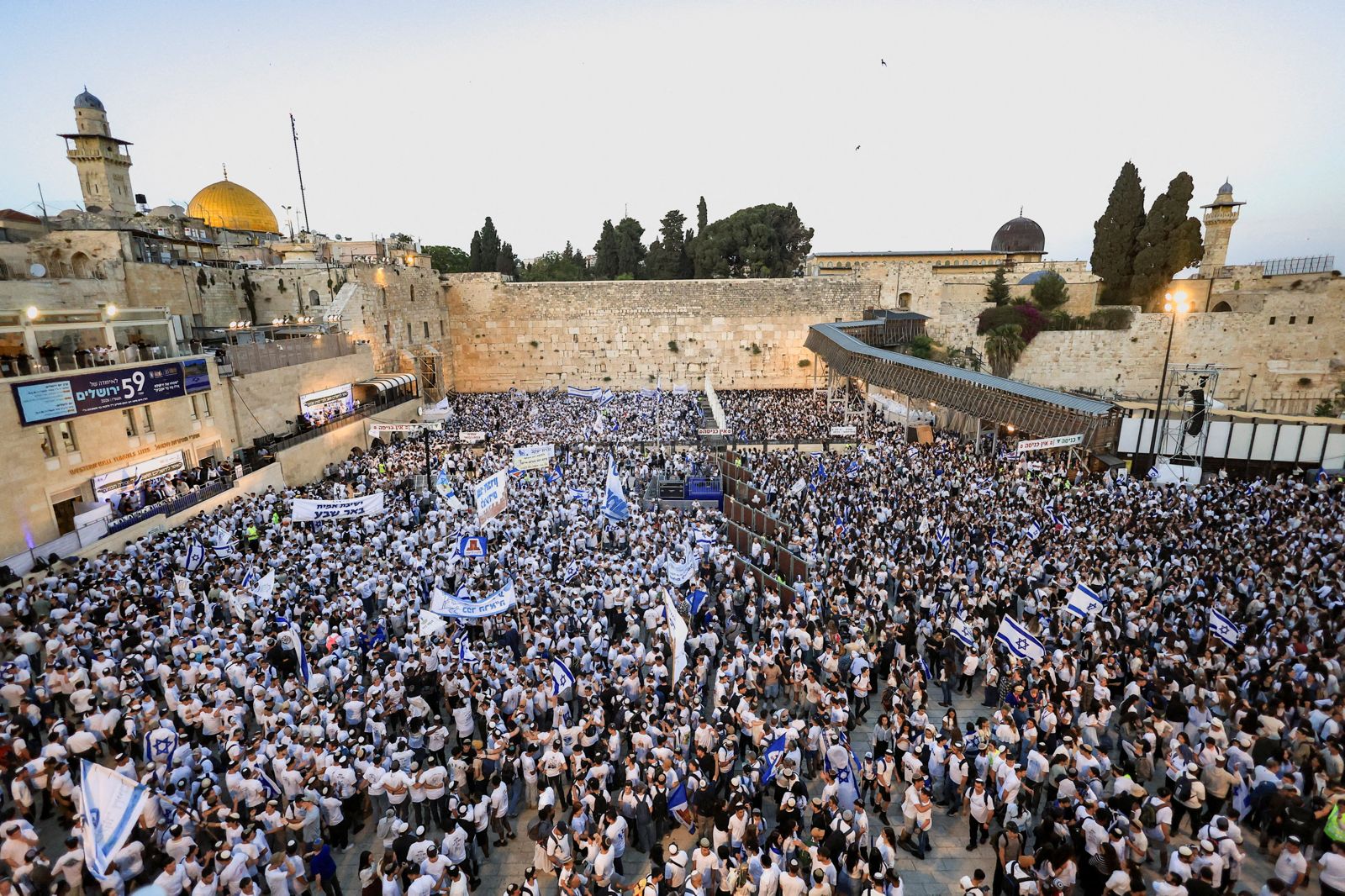
The Jerusalem Day Flag March has evolved from a local celebration of the 1967 reunification of the city into a volatile display of geopolitical friction and ultranationalist fervor. Tens of thousands of marchers, predominantly from the religious Zionist movement, surged through the Muslim Quarter of the Old City this year, chanting slogans that highlight the deepening chasm between Israeli internal politics and international humanitarian concerns. While the event ostensibly marks the capture of East Jerusalem, it now serves as a high-stakes arena where the rhetoric of the ongoing conflict in Gaza meets the ancient stones of the capital.
The atmosphere in the Old City during the march is not one of quiet reflection. It is loud. It is aggressive. It is a physical manifestation of a specific political will that seeks to assert dominance over disputed territory. For the Palestinian residents who live behind the shuttered storefronts of the Damascus Gate, the day is one of forced confinement and fear. This year, the scars of the war in Gaza loomed over every interaction, with participants frequently referencing the destruction in the south as a point of nationalist pride rather than a tragedy to be mourned.
The Mechanics of National Identity on Display
The march is organized by right-wing groups that receive significant logistical and security support from the state. It is not a grassroots accident. Thousands of police officers are deployed to clear the route, often involving the proactive removal of Palestinian activists or the closure of Palestinian-owned businesses hours before the first flag arrives. This creates a vacuum. Into that vacuum pours a sea of blue and white, accompanied by drumbeats and chants that are often directed squarely at the residents watching from behind barred windows.
Security officials view the event as a logistical nightmare that must be managed to prevent a wider regional escalation. They know that a single spark in Jerusalem can ignite a fire in the West Bank or draw rocket fire from regional adversaries. Yet, the political pressure to allow the march to proceed along its traditional route through the Muslim Quarter is immense. To change the route is seen by the marchers and their representatives in the government as an act of surrender—a public admission that Israeli sovereignty in the Old City is conditional.
The "Gaza is a graveyard" chant, which echoed through the narrow alleys of the Old City this year, represents more than just fringe extremism. It reflects a hardening of the Israeli public's stance following the October 7 attacks. The language of the street has shifted. What was once considered radical or unspeakable in polite society is now shouted by teenagers draped in national symbols. This shift is significant because it signals a breakdown in the distinction between military necessity and ideological triumphalism.
The Role of Government Sanction
In previous years, senior government officials might have kept a degree of distance from the most provocative elements of the march. That is no longer the case. Cabinet ministers now walk at the head of the procession, filming themselves for social media and issuing statements that leave little room for ambiguity regarding their long-term goals for the region. Their presence provides a layer of legitimacy to the more extreme rhetoric heard on the ground.
When a minister joins a crowd that is calling for the resettlement of Gaza or the displacement of local residents, the message to the international community is clear. The internal political base is being prioritized over diplomatic standing or the "status quo" agreements that have historically governed Jerusalem’s holy sites. This isn't just about a walk through an old city; it is about the projection of power in a moment of perceived existential threat.
The police presence, while ostensibly there to maintain order, often finds itself in the middle of a conflict it is not equipped to solve. Officers are tasked with protecting marchers while simultaneously suppressing any form of counter-protest or Palestinian expression. This creates an environment where the law is applied unevenly, further eroding trust in the institutions meant to provide safety for all inhabitants of the city.
The Human Cost of Symbolic Territory
Behind the headlines and the viral videos of shouting matches, there is a quiet, grinding reality for the people who call the Old City home. For a shopkeeper in the Muslim Quarter, Jerusalem Day is a day of lost revenue and broken property. It is a day when they must tell their children to stay away from the windows. The psychological impact of having thousands of people march past your door calling for your destruction cannot be quantified by simple casualty counts or arrest records.
The tension is not one-sided. Israeli participants often point to years of historical trauma and the ongoing threat of terrorism as the justification for their uncompromising presence. They see the march as a necessary act of defiance against those who would deny their right to the land. In their view, every flag raised is a rebuttal to the violence of the past. However, this defiance often manifests as the very aggression they claim to oppose.
Strategic Implications for the Region
The international community watches the Jerusalem Day march with a growing sense of unease. For diplomats in Washington, Brussels, and Amman, the event is a recurring obstacle to de-escalation efforts. It complicates the Abraham Accords and provides ready-made propaganda for groups like Hamas, who use the footage to rally support for their cause. The images of ultranationalists celebrating while a humanitarian crisis unfolds in Gaza are a gift to those who wish to isolate Israel on the world stage.
There is also the question of the Temple Mount, known to Muslims as the Al-Aqsa Mosque compound. Many marchers aim to finish their route at the Western Wall, but a growing number of activists are pushing for greater Jewish prayer rights on the mount itself. This is the ultimate red line in Middle Eastern politics. Any perceived shift in the status quo there is not just a local issue; it is a global one. The march serves as a pressure cooker for these sentiments, bringing them to a boil once a year in a highly visible fashion.
The Widening Internal Divide
The march also highlights the fracturing of Israeli society itself. There are many Israelis who find the rhetoric of the march abhorrent. They see it as a corruption of Zionism and a threat to the democratic fabric of the country. Peace activists often hold counter-demonstrations, though they are usually kept far away from the main route by police cordons. This internal friction is a microcosm of the larger debate over the future of the state: whether it will be a liberal democracy or a nation defined primarily by ethno-nationalist religious identity.
The youth participation in the march is particularly telling. Many of the most vocal participants are too young to remember a time before the separation barrier or the blockade of Gaza. Their worldview is shaped by a cycle of conflict that leaves little room for the nuances of coexistence. For them, the march is a rite of passage, a way to signal their belonging to a movement that promises strength and certainty in an uncertain world.
The Economic and Social Vacuum
Jerusalem is a city of layers, both historical and economic. The areas most affected by the march are also some of the most impoverished. By forcing the closure of Palestinian businesses, the state exacerbates the economic disparity that fuels much of the local resentment. It is a cycle of alienation that ensures the next generation will be even more radicalized than the last. When you remove the ability of a community to function normally, you create a space where only extremism can grow.
The infrastructure of the march—the barriers, the checkpoints, the surveillance—becomes a permanent fixture in the lives of the residents. It is not just for one day. The security apparatus required to manage the fallout of such events stays in place, creating a "normalized" state of siege that defines the urban experience in East Jerusalem. This is the reality of a city that is unified on paper but deeply divided in the streets.
The Future of the Flag March
As the conflict in Gaza continues with no clear end in sight, the Jerusalem Day celebrations are likely to become even more charged. The language of "total victory" used by political leaders finds its most visceral expression in the streets of the Old City. There is no easy way to roll back the clock on the radicalization that has taken place over the last several decades. The march has become a bellwether for the soul of the country.
Future iterations of the event will test the limits of Israeli security forces and the patience of its allies. There are calls from some quarters to reroute the march permanently to avoid the Muslim Quarter, but such suggestions are currently a political non-starter. As long as the march is viewed as a zero-sum game of sovereignty, it will remain a flashpoint for violence and a symbol of a peace process that has stalled into non-existence.
The stones of Jerusalem have seen many empires and many marches. They remain indifferent to the chants, but the people living among them do not have that luxury. The policy of allowing the march to proceed in its current form is a choice—a choice that prioritizes the symbolic assertion of territory over the practical necessity of communal peace. Until that calculus changes, the "graveyard" rhetoric will continue to be a grim reflection of a reality that few are willing to confront directly.
Stop treating the march as an isolated parade and recognize it as a policy tool of a specific political faction. Underestimating the impact of this rhetoric on regional stability is a mistake that has been made too many times before. The march is the message.