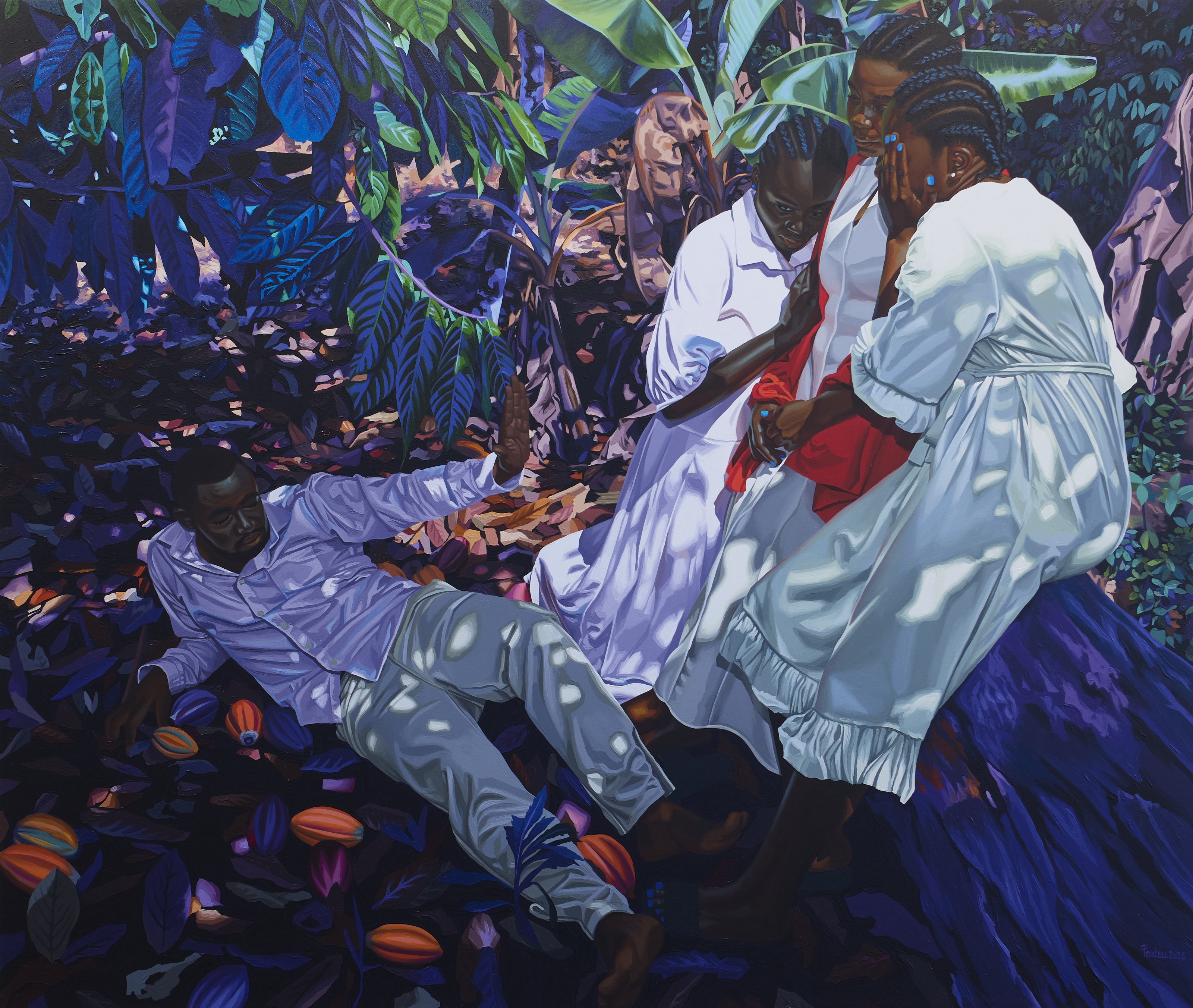
The art world loves a fairy tale. Give them a young painter setting up an easel in the dappled sunlight of a Cameroonian cocoa plantation, fusing classical European Renaissance composition with equatorial agriculture, and the art blogs lose their collective mind. It gets written up as a triumph of cultural reclamation. It gets praised as a bridge between Old Master techniques and modern African realities.
It is absolute theater.
I have watched curators, collectors, and biennale directors circle the globe for the past two decades hunting for geographical novelty. They do not want art that challenges power structures; they want aestheticized geography. Dragging European oil painting tropes into a rural farming estate in Central Africa does not subvert the canon. It just updates the wallpaper.
Let us dismantle the lazy consensus piece running across the culture desks right now. The core assumption of that narrative is simple: placing classical European aesthetics inside a non-Western agrarian workplace inherently decolonizes the art.
That logic is broken. It mistakes the setting for the substance.
The Trap of Exoticized Authenticity
Look closely at what happens when a creator relocates their practice to a commodity-producing rural zone. The art market treats the soil as a performance metric. If a painter works in a sterile white-box studio in London or New York, they are judged purely on line, color, and market demand. But the moment they set up camp next to cocoa pods in West or Central Africa, the critics start projecting a sociological mandate onto every brushstroke.
Suddenly, a portrait rendered in the chiaroscuro style of Caravaggio becomes a profound political statement simply because the subject is holding a machete or standing under a palm tree.
This is not radical. It is pandering.
It tells Western collectors precisely what they want to believe about contemporary African art: that it must remain tethered to the soil, to manual labor, and to an explicitly rustic relationship with raw commodities. Try selling a pristine geometric abstract painting created in that same plantation that has zero references to agriculture or heritage. Watch how fast the institutional gatekeepers lose interest. They do not want universalism from these regions. They want local color packaged for export, dressed up in the historical vocabulary of the very empire that drew the borders in the first place.
The Renaissance Fallacy
Why are we still using the Renaissance as the default gold standard for technical excellence?
The entire conceit of taking 16th-century Italian lighting and compositional geometry and dropping it onto a modern agricultural site relies on a deeply Eurocentric premise. It assumes that artistic validation requires bowing before the altar of European academic tradition.
If an artist spends years mastering glazing techniques invented in Florence, and then applies them to workers on a cash-crop farm, what have they actually achieved? They have proven they can use a colonial toolset to document post-colonial realities. That is not a subversion of the master's house. That is interior decorating with extra steps.
True disruption does not borrow the visual grammar of the colonizer to make the colonized look noble. True disruption throws the grammar away.
When you trap modern African figurative painting inside the rigid, theatrical lighting of European historical painting, you flatten complex contemporary identities into historical tropes. You turn living, breathing individuals into archetypes. The cocoa farmer becomes a modern saint in a Renaissance altarpiece. The plantation becomes a pastoral stage set.
None of this changes the price of cocoa on the global commodities exchange. None of this alters the structural extraction that keeps agrarian workers in poverty while galleries in Chelsea rake in six figures for canvases depicting their labor.
The Economics of the Plantation Aesthetic
Let us talk about the money, because the cheerleaders of this movement conveniently ignore the economic pipeline.
Imagine a scenario where a canvas painted on a Cameroonian farm sells for fifty thousand dollars at a Basel preview. How much of that capital flows back into the local cooperative that grew the beans shading the artist's studio? How much builds local infrastructure, funds independent art schools, or creates sustainable galleries in Yaoundé or Douala that do not have to beg for validation from European patrons?
Almost none.
The value is extracted, just like the cocoa beans. The raw material—in this case, authentic local flavor and picturesque labor—is harvested on-site, processed through the financial hubs of the global art market, and consumed by collectors who view the whole enterprise as a charming exercise in worldly philanthropy.
The plantation is not a creative sanctuary. It is a marketing prop. It provides a narrative hook for press releases. It gives wealthy buyers a neat little story to tell dinner guests about how socially conscious their latest acquisition is, all while keeping the actual systems of artistic and economic power firmly anchored in London, Paris, and New York.
What Real Artistic Autonomy Looks Like
If we want to support genuine innovation across the continent, we need to stop rewarding artists for performing geography.
Real autonomy means an artist can paint abstract geometric grids in an urban high-rise in Lagos without feeling the burden of representing their entire continent's socioeconomic struggles. It means rejecting the soft bigotry of low expectations that demands every piece of art originating outside Western capitals must function as a political thesis on labor, history, or post-colonial identity.
Stop looking for the picturesque. Stop celebrating the intersection of corporate commodity farming and classical European portraiture as if it were a revolutionary manifesto. It is just paint on canvas, marketed by people who love the aesthetic of struggle as long as they control the ledger.
The next time you see a profile praising an artist for finding inspiration in a rural resource zone, ask yourself a simple question: Who is actually cashing the check, and who is being framed for the background.
Cut the romance. Follow the capital.