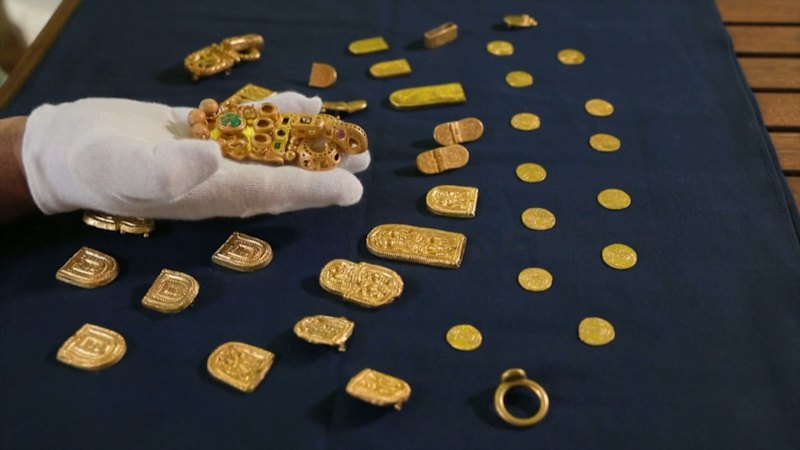
Another week, another headline breathlessly reporting that marine archaeologists pulled a handful of ancient gold coins from a shipwreck near Croatia. The media swoons. The internet gushes over "priceless treasure." The public imagines swashbuckling divers lifting chestfuls of bullion from the floor of the Adriatic Sea.
It is absolute rot. For a more detailed analysis into similar topics, we suggest: this related article.
Every time a news outlet fixates on a shiny piece of metal dragged out of the mud, it fundamentally distorts how ancient history actually worked. Worse, it feeds a toxic, greedy narrative that reduces centuries of complex maritime trade to a glorified pirate fantasy.
If you care about understanding the past, stop looking at the gold. The real story, the real value, and the real historical truth lie in the dirty, unglamorous junk sitting right next to it. To get more context on this issue, detailed analysis can also be found on Associated Press.
Gold Coins Tell Us Almost Nothing
Gold is historically boring.
When a ship sank off the coast of Dalmatia two thousand years ago, gold coins were the absolute least interesting thing on board. Bullion was standard, standardized, and spent everywhere. An imperial Roman aureus minted under Vespasian tells you precisely two things: Vespasian was emperor, and somebody on that ship had money.
That is it.
Gold does not rot. It does not react with saltwater. It sits in the seabed looking practically the same as the day it fell overboard. Because it survives so perfectly, it provides zero environmental or context-specific data about the site. It is an inert, shiny distraction.
You know what actually tells a story? Broken ceramic pots.
Amphorae—the plain, clay storage jars used across the Mediterranean—are the true data goldmine of maritime history. A single shattered jar can tell an archaeologist:
- The exact region where the clay was dug up (via petrographic analysis).
- The exact type of wine, olive oil, or fermenting fish sauce (garum) carried inside (via organic residue testing).
- The specific trade route the vessel took based on resin lining chemistry.
- The socio-economic class of the consumers waiting at the destination port.
When headlines trumpet gold, they ignore the fact that forty broken amphorae hold ten times more usable economic data than a hundred gold coins. Gold shows wealth; pottery shows the heartbeat of an entire civilization’s daily commerce. But pottery does not generate clickbait.
The Financial Delusion Of Deep-Sea Treasure
Let us talk about the money, because the mainstream media loves to slap absurd dollar figures on these discoveries. "Shipwreck contains $10 million in ancient gold!"
No, it does not.
That valuation is a myth invented by private salvage operators, greedy auction houses, and lazy journalists who do not understand market liquidity or heritage law.
Try taking a 2,000-year-old Roman coin retrieved from territorial waters and selling it on the open market. Here is what actually happens:
- State Ownership Claims: Under international maritime law and the 2001 UNESCO Convention on the Protection of the Underwater Cultural Heritage, artifacts found in sovereign waters belong to the state, not the diver. Croatia, Greece, Italy, and Spain will seize illicitly retrieved material faster than a privateer can drop anchor.
- Market Saturation: The moment a hoard of 5,000 identical late-Roman gold coins hits the legal market, the price per unit collapses. Valuations assume each coin sells at peak retail collector prices. Supply and demand do not work that way.
- Conservation Costs: Preserving underwater artifacts costs a fortune. Desalination, stabilize-treatment, micro-excavation, and archival storage swallow budgets whole.
I have watched private investors throw millions into deep-sea recovery ventures, chasing phantom gold hoards off the Mediterranean and Atlantic coasts, only to end up bankrupt, embroiled in international lawsuits, or holding bucketfuls of unsellable silver that costs more to store legally than it is worth.
The idea that marine archaeology is a profitable hunt for lost riches is an illusion selling tickets to suckers.
How "Treasure Fever" Destroys History
The obsession with gold is not just intellectually lazy; it is actively destructive.
When media outlets hype the monetary value of underwater finds, they spark gold fever among amateur divers and illicit looters. A looting operation does not carefully grid a site, map the spatial distribution of artifacts, or measure sediment layers. Looters use heavy vacuums, prop-wash deflectors, and crowbars to tear through delicate wood structures just to grab metal objects they can sell on the black market.
Imagine a scenario where someone walks into the Louvre, rips a painting off the wall, cuts out the one corner that features a gold frame, and burns the rest of the canvas. That is precisely what underwater looting looks like.
The structural timber of an ancient ship contains crucial naval architectural data:
- Tree-ring patterns (dendrochronology) that pinpoint the exact year and forest where the ship was built.
- Tool marks that reveal iron production capabilities and shipbuilding technology.
- Ballast stones that reveal the ship’s origin port by matching regional geology.
When a looter or an aggressive "treasure hunter" blasts away the seabed sediment with water jets to find coins, that organic data is destroyed instantly. The context is wiped out. Without context, an artifact is just a paperweight with a vague origin story.
What Real Maritime Archaeology Looks Like
If you want to know what actual, groundbreaking underwater research looks like in the Adriatic or Mediterranean, look away from the gold coins. Look at the mundane, grimy details that rarely make the front page.
Resin Linings and Ancient Gastronomy
Archaeologists analyzing the interior pitch of jars found off the Croatian coast discovered that ancient vintners were blending specific local pine resins into their wine to preserve it for long sea voyages. This did not just extend shelf life; it created distinct flavor profiles that became luxury brands across the Roman Empire. We learned how ancient people actually tasted their food through molecular chemistry, not gold coins.
Ballast Stone Sourcing
By running X-ray fluorescence tests on heavy, uninteresting river rocks found in the bottom of a hull, researchers mapped trade routes that ran counter to historical texts. Ships were not just sailing straight from Rome to Constantinople; they were running complex, multi-stop cabotage routes, picking up local cargo and stone in obscure coastal villages.
Shipboard Life
Excavating the galley area of a merchant wreck reveals hand-mills for grain, bone gaming dice, personal amulets, and pig bones bearing butchery marks. This reveals the diet, religion, and daily coping mechanisms of enslaved sailors who actually crewed these wooden death traps.
That is human history. A gold coin is just money.
The Delusion Of "Priceless"
We need to kill the phrase "priceless treasure" once and for all.
Assigning financial value to cultural heritage is a fundamental mistake. When we label a discovery by its estimated market price, we validate the concept that these items exist to be traded, owned, and monetized.
The true value of a shipwreck is informational. Once an artifact is removed from its spatial context without meticulous recording, its scientific value drops to zero, regardless of how much gold it contains. An intact, unlooted wreck filled with nothing but salted fish bones and coarse kitchenware is worth vastly more to human knowledge than an isolated chest of gold coins pulled up by a commercial salvage rig.
Stop celebrating the gold. Start asking what the mud contained around it.
Until we strip the pirate romanticism out of marine archaeology, we will keep worshipping shiny trinkets while the actual book of human history rots at the bottom of the sea.


