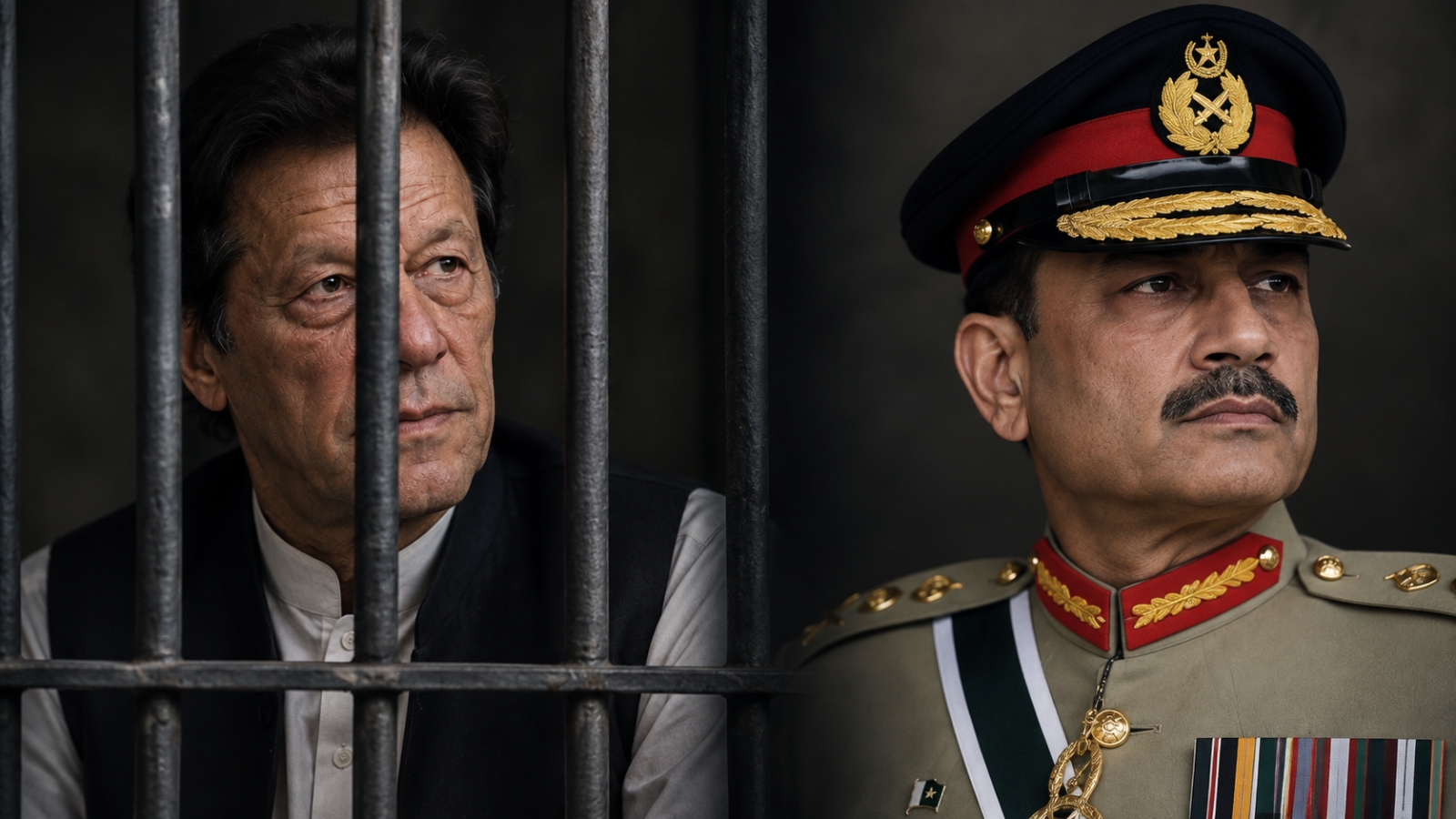
The political pressure cooker in Pakistan has reached a boiling point far beyond the usual noise of Islamabad's parliamentary corridors. When the sons of imprisoned former Prime Minister Imran Khan publicly accused Pakistan Army chief General Asim Munir of deliberately endangering their father's life behind bars, the dynamic shifted. This was not just another standard opposition grievance. It marked a sharp escalation in an intense dynastic and military standoff, thrusting the personal safety of the country's most polarizing political figure into the center of international scrutiny.
Kasim and Suleiman Khan stepped before foreign microphones with a stark warning. They argued that their father faces systematic isolation and psychological torment designed to break his resolve inside Adiala Jail. For years, the narrative surrounding Imran Khan focused strictly on his populist appeal, his populist rallies, and his dramatic removal from power through a no-confidence vote in 2022. Now, the battleground has narrowed to the grim stone walls of a high-security prison and the opaque command structure of General Munir's military establishment.
Understanding how this confrontation reached such a volatile juncture requires looking past the daily churn of court hearings and reviewing the structural mechanics of Pakistani statecraft.
The Anatomy of Institutional Dominance
Pakistan has operated under a recurrent cycle where civilian administrations function under the watchful eye—and often the direct veto—of the military establishment. Imran Khan arrived in office in 2018 with the tacit backing of this very establishment. That marriage of convenience fractured irrevocably over intelligence appointments and policy disagreements. When Khan attempted to assert civilian supremacy over military promotions, the alliance collapsed.
The subsequent sequence of events followed a familiar historical script. A no-confidence vote removed Khan, a flurry of corruption charges followed, and legal disqualifications piled up. Yet unlike previous ousted leaders who chose exile or faded into quiet irrelevance, Khan engineered a massive counter-movement. He mobilized millions through anti-establishment rhetoric, framing his struggle as a fight for genuine freedom against an entrenched oligarchy.
This strategy cornered the military leadership. General Munir inherited an institution facing unprecedented pushback from the public square. Social media platforms buzzed with dissent, and overseas diaspora communities rallied with financial and political backing. The military responded with a heavy hand, deploying anti-terrorism laws, mass arrests, and strict media blackouts to neuter the Pakistan Tehreek-e-Insaf party.
Placing Khan behind bars was intended to silence the thunder. Instead, it turned him into a permanent martyr figure.
Inside the Prison Walls
The grievances raised by Khan's sons center on the conditions of his confinement. Solitary confinement, restricted access to legal counsel, and barred family visits form the core of their complaints. International human rights organizations have repeatedly voiced alarm over the treatment of political prisoners in Pakistan, noting that due process frequently takes a back seat to security imperatives.
When a state locks away its most popular political leader, the prison ceases to be a mere correctional facility. It becomes the primary political arena of the nation. Every rumor regarding Khan's health, every denied meeting with his lawyers, and every censored statement amplifies public anxiety.
The government and military establishment consistently maintain that Khan receives treatment consistent with legal guidelines and prison rules. They portray the legal cases against him—ranging from state secrets leaks to corruption—as routine enforcement of the rule of law. However, domestic and international legal observers point out the extraordinary speed of convictions and the systematic hurdles placed in the path of Khan's defense teams. The judiciary itself remains deeply polarized, caught between public pressure and institutional directives.
The International Dimension
Imran Khan's family recognized that domestic avenues for relief were increasingly blocked by judicial maneuvering. By taking their campaign to Western capitals and international media platforms, they shifted the pressure outward.
Foreign governments, particularly in the United States and the European Union, find themselves in a delicate diplomatic posture. Pakistan remains a nuclear-armed state facing severe economic instability, a persistent Islamist insurgency, and critical dependence on International Monetary Fund bailout packages. Western diplomats cannot afford to ignore Pakistan's strategic positioning, yet turning a blind eye to widespread democratic regression erodes their own stated values on human rights.
General Munir understands this calculus well. The military establishment banks on the reality that global powers prioritize regional stability over the fate of any single politician. As long as the state maintains basic macroeconomic management and cooperates on core security interests, foreign capitals are likely to issue muted expressions of concern rather than punitive economic or diplomatic measures.
The Point of No Return
The standoff between the military high command and the imprisoned former premier has created a zero-sum game where neither side can afford a tactical retreat.
If General Munir yields to populist pressure and releases Khan, the military risks losing its overarching supervisory role in national politics, potentially opening the door for sweeping retribution from a resurgent PTI administration. Conversely, if Khan remains locked away indefinitely under harsh conditions, the risk of social explosion grows with every passing month. Economic hardship, high inflation, and widespread disillusionment among the youth provide fertile ground for ongoing civil unrest.
The sons' public plea is a calculated attempt to keep the spotlight burning. They are betting that international visibility offers a layer of protection that local courts and prison guards cannot entirely bypass.
History suggests that when powerful institutions attempt to completely erase a populist icon through administrative force, they often succeed only in hardening the resistance against them. Pakistan stands at a dangerous crossroads where the health and safety of one man inside a concrete cell serves as the ultimate litmus test for the future of the nation's fragile republic. The walls of Adiala Jail hold more than a political prisoner; they contain the unresolved tension between civilian sovereignty and military dominance that has haunted the country since its birth.