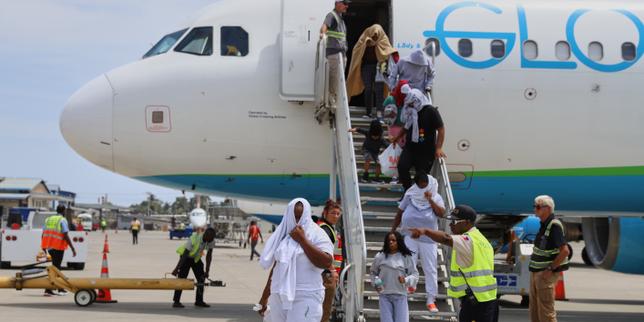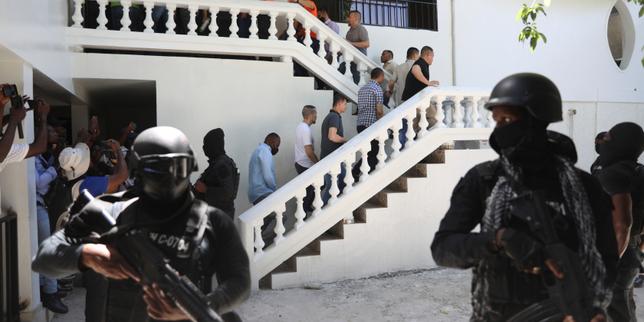
Five years after assassins breached the private residence of Haitian President Jovenel Moïse and gunned him down in his bedroom, eighteen suspects face prosecution not inside a courtroom in Port-au-Prince, but thousands of miles away in a federal courthouse in Miami. This massive transfer of defendants lays bare a grim institutional reality. Haiti's domestic judicial apparatus remains entirely broken, incapable of holding power to account or conducting a secure trial. When a sovereign nation outsources the prosecution of its assassinated head of state to a foreign power, it signals an administrative collapse far deeper than any single political crisis.
The July 2021 assassination shocked the international community, yet the five years since that night have transformed a murder investigation into a sprawling transnational legal battleground. The eighteen men now caught in the American federal system represent a strange cross-section of modern political violence. Among them are retired Colombian soldiers recruited under false pretenses, Haitian-American fixers with deep ties to South Florida real estate, and financiers who allegedly believed they could step into the political vacuum left by Moïse's death.
The Paralysis of the Domestic Judiciary
To understand why these eighteen suspects stand trial in Florida rather than Haiti, one must examine the absolute degradation of the Haitian justice system. Investigative magistrates assigned to the case faced a terrifying gauntlet. Several judges resigned, went into hiding, or fled the country after receiving explicit death threats. Others found their offices vandalized or their direct staff intimidated by armed actors operating with total impunity.
When an institutional framework cannot protect its own investigators, justice becomes impossible. The local courts lacked the basic security infrastructure required to detain high-profile foreign mercenaries and politically connected elites without risking prison breaks, bribery, or outright assault. In a country where armed gangs control substantial portions of the capital, holding a trial of this magnitude on home soil was never a realistic option.
Foreign intervention in Haitian affairs is a deeply sensitive subject, loaded with historical grievances and resentment. Yet, the inability of local authorities to prosecute the murder of their own president left an institutional vacuum. The American Department of Justice stepped into that vacuum because several conspirators used US financial systems to wire money, purchased weapons in Florida, and held dual citizenship.
The Anatomy of a Transnational Conspiracy
The conspiracy that ended Jovenel Moïse's life was engineered across multiple international borders. It was not a spontaneous uprising or a simple palace coup. It was a corporate-style operation financed by wealthy actors and executed by hired muscle.
Recruitment centered around CTU Security, a small private security firm based in Florida. Retired Colombian military personnel were told they were deploying to Haiti to provide security for VIPs or assist with infrastructure projects. Once on the ground in Port-au-Prince, the mission shifted dramatically. The soldiers were informed that their objective was to arrest the president under an expired or fabricated arrest warrant. Instead, the operation devolved into a targeted assassination.
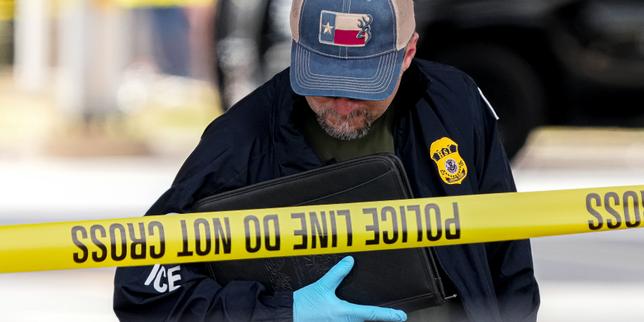
The financial trail offered federal investigators in the United States a clear roadmap. Conspirators wired funds through Miami-based banks, coordinated logistics over encrypted messaging apps, and held planning meetings in upscale hotels across Florida and the Dominican Republic. Because these actions violated American laws against conspiring to kill or kidnap individuals outside the United States, federal prosecutors in Miami possessed immediate jurisdictional leverage.
The Long Reach of American Federal Law
The invocation of US federal jurisdiction in a foreign assassination case highlights the unique reach of American extraterritorial statutes. Prosecutors utilized laws designed to combat international terrorism and conspiracies targeting individuals protected by international law, or simply conspiracies hatched on American soil involving US residents and funds.
Several defendants quickly opted for plea agreements, trading cooperation for lighter prison sentences. These pleas peeled back the layers of secrecy surrounding the plot. Testimony from figures like Rodolphe Jaar and Joseph Vincent exposed the inner workings of the financing and the chaotic hours immediately following the raid. Yet, while American courts efficiently processed these intermediate conspirators, the trials operated under strict legal boundaries that frequently prevented a broader exploration of the structural rot inside Haitian politics.
For the American judicial system, the trial is a matter of enforcing domestic laws broken by individuals operating within US borders. For Haiti, it is a glaring reminder of state incapacity.
Outsourcing Sovereignty
Relying on American courts to solve the crime creates a profound dilemma for Haiti. On one hand, federal prosecutors in Miami operate with resources, forensic capabilities, and security measures that the Haitian National Police simply cannot match. Guilty pleas and convictions have accumulated steadily in Florida, offering a degree of factual clarity that would have been unattainable in a compromised local tribunal.
On the other hand, this reliance strips Haiti of its judicial agency. Justice delivered in a foreign courtroom feels distant to the average citizen in Carrefour or Delmas. It transforms a national trauma into a foreign legal proceeding governed by American statutory guidelines and sentencing rules. The trial transcripts are written in English, the proceedings are broadcast to American media, and the ultimate accountability is meted out by an American judge.
This dynamic deepens a longstanding dependency. When a nation cannot try the murderers of its president, it signals to its populace and the world that its foundational institutions have ceased to function as sovereign entities. The extraditions solved the immediate problem of how to secure custody of the suspects, but they exposed a vacuum of state power that no foreign verdict can patch over.
The Missing Masterminds
As the legal proceedings in Miami march forward, a persistent question haunts the periphery of every indictment. Who actually financed the operation?
The men sitting in American detention centers—the Colombian foot soldiers, the logistical coordinators, the mid-level fixers—were cogs in a much larger machine. Testimony and investigative reports point toward prominent Haitian politicians, business figures, and political aspirants who allegedly sought to replace Moïse and assume power. Yet, many of these suspected intellectual authors remain outside the reach of the Miami courtroom, operating with virtual impunity inside Haiti or elsewhere abroad.
Federal prosecutors have successfully dismantled the operational layer of the conspiracy. They have mapped out how the guns were bought, how the tickets were booked, and how the safehouses were run. But bridging the gap between the operational executioners and the financial masterminds remains an uphill battle. Trials focused heavily on foreign mercenaries and lower-level intermediaries risk shielding the domestic elites who allegedly greenlit the assassination from ultimate reckoning.
Five years after the president was slain in his private quarters, the pursuit of truth remains fractured. The eighteen extraditions to the United States secured a measure of legal retribution, yet they serve as a permanent monument to a broken state unable to judge its own darkest hour.