Seventeen.
Think about what you were doing at seventeen. Maybe you were parallel parking your parents' sedan in an empty mall lot, sweating through your shirt while a driving instructor tapped a clipboard against the dashboard. Maybe you were arguing about curfew, or staring at a calculus textbook, or trying to figure out who you were going to be when the training wheels finally came off. Meanwhile, you can read other stories here: The Architecture of Posthumous Legitimacy in Hong Kong Civic Leadership.
Nathalia Gadelha was already flying airplanes.
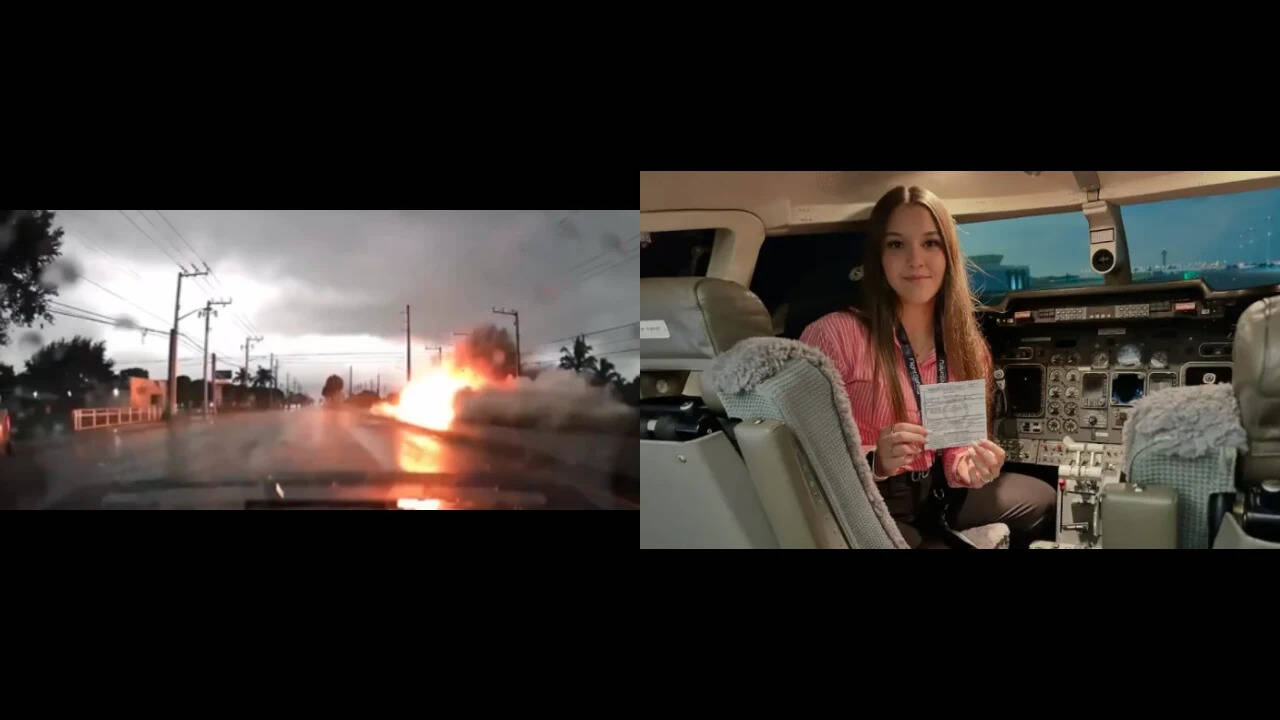
While most teenagers were still negotiating the keys to the family car, she was earning her private pilot’s license, taking command of metal, wind, and gravity in a world that still largely views the cockpit as an old boys' club. Years later, she would sit in the right seat of a Learjet over Florida, a commercial pilot living out the exact dream she had chased since before she was old enough to vote. And then, in a sudden, violent shudder of altitude and fire, that dream ended in a Florida crash that claimed her life. To see the bigger picture, check out the excellent article by Associated Press.
When news breaks of a fatal aviation accident, the headlines arrive stripped of oxygen. They give us registration numbers, tail codes, airport identifiers, and a cold roll call of the dead. Co-pilot of doomed Learjet flight that crashed in Florida identified as Nathalia Gadelha. She got her private pilot's license when she was 17. Twelve words of biography tacked onto a tragedy. A data point. A line item in a preliminary report.
If we stop there, we miss the entire point of her life—and the quiet, terrifying bargain every young aviator makes the moment they decide the ground isn't enough.
The Architecture of a Dream
To understand why a seventeen-year-old girl would spend her weekends memorizing wind shear charts and stall recovery procedures instead of sleeping in, you have to understand the pull of the cockpit.
I have spent enough hours around small municipal airfields—smelling the sharp, sweet bite of 100-octane low-lead fuel mixing with morning dew on the tarmac—to recognize the look in the eyes of young student pilots. It isn't mere ambition. It is a specific kind of hunger. On the ground, life is loud, messy, and full of things you cannot control. At five thousand feet, trimmed out in smooth air above a patchwork of highways and rivers, the rules are absolute. Lift, weight, thrust, drag. You respect the physics, you run the checklist, and the machine rewards you with a view of the earth reserved for birds and astronauts.
For a young woman stepping onto the ramp, that hunger comes with an extra tax.
Aviation remains overwhelmingly male. Walk into almost any flight school lounge or regional crew room, and the demographics haven't shifted nearly as fast as the avionics. According to the Federal Aviation Administration, women still make up less than ten percent of all certified pilots in the United States, and an even smaller fraction of those flying business jets. When Nathalia Gadelha walked out to her trainer aircraft as a teenager, she wasn't just learning how to flare before touchdown or read a sectional chart. She was silently proving, over and over again, that she belonged in the seat.
Getting a private pilot’s license at seventeen requires a discipline that borders on obsession. You cannot cram for a checkride the night before. An FAA examiner doesn't care how charming you are or how hard you tried; they care whether you can hold your altitude within a hundred feet during a steep turn, whether you can recover from a simulated engine failure without panicking, and whether your hands stay steady when a crosswind tries to push your wheels off the centerline.
Picture a hypothetical afternoon in her early training—not as a literal transcript, because none of us were in that trainer with her, but as the universal crucible every teenage pilot survives. The cabin is cramped, vibrating like a tuning fork. Sweat pools beneath the headset ear cups. The instructor reaches over, pulls the throttle all the way back to idle, and says four quiet words: You just lost your engine.
In that moment, your brain wants to freeze. Your stomach drops. Every instinct screams at you to pull back on the yoke to stay away from the trees rushing up below. Pulling back, of course, is the exact thing that will stall the wing and kill you. So you fight every animal instinct in your body. You push the nose down to buy airspeed. You pick a field. You run the flow. You breathe.
Nathalia passed that test at seventeen. She didn't just dabble in aviation; she built her bones out of it, climbing the brutal, expensive, exhausting ladder from single-engine piston trainers to multi-engine ratings, instrument certifications, and finally the sleek, swept-wing world of corporate jets.
Inside the Tin Can at Forty Thousand Feet
To non-pilots, a Learjet looks like glamour. It is the silhouette of private wealth, executive convenience, and effortless speed. You step off a red carpet, duck under a low cabin doorway, sink into cream leather, and arrive two states away before your coffee cools.
Up front, behind the curtain, it is a different universe entirely.
A Learjet is often described by veteran pilots as a sports car with wings—fast, responsive, demanding, and famously unforgiving if you let yourself fall behind it. Unlike massive commercial airliners cushioned by layers of triple-redundant automation and wide, forgiving flight envelopes, light business jets fly high and fast on relatively small wings. Everything happens quicker. Weather builds faster. Runways shrink sooner.
When you sit in the right seat as a co-pilot—the First Officer—you are not a passenger with a better view. You are half of a single nervous system.
Consider what happens during a normal flight in a jet like the one Nathalia was flying in Florida. While the captain might be flying the leg, the co-pilot is managing the radios, monitoring engine temperatures, cross-checking altitudes, watching weather radar paint cells of violent convection ahead, and running through emergency memory items in the back of their mind. Aviation safety relies on a concept called Crew Resource Management—the idea that two human beings in a cockpit must operate without ego, catching each other's blind spots before a minor hiccup cascades into an irreversible chain of events.
It is an intimate, high-stakes partnership. You trust the person next to you with your pulse.
And yet, aviation holds a paradox that terrifies even seasoned captains if they stare at it too long. Flying is statistically the safest way to travel on earth, a triumph of engineering and obsessive regulation. At the same time, it is completely intolerant of carelessness or sudden mechanical betrayal. As the old hangar saying goes, aviation in itself is not inherently dangerous, even to a greater degree than the sea, but it is terribly unforgiving of any carelessness, incapacity, or neglect.
When something goes wrong at low altitude—during takeoff, climb-out, or final approach—time compresses into seconds. There is no pulling over to the shoulder. There is no pausing the simulation to look up a checklist. You play the hand you are dealt with the muscle memory you built years earlier, hoping the metal holds together long enough to reach concrete.
What the Headlines Leave Out
When the Learjet went down in Florida, the public reaction followed a familiar, predictable script.
First comes the shock of the footage—black smoke rising against a flat subtropical sky, emergency vehicles flashing red and blue against scorched grass or asphalt, news helicopters circling like hawks above the debris field. Then come the amateur investigators in the comment sections, dissecting flight tracker paths and weather reports before the foam has even settled on the fuselage. Was it mechanical? Was it weather? Who was at the controls?
I find myself frustrated every time I watch this ritual unfold, because the obsession with the final thirty seconds almost always erases the thousands of hours that came before it.
Yes, the National Transportation Safety Board will eventually publish a exhaustive, clinical dissection of the Florida Learjet crash. Investigators will examine turbine blades under microscopes, pull maintenance logs, reconstruct flight paths, and listen to whatever data survived the impact. That work is vital; every safety rule written in modern aviation was inked in the blood of previous accidents, ensuring that the next crew flying through Florida skies has a slightly wider margin of survival.
But a NTSB report cannot measure what it felt like for Nathalia Gadelha to look down at the coastline from thirty-five thousand feet and know she had earned every inch of that altitude.
Think about the sheer grit required to reach the flight deck of a jet when you start out as a teenager with nothing more than a dream and a logbook full of blank pages. Flight training isn't like college, where you can coast through a few lectures and still walk across a stage with a diploma. Every single rating is a wall you have to climb with your bare hands. You fail a maneuver, you pay for another hour of fuel and go back up until your hands don't shake. You move away from home. You take jobs ferrying planes, instructing nervous beginners in bouncing Cessnas, flying freight through miserable midnight weather just to log another fifty hours of turbine time.
People often ask why young pilots endure it—the low starting pay, the erratic schedules, the holidays spent in sterile airport hotels three time zones away from family.
The answer is simple, even if it sounds impossible to explain to someone who has never left the ground. Once you have broken through a solid deck of gray clouds into blinding, cathedral-bright sunlight above, walking around on the sidewalk feels like living in a basement.
The Invisible Weight of the Right Seat
There is a particular vulnerability in admitting that we don't always know how to grieve people we only meet through tragedy.
When a young pilot dies, those of us who love aviation feel a strange, hollow ache—a mixture of profound sorrow and quiet recognition. We recognize the logbooks stacked neatly on a shelf. We recognize the proud photos taken beside a propeller at age seventeen, grinning wide in a oversized headset, holding up a temporary airman certificate like a golden ticket. We recognize the parents who drove her to the airport at dawn, swallowing their own quiet terror every time she taxied toward the runway alone, because they loved her too much to clip her wings.
If you are reading about Nathalia Gadelha because you saw her name scrolling across a news ticker, it is easy to let the tragedy flatten her into a cautionary tale. People do that when something scary happens. It is a psychological defense mechanism. If we can reduce a plane crash to a headline, a statistic, or a distant fluke, we don't have to confront the fragility of our own lives—or the breathtaking courage it takes to pursue something magnificent knowing the risks are real.
But Nathalia didn't live her life in fear of the ground. She spent her life mastering the sky.
Look at the arc of those years: from a seventeen-year-old girl signing her first solo endorsement, to a professional aviator trusted with the controls of a high-performance jet. That trajectory doesn't happen by accident. It is built out of early mornings, relentless study, quiet resilience in rooms where you are the youngest person and the only woman, and a refusal to settle for a smaller life.
Somewhere in a hangar or a family living room, there is a logbook whose final page ended far too soon, the ink drying mid-story. Yet every line written before that last entry tells the same truth: she didn't wait for permission to fly, and she didn't waste a single mile of sky she was given.
Seventeen years old, hands steady on the yoke, climbing into the blue while the rest of the world was still asleep.