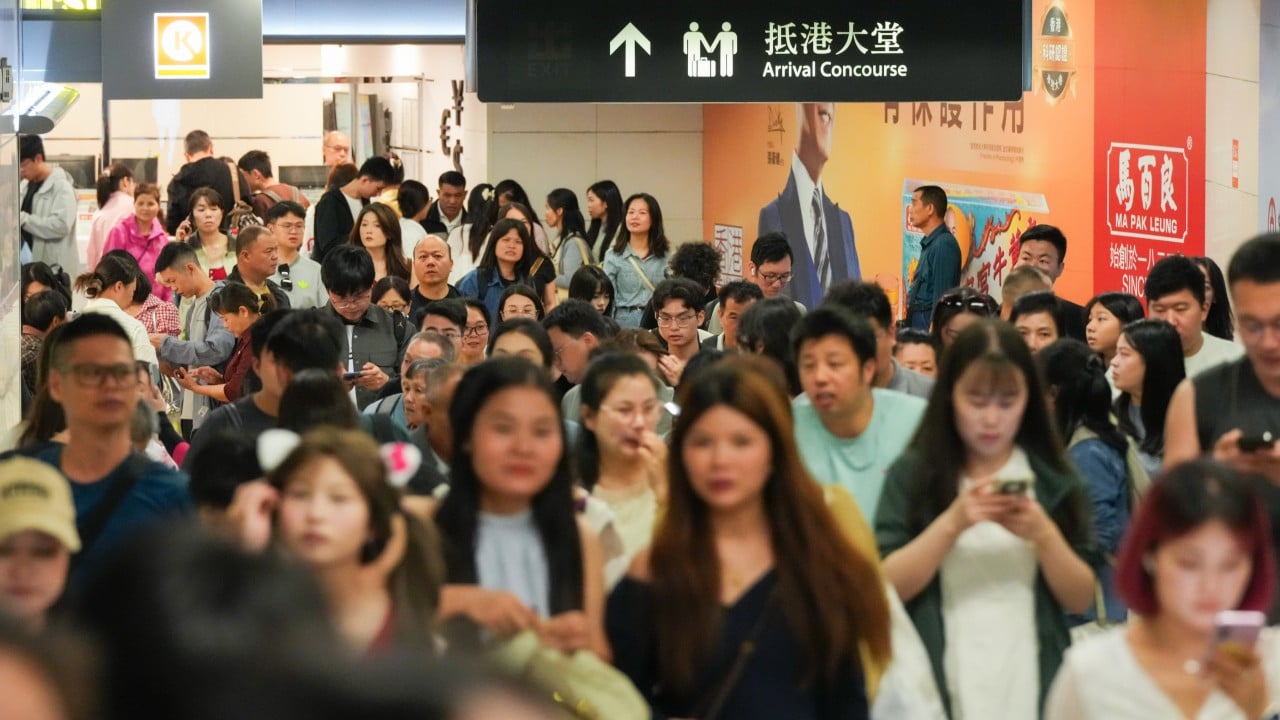
The border at Lo Wu doesn't just open; it exhales. On the first morning of the Golden Week holiday, that collective breath carried 76,056 individual stories across the line from mainland China into Hong Kong. This wasn't the frantic, luxury-focussed stampede of a decade ago. There were no empty suitcases being dragged behind visitors like plastic coffins waiting to be filled with Swiss watches and French handbags.
Instead, there was Chen.
He is twenty-four, an architectural illustrator from Shenzhen, and he represents the tectonic shift in how a billion people are beginning to view the concept of "away." He carried a canvas backpack containing a film camera, a bottle of electrolyte water, and a pair of broken-in trail shoes. For Chen, and the tens of thousands of "city walkers" flanking him, the value of Hong Kong is no longer found under the fluorescent lights of a Tsim Sha Tsui shopping mall. It is found in the humidity of the Dragon’s Back trail and the peeling paint of a Sham Shui Po corner store.
The Death of the Shopping List
For years, the narrative of mainland tourism in Hong Kong was built on a foundation of pure commerce. It was a transactional relationship. You came, you queued, you swiped, you left. But the data from this latest opening reveals a deeper, more quiet evolution. The 76,056 visitors who crossed on day one are part of a demographic that has traded the "Big Bus" tour for the "Small Lane" wander.
This isn't just a change in itinerary. It is a change in soul.
The economic engine of the city used to hum to the sound of cash registers. Now, it vibrates to the rhythmic thud of hiking poles against volcanic rock. The Hong Kong Immigration Department’s figures reflect a reality that the retail sector is still scrambling to digest: the modern traveler is seeking "cultural oxygen" rather than material weight. They are looking for the version of Hong Kong that exists in the gaps between the skyscrapers.
A Mountain for Every High Rise
Consider the geometry of the city. We often think of Hong Kong as a vertical concrete jungle, a claustrophobic achievement of engineering. Yet, forty percent of the territory is protected parkland. To the 76,056 people crossing the border, those green lung spaces are the new luxury.
Hypothetically, if you were to stand at the summit of Victoria Peak and look down, you would see two distinct Hong Kongs. One is the familiar postcard of glass and steel. The other is a tangled, emerald wilderness that starts where the pavement ends. The new wave of visitors isn't looking down at the city; they are looking out from the ridges.
The "City Walk" phenomenon—a term that has exploded across platforms like Xiaohongshu—is essentially a rebellion against the curated experience. It is the art of getting lost on purpose. For a visitor from a sprawling, ultra-modern mainland metropolis, the grit of Hong Kong’s older districts is exotic. The sight of a wet market, the smell of roasted goose hanging in a window, and the tactile sensation of a steep, narrow alleyway in Central offer a sensory density that a polished mall cannot replicate.
The Invisible Stakes of a Changing Economy
This shift creates a strange tension. While the sheer volume of visitors is a boon for the city’s post-pandemic recovery, the spending patterns have mutated. The "Invisible Stakes" here involve the survival of the small business versus the luxury conglomerate.
When 76,000 people arrive looking for a specific, "Instagrammable" pineapple bun in a back-alley cafe rather than a diamond ring on Canton Road, the flow of capital changes direction. It moves from the hands of the elite few into the pockets of the neighborhood many. It is a democratization of the tourist dollar, though it comes with a catch: these visitors are more discerning, more price-sensitive, and far more likely to leave if the "vibe" feels manufactured.
They are chasing authenticity, a resource that is notoriously difficult to mass-produce.
The Rhythm of the Border
The logistics of such a movement are staggering. To visualize 76,056 people, don't think of a crowd. Think of a river. This river doesn't just flow through the MTR stations; it pools in unexpected places. By midday on the start of Golden Week, the queues weren't at the Chanel counter. They were at the bus terminus for Shek O and the ferry piers for Lamma Island.
There is a specific kind of exhaustion that comes with this new form of travel. It is a "good tired." It’s the fatigue of having climbed a thousand stone steps in the heat to see a view of the South China Sea that hasn't changed in three centuries.
This version of Hong Kong is harder to sell in a brochure because it requires effort. You have to sweat for it. You have to navigate the complex web of minibuses. You have to interact with a local dai pai dong owner who might not speak your dialect but understands the universal language of a cold milk tea.
Why the "City Walk" Matters
We often dismiss travel trends as fleeting whims of the youth. That would be a mistake. The move toward hiking and city walking represents a broader psychological shift in a post-transition world. People are tired of the digital sheen. They want to touch something real.
When Chen reached the top of the mountain, he didn't immediately take a photo. He stood there for a full three minutes, watching the fog roll over the high-rises of Quarry Bay. He looked like a man who had finally found the volume knob for his own life and turned it down.
The 76,056 people who inaugurated this Golden Week are not "invaders" or "shoppers." They are observers. They are participants in a living, breathing urban experiment. They are proving that the most valuable thing Hong Kong has to offer isn't something you can put in a box and take home.
It is the feeling of being small against a mountain, then turning around and feeling giant against a skyline.
As the sun began to dip behind the peaks of Lantau, the first day of the holiday didn't end with the clatter of shutters closing on storefronts. It ended with thousands of pairs of dusty shoes walking back toward the border, carrying nothing but the memory of a breeze and the quiet satisfaction of a city finally seen for what it truly is.