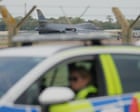
When counter-terrorism police swarmed Gloucestershire following suspicious activity near RAF Fairford, the illusion that European soil is safely insulated from Middle Eastern proxy conflicts shattered. This wasn't just a localized security breach. It exposed a stark reality about how Tehran projects power far beyond its immediate borders, utilizing localized cells and coded jail communications to target military installations housing American and British service personnel.
If you think threats from the Islamic Revolutionary Guard Corps stay neatly contained within the Middle East, you're not paying attention. The real question isn't whether Iran has the capability to strike the UK with ballistic missiles tomorrow, but how effectively its shadow war of hybrid tactics, surveillance, and proxy sabotage is already testing British defenses.
The Anatomy of the Fairford Incident
Let's look at what actually happened rather than drowning in bureaucratic euphemisms. UK authorities and US intelligence unspooled a plot that traced straight back to coordinated directives from operatives linked to the IRGC. Even with suspects communicating via coded phone calls from detention facilities overseas, the operational footprint was distinct enough to cause immediate panic.
The US military didn't pull its strategic bombers out of Gloucestershire just for a routine exercise. They left because the threat environment shifted from abstract intelligence briefings to concrete operational vulnerabilities. When suspicious vehicles filled with fuel drums are intercepted near perimeter fences, military planners stop treating risk as a theoretical exercise.
Beyond Missiles: The Reality of Modern State Threats
Most people assume a state threat looks like an incoming fleet of long-range missiles or an open declaration of war. Iran plays a different game entirely. Tehran relies on a blended playbook of cyber attacks on critical infrastructure, targeted intimidation of dissidents and journalists on British streets, and the use of criminal networks to carry out reconnaissance on sensitive military sites.
We saw this playbook run in Cyprus earlier in the year when regional drone strikes hit British-associated installations. We saw it when hackers probed power grids and water systems. The threat to the UK isn't an amphibious invasion or a full-scale blitz; it's a slow-bleed campaign designed to make Western governments weigh the cost of supporting operations against Tehran's regional interests.
Why the UK Is a Prime Target
Britain occupies a uniquely awkward position in Tehran's strategic calculus. As a primary staging ground for Western air power projection, British airbases like RAF Fairford and RAF Mildenhall act as logistical backbones for actions that directly counter Iranian operations.
When the US Air Force uses these bases to launch missions, Iran views them as legitimate co-belligerent targets. Tehran made no secret of this, explicitly stating that any European facility utilized to facilitate attacks against Iranian interests enters the crosshairs. British counter-terrorism units are now forced to treat every domestic security anomaly through the lens of state-sponsored espionage and sabotage.
What Comes Next for Domestic Security
The British government responded with fresh sanctions and stricter designations targeting the IRGC and its affiliated networks. But pieces of paper and asset freezes don't stop determined operatives from recruiting local fixers or utilizing established criminal underworld connections for logistical support.
Protecting open societies from covert state aggression requires an uncomfortable shift in posture. Intelligence agencies must monitor not just foreign agents, but the porous boundary where transnational crime syndicates cross paths with ideological proxies.
Evaluate your own assumptions about national security. Distance is no longer a shield, and cyber or physical sabotage on home soil is the new baseline of modern geopolitical friction. Stay vigilant, look past official reassurances, and recognize that the shadow war has already reached local runways.