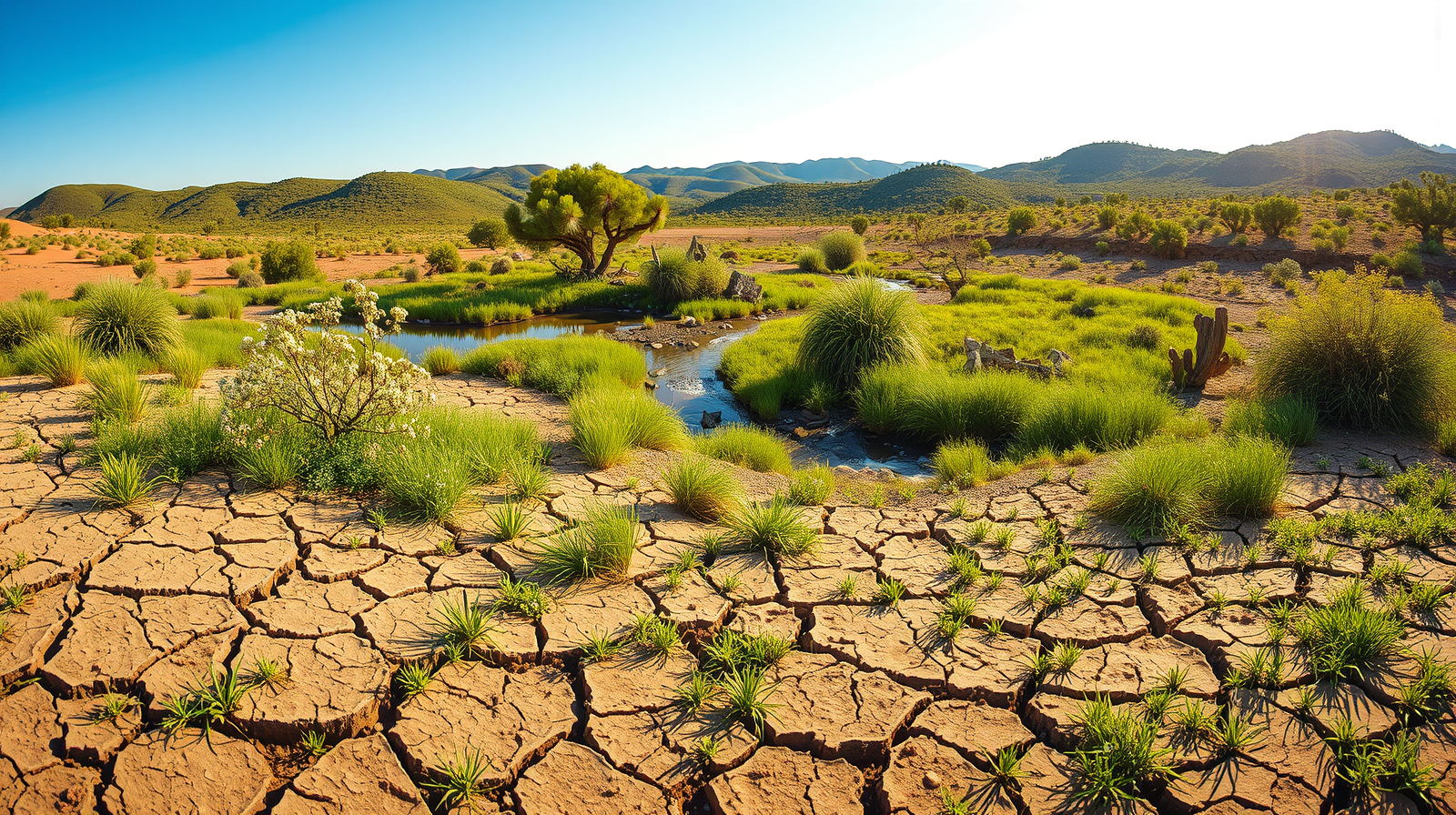
Saudi Arabia has planted 159 million trees and successfully restored one million hectares of degraded land under national green initiatives. Numbers are easy to print on glossy ministerial brochures. Sand is not nearly as accommodating.
When you spend decades watching government-led environmental campaigns across arid zones, your initial reaction to a milestone like one million restored hectares is not celebration. It is skepticism. Arid land reclamation is an exercise in brutal economics and high-stakes biology. Every single sapling put into the ground in the Arabian Peninsula represents a battle against blistering temperatures, evaporating water tables, and shifting dunes.
Understanding Saudi land restoration requires looking past the PR victories. The Kingdom faces a severe ecological bottleneck. Overgrazing, unmanaged off-road traffic, and decades of industrial expansion have stripped vast stretches of native vegetation. Without that vegetative cover, topsoil blows away during seasonal khamsin winds. Dust storms choke cities, agricultural productivity plummets, and aquifers fail to recharge because bare earth barks back at the rain instead of soaking it up.
Fixing this demands more than digging trenches and dropping seeds from a helicopter. It requires a massive systemic overhaul of how water, agriculture, and land tenure are managed across a country where annual rainfall is measured in millimeters rather than inches.
The Water Paradox
You cannot talk about planting millions of trees in a desert without addressing the glaring contradiction of water consumption.
Water is the currency of survival in the desert. Every newly planted native tree—whether it is the salt-tolerant Ghaf tree or the hardy Sidr—needs deep irrigation during its infancy. Where does that water come from? In many cases, it comes from treated municipal wastewater or desalinated water pumped inland at massive energy costs.
Critics often point out the circular irony. Burning fossil fuels to power desalination plants to water trees meant to offset carbon emissions creates a distinct financial and energetic paradox. However, looking at the operational reality on the ground reveals a pivot toward smarter methodology. The focus has shifted heavily away from thirsty imported ornamentals toward indigenous flora. Native species have evolved genetic strategies to survive on ancient, deep-seated moisture and flash-flood runoff.
Survival rates remain the ultimate metric of truth. In large-scale ecological engineering projects, a sapling planted is not a tree established. Many early greening efforts in the region suffered catastrophic mortality rates once initial irrigation infrastructure failed or maintenance budgets shifted. The current phase of Saudi land restoration attempts to sidestep this trap by utilizing micro-catchment earthworks—small, V-shaped ridges known as negaim that trap and funnel precious rainwater directly to the root zones of newly planted seedlings without continuous mechanical pumping.
Beyond the Sapling Count
Numbers like 159 million trees sound definitive. They make for clean headlines. They fail to describe the ecosystem beneath the branches.
True land restoration is not about arboriculture; it is about soil microbiology. If you plant a tree in sterile, compacted sand with no organic matter and zero microbial life, you have merely created a very expensive wooden stake.
Soil restoration in the Kingdom relies heavily on mycorrhizal fungi inoculation and the reintroduction of organic crusts that bind sand particles together. These biological soil crusts prevent wind erosion long before the canopy of a mature tree can shield the ground. When these micro-ecosystems take hold, they capture atmospheric nitrogen and create a sponge-like matrix that retains moisture from morning dew.
The strategy also leans heavily on protecting existing degraded patches rather than starting from scratch everywhere. Livestock exclusion zones have proven far more effective than planting new areas. When pastoralists agree to keep camels and sheep out of a degraded wadi for three to five years, the dormant seed bank explodes back to life. Acacia trees, desert grasses, and perennial shrubs reappear naturally, displaying a resilience that humans often struggle to replicate through artificial planting.
+-------------------------------------------------------+
|            The Restoration Hierarchy                  |
+-------------------------------------------------------+
| 1. Livestock Exclusion (Letting nature self-heal)     |
| 2. Soil Microbe Inoculation (Binding the sand)        |
| 3. Water Harvesting Earthworks (Negaim / V-ditches)   |
| 4. Native Species Planting (Ghaf, Sidr, Acacia)       |
+-------------------------------------------------------+
This passive restoration approach is cheaper and creates ecosystems that are genetically diverse and self-sustaining. Yet, passive restoration does not generate the kind of punchy metrics that policymakers can take to international climate summits. Consequently, governments lean toward massive, visible planting campaigns even when biological realities favor patience and fencing.
Economic Incentives and Rural Realities
Environmental policy fails when it ignores the people who live on the land. For generations, Bedouin communities relied on open grazing across the Arabian steppe. Restricting access to traditional rangelands to protect fragile ecosystems creates immediate economic friction.
If pastoralists cannot graze their herds in a recovering valley, they must buy supplemental feed, driving up the cost of local meat and dairy. To bypass this resistance, successful land rehabilitation projects must integrate local economic drivers.
- Green Job Creation: Local cooperatives are contracted to collect native seeds, manage nurseries, and monitor plant health.
- Ecotourism Infrastructure: Restored wadis and protected reserves are being zoned for low-impact tourism, providing alternative revenue streams for rural communities.
- Carbon Credit Markets: Emerging frameworks allow pastoral communities to earn revenue by managing rangelands for carbon sequestration and biodiversity gains.
Aligning ecological goals with rural financial survival ensures that a newly planted forest is not clear-cut or overgrazed the moment government oversight relaxes. The transition from punitive conservation to community-managed stewardship remains the single biggest variable determining whether these million-hectare milestones endure for decades or vanish with the next drought cycle.
Measuring Success Against the Clock
Climate models for the Middle East paint a harsh picture. Temperatures across the Arabian Peninsula are rising at roughly twice the global average. Droughts are projected to become longer and more intense, while rare rainfall events are expected to grow more violent and destructive.
Under these conditions, static measures of success become obsolete. A million hectares restored today does not guarantee a functioning ecosystem in twenty years if shifting rainfall patterns kill off the foundational plant species.
Adaptability is the actual measure of maturity for the Saudi green initiative. Foresters and land managers are experimenting with climate-resilient provenances—sourcing seeds from the most heat-tolerant and drought-resistant populations of native trees across the region. They are using remote sensing and drone monitoring to track soil moisture levels and canopy health in real-time, catching infestations or water stress before entire stands die off.
The true test of the 159 million trees is not whether they look green in promotional videos today. It is whether those root systems can hold the ground together when the next multi-year drought strikes, transforming a political announcement into a permanent ecological shield.