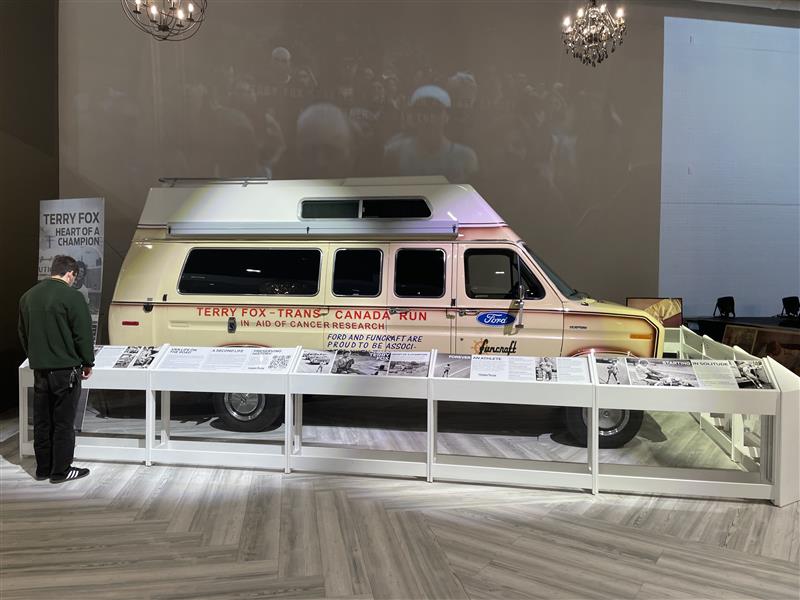
The air inside the Halifax museum smells of floor wax and quiet reverence, a sterile contrast to the salt-stung wind howling off the Atlantic just outside the doors. Most visitors walk past the glass cases of privateers’ maps and ship models with a polite, fleeting interest. But then they see it. It is a 1980 Ford Econoline van. It is beige—a color so mundane it almost disappears against the gallery walls. There are no sleek aerodynamic lines here. No chrome flourishes. It is a box on wheels, dented by the road and scarred by the memory of a thousand highway miles.
Yet, people stop. They don't just look; they lean in. They touch the glass barriers as if trying to catch a phantom heat radiating from the metal. This isn't just an automotive relic. This is the rolling heart of a miracle.
To understand why a rusted Ford van matters, you have to look past the vehicle and into the eyes of the twenty-two-year-old kid who lived inside it. Terry Fox didn't have a corporate sponsor or a fleet of support vehicles. He had a prosthetic leg made of steel and specialized plastics that clicked with every rhythmic, agonizing step. He had a dream that most people called a delusion. And he had this van.
The Smell of Sweat and Liniment
The interior of the van was never a museum piece. In 1980, it was a cramped, sweltering locker room. It was a kitchen. It was a sanctuary. Doug Alward, Terry’s best friend, sat in the driver's seat for months, staring at the endless gray ribbon of the Trans-Canada Highway while Terry’s mechanical leg hammered against the asphalt outside.
If you could step back in time and open that side door in the middle of Northern Ontario, the smell would hit you first. It was the scent of damp socks, stale coffee, and the sharp, medicinal tang of liniment used to soothe Terry's stump, which was often raw and bleeding by noon. There was no air conditioning. There were no ergonomic beds. They slept on thin mattresses wedged between crates of canned tuna and stacks of donated running shoes.
The van was the only thing that didn't move at the pace of a marathon. It crawled. It lingered. It waited for the kid with the curly hair to catch up, step by agonizing step.
The Invisible Stakes of a Cold Start
When the journey began in St. John’s, Newfoundland, the van was virtually ignored. There were no news cameras. No crowds. Terry dipped his artificial leg into the Atlantic, and the van followed him as he turned west. At that moment, the stakes were entirely internal. If the van broke down, the dream died. If Terry’s spirit broke, the van would simply be another used Ford sold for parts in a local classified ad.
We often talk about heroes as if they are carved from granite, impervious to the doubts that plague the rest of us. But the van tells a different story. Inside those four metal walls, Terry Fox was human. He was tired. He was sometimes cranky. He and Doug argued over the music on the radio or who had to deal with the laundry. The van held the vulnerability that the public never saw in the iconic photographs of Terry running through a rainstorm.
It was their fortress against a world that, at least initially, didn't quite know what to make of them. People would drive past and wonder why a beige van was pacing a hitchhiker with a limp. The van was the witness to the silence of the road before the noise of the fame arrived.
The Shift in the Atmosphere
By the time the Econoline crossed into Ontario, the atmosphere changed. The "Van of Hope" was no longer just a support vehicle; it was a beacon. People began to recognize it from the evening news. They saw the hand-painted signs on its sides. They saw the way it hovered behind Terry like a protective older brother.
Crowds began to line the highways. They didn't just cheer for Terry; they chased the van. They shoved crumpled five-dollar bills through the windows. They handed over jars of coins. They touched the side panels as Terry passed, as if the vehicle itself had become a holy relic through sheer proximity to his grit.
Imagine being Doug, gripped by the steering wheel, watching the odometer click upward while the world outside transformed from apathy to an electrical storm of hope. The van was the counting house for a nation’s generosity. It became heavy—not just with the weight of the supplies, but with the weight of the expectations of millions of people who finally believed that cancer could be beaten.
The Day the Engine Idled
The narrative of the van usually ends in Thunder Bay. That is where the road stopped. That is where the cancer, which had already taken Terry's leg, moved into his lungs.
The image of the van parked at the side of the road, its engine finally switched off while Terry was flown to a hospital, is one of the most haunting in Canadian history. For 143 days and 5,373 kilometers, the van and the man were an inseparable unit. When the runner stopped, the van lost its purpose. It was returned to the Ford dealership that had loaned it, eventually slipping back into the mundane world of commercial use.
For years, it was just a van again. It hauled goods. It changed hands. The magical aura faded into the reality of rust and high mileage.
The Resurrection of a Relic
The fact that this vehicle is now on display in Halifax is a testament to our need to touch the physical reality of our legends. We don't want just the stories; we want the steel. We want to see the scratches on the dashboard. We want to stand where Doug sat and look out the window where Terry would have been visible in the side mirror, bobbing up and down in that signature "Fox Trot."
Restoring the van wasn't about making it look brand new. To make it look "showroom fresh" would be a lie. The curators had to preserve the struggle. They had to keep the character of a vehicle that had been lived in, fought in, and prayed in.
When you stand before it in the Halifax museum, you aren't looking at a masterpiece of engineering. You are looking at a vessel. It carried the hopes of a generation across a continent. It proved that you don't need a high-tech laboratory or a billion-dollar infrastructure to change the world. You just need a friend, a reliable engine, and a level of courage that defies the limits of the human body.
The van sits quietly now. The tires are still. The engine is cold. But for anyone who stands in its presence, the silence is deceptive. If you listen closely enough, past the hum of the museum’s climate control, you can almost hear the rhythmic click of a prosthetic leg against the pavement. You can almost feel the vibration of a nation waking up.
History is often told through grand monuments and sweeping declarations. Sometimes, though, history is a beige 1980 Ford Econoline that refused to quit until the man it followed couldn't go a single step further. It remains a reminder that the most ordinary tools can facilitate the most extraordinary journeys, provided the person behind the wheel—and the person on the road—refuses to look back.