The summer heat on the asphalt always smelled of old pennies and scorched tar. Growing up near the highway interchange, I thought that smell was just how the earth breathed during July. Cars hummed past in a endless, grey river, tires hissing against the grit. Nobody stops to think about what holds a road together until it cracks open, spitting jagged teeth of gravel that ping against your windshield. We treat pavement like bedrock. We assume it has always been there, dead, heavy, and eternal.
It is not eternal. It wears down. It bleeds oil, swallows rain, and bakes under an unblinking sun until it crumbles. And every single mile of it has to be replaced eventually.
Drive down a certain stretch of road in Hawaii, and you are rolling over thousands of ghosts.
Not human ghosts. Plastic ones.
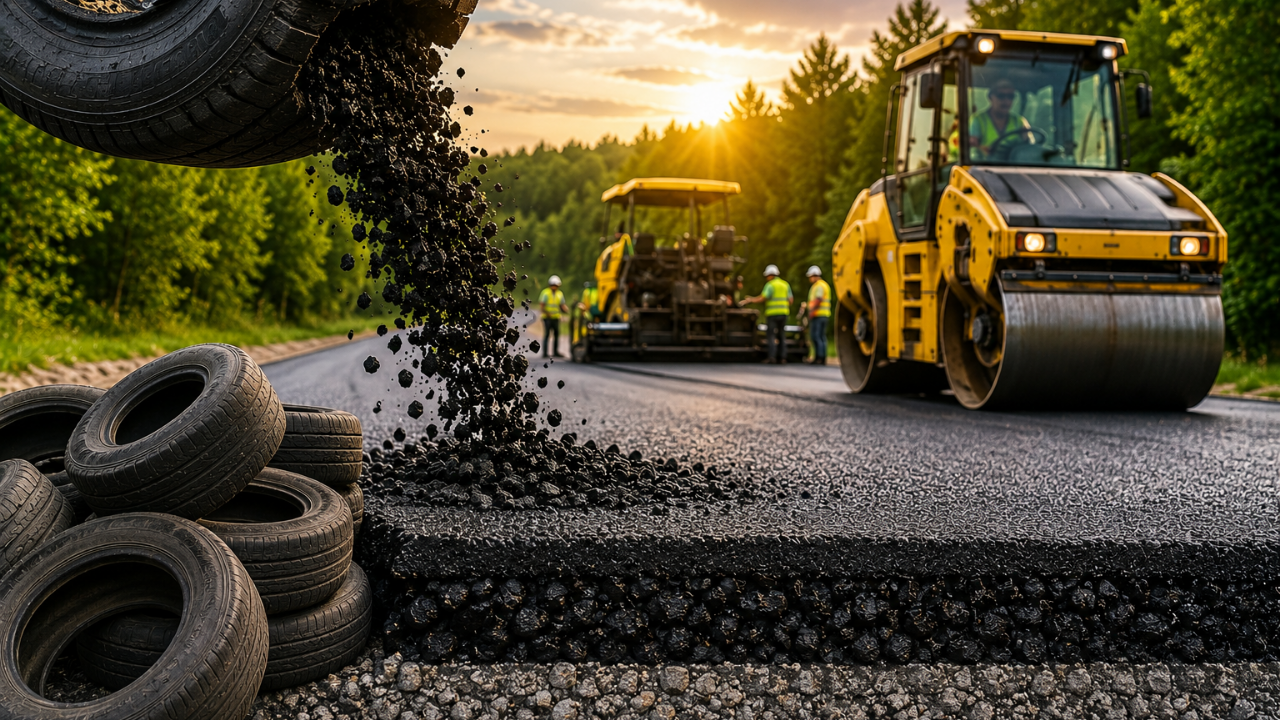
In 2022, road crews laid down an innovative stretch of pavement embedded with recycled plastic. We are talking about the equivalent of 195,000 plastic bottles diverted from landfills and crushed into the grey mix beneath daily commuters. When I first heard that number, it felt like one of those sterile corporate statistics meant to make us feel better while the world burns. One hundred ninety-five thousand sounds like a lot until you throw it into an ocean already choked with islands of refuse. It sounds like a drop of water in an active volcano.
(Note: The 195,000 figure is a verified metric from local infrastructure projects detailing the scale of plastic diversion for that specific paving initiative.)
Yet, stood on that stretch of Hawaiian asphalt, you cannot tell the difference. It looks dark, dull, and entirely ordinary. But beneath the surface, chemistry is doing something quiet and radical.
The Chemistry of Our Waste
Picture a kitchen trash can at the end of a long week. It is full of milk jugs, shampoo bottles, takeout containers, and crinkling film wrappers. High-density polyethylene, mostly. Materials designed by brilliant minds to last forever, discarded after five minutes of use. That is the grand irony of our consumer age. We engineered immortal packaging for mortal items.
Then we buried it. Or worse, it found its way into the belly of an albatross or drifted in a gyre five hundred miles from the nearest shore.
Traditional asphalt relies on bitumen, a sticky, heavy fraction of crude oil, to glue crushed rock and sand together. Bitumen is an aging giant. It gets brittle when the temperature drops and soft when the mercury climbs. Rutting happens. Potholes bloom. Engineers have spent decades tossing additives into the mix—rubber from old tires, polymers, fibers—trying to make the glue stick better, stretch further, and fight the relentless erosion of weather and weight.
Enter the plastic bottle.
Instead of melting down virgin polymers, engineers ground up post-consumer plastic and blended it directly into the binder. Think of it like baking bread and discovering that an unexpected ingredient makes the crust twice as tough. The plastic does not just sit there as trash trapped in stone; it chemically integrates with the asphalt binder, reinforcing the microscopic web that holds the entire road structure together.
It sounds clean. It sounds like a miracle cure. But let us be honest with each other: we have a complicated history with silver bullets.
The Weight of Doubt
I am cynical about corporate greenwashing. We all should be. When a government agency or a massive corporation announces they have saved a specific number of bottles, my immediate reaction is to look for the trapdoor. Is this a PR stunt? Are they spending five times more energy to process the plastic than the road will ever save in carbon emissions? Does this plastic leach microparticles into the tropical groundwater every time a torrential Hawaiian downpour lashes the highway?
These are not trivial questions. They are the kinds of doubts that keep environmental scientists awake at night.
To understand why this matters, you have to look at how infrastructure is actually funded and maintained. State departments of transportation are perpetually broke and perpetually exhausted. They do not adopt new materials because they want to save the planet. They adopt new materials because they are desperate for something that will last through the rainy season without needing a patch crew by November. Asphalt modification is an economic war of attrition.
When Hawaii integrated those 195,000 bottles into the mix, they were running an experiment in survival. Early laboratory tests and field observations suggest that polymer-modified asphalt can increase the fatigue life of a road. It resists cracking under heavy loads. It handles thermal stress better than standard mix.
Consider what happens next: if a road lasts thirty percent longer before it needs to be milled and repaved, you burn less diesel hauling fresh aggregate. You close lanes for construction half as often. You keep millions of pounds of petroleum-based binder in the ground instead of burning more crude.
The math starts to shift. The narrative moves away from corporate PR and into the quiet, grinding mechanics of municipal survival.
Walking the Line
Step out of an air-conditioned sedan onto that road. The trade winds carry the sharp, salt-heavy scent of the Pacific, mixing with the damp scent of jungle ferns just beyond the guardrail. Overhead, the sky is a bruised, brilliant blue, heavy with the threat of a afternoon cloudburst.
You crouch down and run your hand over the rough grey surface. It bites slightly against your palm, coarse and unforgiving.
Somewhere deep inside this matrix of crushed basalt and mineral filler are the remnants of a shampoo bottle bought at a Oahu convenience store five years ago. It held someone's morning routine. It lived in a recycling bin, went through a sorting facility, got chopped into flakes, melted down at high temperatures, and was reborn as a highway.
That is the strange, beautiful choreography of modern waste. We have built a world so saturated with our own artifacts that we can no longer throw anything away, because "away" no longer exists. There is only here. Everything we make stays here, stacked in landfills, floating in gyres, or baked into the ground beneath our tires.
So we have two choices. We can keep digging up fresh crude oil to pave the paths we walk, pretending that our resources are infinite. Or we can learn to live inside our own debris, transforming our discarded trash into the very foundations we rely on to move forward.
The road does not care where the binder came from. It only cares about the weight bearing down upon it.
As a heavy transport truck thunders past, the ground beneath my boots vibrates with a deep, bass thrum. The air pressure shifts, rustling the palm fronds. The truck rolls smoothly over the polymer-reinforced seam, its tires singing that familiar highway song, carrying cargo toward the port.
Underneath, the plastic holds. For now. And that is all any road can ever promise us.