The dust in Washington, D.C., feels different than the dust in Tashkent. In the polished, air-conditioned halls of international summits, the world’s environmental crises are discussed in parts per million, metric tons, and billions of dollars. Figures float across projector screens, abstract and clean.
But if you travel thousands of miles east to the heart of Central Asia, the crisis is not an abstract percentage. It is a physical weight. It is the sting of salt blowing off a dry sea bed, scraping against the back of your throat. Building on this theme, you can find more in: The Long Winter and the Sky Above.
For decades, the nations of Central Asia were viewed through a single, condescending lens by the international community: recipients. They were the regions on the receiving end of aid packages, the developing economies waiting for wealthier capitals to dictate the terms of survival. They were the victims of twentieth-century ecological disasters they did not engineer.
Then, a quiet shift occurred at an environmental gathering in Washington. Uzbekistan, long categorized as a nation needing rescue, walked to the podium and changed the script. They didn't ask for a check. They offered to write one. Analysts at The Washington Post have provided expertise on this matter.
The Ghost of the Aral
To understand why this matters, you have to look at what was lost.
Imagine a fisherman named Timur. He is a hypothetical composite of a generation, but his reality is documented in every rusted hull sinking into the desert sand. Forty years ago, Timur would have woken up to the sound of waves lapping against the docks of Muynak. The Aral Sea was the fourth-largest inland body of water on earth, a sprawling blue oasis that moderated the climate and fed entire cities.
Then came the Soviet irrigation schemes. Rivers were diverted to feed thirsty cotton fields. Slowly, the water retreated.
Timur watched the shoreline recede by miles every year. The fish died as the salinity soared. Eventually, the water vanished entirely, leaving behind a toxic desert known as the Aral-kum. Today, when the wind blows, it kicks up millions of tons of salted dust mixed with pesticide residue, carrying it across the continent. It alters the weather. It shortens breaths.
For a long time, the global response to this tragedy was a mix of pity and clinical study. Western experts flew in, shook their heads at the rusted ships, signed declarations, and flew out. Uzbekistan was a line item on the Global Environment Facility (GEF) balance sheet—a country requiring intervention.
Being a recipient creates a psychological trap. It forces a nation into a defensive posture, constantly justifying its need, forever reacting to priorities set by bureaucratic boards in distant cities. It is a position of dependency.
But nations, like people, grow tired of being defined solely by their scars.
The Flip of the Ledger
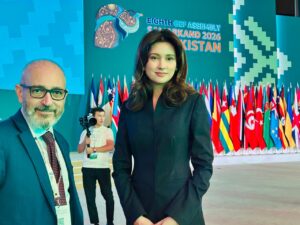
At the GEF’s Eighth Assembly, the Uzbek delegation did something that disrupted the conventional architecture of global diplomacy. They signaled their transition from a recipient nation to a donor.
It was a small financial commitment in the grand scheme of global trillions, but symbolically, it was an earthquake.
Think of it as a shift in a household dynamic. When you are broke, you accept whatever groceries your neighbors bring you, even if you hate the food. The moment you offer to contribute to the neighborhood fund, the power dynamic changes. You are no longer just a guest at the table; you help pay for the wood it was built from.
This transition is part of a broader, deliberate strategy by Tashkent to redefine its place on the global stage. The country is no longer content to be a passive geographic buffer zone between empires. By stepping into the role of a donor, Uzbekistan is asserting that it possesses the expertise, the political will, and the capital to help solve regional crises.
Consider the complexity of managing water in Central Asia. The region’s lifeblood comes from the glaciers of the Tien Shan and Pamir mountains, flowing through the Amu Darya and Syr Darya rivers. These waters cross jagged, post-Soviet borders. When one nation builds a dam for electricity, another downstream loses water for crops. It is a fragile ecosystem where a single miscalculation can trigger a geopolitical crisis.
By becoming a donor, Uzbekistan positions itself as the natural mediator of these tensions. You cannot easily lead a regional coalition when you are viewed as a charity case. You can lead when you are actively financing the solutions.
The Invisible Stakes
Why should someone sitting in London, Tokyo, or New York care about a diplomatic pivot in Central Asia?
Because the old model of climate aid is broken. For years, wealthy nations viewed environmental funding as a form of distant altruism—a moral luxury. But ecosystems do not recognize national sovereignty. The dust storms from the dry bed of the Aral Sea have been tracked as far away as Scandinavia and the glaciers of the Himalayas, accelerating their melt.
The world is beginning to realize that local ecological collapse has global ripples. If Central Asia destabilizes due to water scarcity, the economic and security consequences will hit global markets.
Uzbekistan’s move is a rejection of the idea that only the Global North has the answers or the responsibility. It highlights an uncomfortable truth that many international institutions hesitate to admit: local experts often understand the terrain far better than the Ivy League consultants flown in for a two-week assessment.
The Uzbeks have spent years experimenting with ways to mitigate the Aral disaster. They have planted millions of hectares of black saxaul—a hardy, desert-resistant shrub—directly into the dry sea bed. These plants act as a green shield, pinning the toxic sand to the earth and preventing it from taking flight. It is grueling, unglamorous work, executed by local foresters who understand the nuance of the soil and the cruelty of the wind.
This is the lived experience they are bringing to the donor table. They are trading in the currency of practical survival.
A New Map of Influence
The transformation is not without friction. Skeptics will point out that Uzbekistan still faces massive internal environmental challenges. The air quality in Tashkent frequently hits hazardous levels during the winter. Energy grids are strained. The transition to a green economy is expensive, messy, and slow.
Admitting these vulnerabilities is crucial. This is not a story of sudden, flawless perfection. It is a story of a messy, ambitious pivot.
But look at the alternatives. The traditional donors of the West are increasingly bogged down by domestic political polarization, with climate funding often becoming a casualty of budgetary battles. In this vacuum, middle powers are stepping up. They are rewriting the rules of engagement.
By contributing to the GEF, Uzbekistan is signaling to its neighbors—Kazakhstan, Kyrgyzstan, Tajikistan, and Turkmenistan—that regional challenges require regional ownership. It is an invitation to stop waiting for Washington or Brussels to save them.
The old map divided the world neatly into those who give and those who take. That map is burning. In its place is a far more complex web of shifting alliances, where former aid recipients are leveraging their unique, painful expertise to become the architects of their own future.
The rusted ships still sit in the sand at Muynak, a stark monument to human arrogance. They will likely never float again. But the nation surrounding them is no longer waiting for the tide to miraculously return from the outside. They are digging their own channels.