The dust settles differently in Paris. It rises in rust-colored clouds, coating the white canvas lines, the heavy socks of the players, and the throats of fifteen thousand people sitting in the suffocating heat of Court Philippe-Chatrier. On television, clay looks soft. It looks like velvet.
It is not velvet. It is crushed brick, acting as a grinding wheel that ruthlessly wears down anything less than absolute perfection.
Jannik Sinner knew this long before the first ball was struck. You could see it in the way he walked onto the court—a young man carrying the immense, invisible weight of a sport’s expectations on a hip that had been betraying him for weeks. He was supposed to be invincible. He was the reigning Australian Open champion, the golden boy of Italian tennis, the man anointed to inherit the earth from the aging gods of the baseline.
Then, the clay demanded its tax.
Tennis is a brutal, isolated theater. There are no teammates to absorb a bad shift. There is no coach allowed to run onto the field and call a timeout when the lungs burn and the joints lock. It is just one human being, completely exposed, trying to solve a kinetic puzzle while a stadium watches them bleed. When an underdog senses that vulnerability, the atmosphere changes. It shifts from a standard sporting event into something ancient and predatory.
Every great upset begins not with a roar, but with a whisper of doubt.
For the first two sets, the script held its shape. Sinner moved with that strange, loose-limbed elegance that defines his game, striking the ball with a sound like a rifle shot. His opponent, a journeyman fighting for the match of his life, looked like a man trying to hold back an avalanche with a plastic shovel.
But a tennis match is long. It stretches across hours, bridging the gap between afternoon sun and evening chill.
Somewhere in the third set, the limp arrived.
It was subtle at first. A fraction of a second longer to recover after a wide forehand. A slight grimace, quickly wiped away, when pushing off the right leg to serve. To the casual observer, it was nothing. To an opponent across the net, it was a flashing neon sign.
The human body is an extraordinary machine, but it possesses hard, mathematical limits. When a hip joint inflamed by weeks of high-intensity friction refuses to rotate, the mind tries to compensate. The shoulder pulls harder. The wrist snaps faster. The entire kinetic chain—the delicate, beautiful sequence of muscles transferring power from the dirt up through the racquet—collapses.
Consider what happens next. The shots that previously missed the tape by an inch now hit the middle of the net. The deep, penetrating groundstrokes begin to land short, inviting attack.
The crowd felt it before they saw it. A collective hush fell over Chatrier. This was not supposed to happen. The tournament brackets had already been drawn up in the minds of executives and fans alike, charting a collision course between the sport's newest titans. Nobody factored in the physical reality of a twenty-two-year-old body breaking down under the strain of its own ambition.
We often view elite athletes as flawless avatars of willpower. We forget that underneath the sponsorships and the pristine kit, they are remarkably fragile organisms operating on a knife's edge. A single millimeter of swelling can turn a champion into a bystander.
Sinner fought. He used every ounce of tactical intelligence he possessed, shortening the rallies, coming to the net, trying to survive on sheer instinct. It was a brave display, but bravery is poor currency when your opponent is hitting lines and playing without fear. The underdog, realizing the giant was mortal, began to swing with the freedom of a man with nothing left to lose.
The final game was a microcosm of the entire tragedy. Sinner stood at the baseline, his breath coming in ragged gasps, his face pale under the Parisian sun. He served. The return was deep, heavy, and cruel. Sinner moved toward it, his mind knowing exactly where the ball would land, but his right leg refused the command.
He didn't even swing. He just watched it bounce away.
The roar that followed was deafening, a seismic wave of sound celebrating the impossible shock of the favorite going down. The victor dropped to his knees, burying his face in the very clay that had just served as his executioner's block.
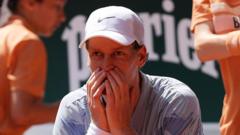
Sinner walked to the net. His walk was slow, stiff, and painfully dignified. He shook hands, congratulated his opponent with genuine warmth, and packed his bags while the stadium cheered for someone else.
The locker room after a loss like that is the quietest place on earth. The ringing in the ears slowly fades, replaced by the throb of an injury that no longer has adrenaline to mask it. The ice packs are applied. The trainers speak in low, hushed tones. The grand dreams of a French Open title evaporate into the humid French evening, leaving behind only the cold reality of rehabilitation and the question of what might have been.
Tomorrow, the sports pages will analyze the data. They will talk about unforced errors, first-serve percentages, and tournament seedings. They will treat the match like a math problem that Sinner failed to solve.
But they will miss the point.
Tennis is not a game of numbers. It is a game of survival, played on a surface that remembers every injury, punishes every weakness, and offers no sympathy to those who carry the crown. The red clay of Paris does not care about rankings, or legacies, or the stories we like to tell ourselves about greatness. It only cares about who can stand the heat, and who breaks under the weight of the sun.