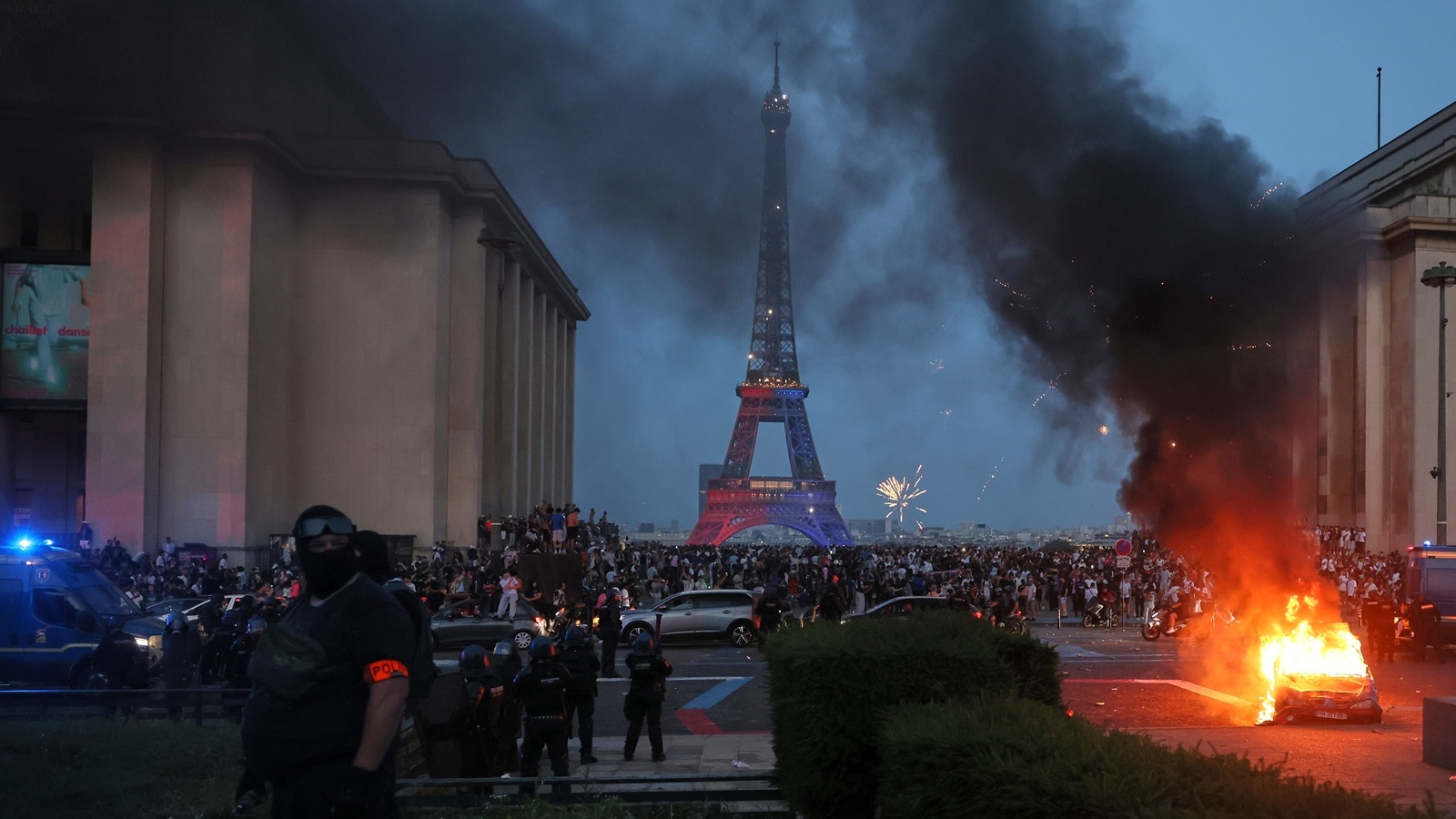
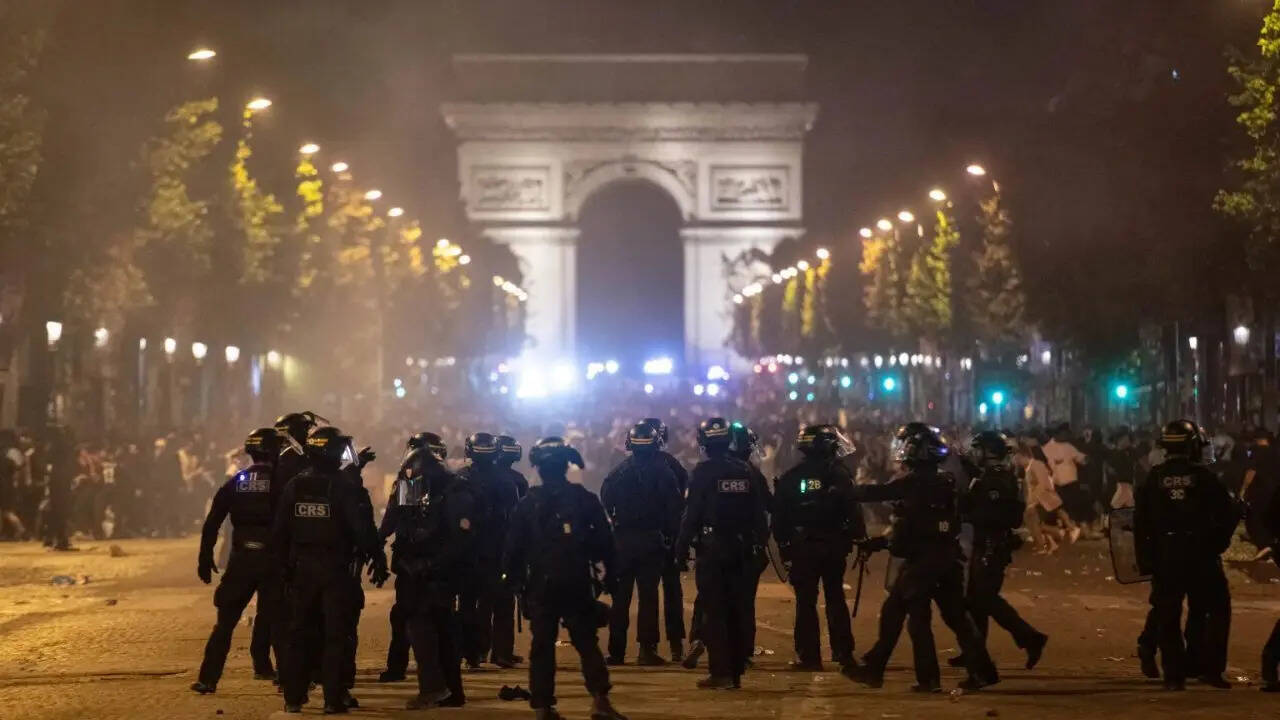
Paris Saint-Germain secured its second consecutive Champions League trophy on Saturday night in Budapest, defeating Arsenal 4-3 on penalties after a grueling 1-1 draw. Yet, as captain Marquinhos lifted the silverware at the Puskas Arena, the streets of Paris erupted into a familiar, destructive chaos that resulted in mass arrests, burning vehicles, and clouds of tear gas along the Champs-Élysées. While early media reports quickly blamed the violence on unruly football hooligans capitalizing on a historic sporting triumph, this standard narrative misses the point entirely. The riots in Paris were not a spontaneous sports celebration gone wrong, but rather the explosive manifestation of deep-seated socioeconomic friction, heavy-handed policing tactics, and a city permanently on edge.
To understand why a football match triggers a security crisis in the French capital, one must look past the pitch and into the fractured relationship between the Parisian police force and the youth of the city's peripheral neighborhoods.
The Anatomy of a Predictable Explosion
For decades, major sporting events in France have served as a lightning rod for civil unrest. The moment Ousmane Dembélé leveled the scoring with his 65th-minute penalty, the tension in the gathering crowds back home in Paris became palpable. By the time Gabriel Magalhães sent Arsenal's final penalty over the crossbar to seal PSG's back-to-back European title, the celebration was already mutating.
The immediate deployment of thousands of riot police units across sensitive zones in Paris reflects a systemic expectation of violence rather than a strategy of crowd management. When authorities treat a gathering of sports fans strictly as a potential riot, the outcome often becomes a self-fulfilling prophecy.
- Pre-emptive Posturing: Heavy tactical gear and armored vehicles cordoned off the Champs-Élysées hours before kickoff, establishing an adversarial atmosphere.
- The Flashpoint Point: The ignition of red flares by fans was met almost instantly with tear gas volleys, scattering peaceful celebrants and leaving the streets to hardened agitators.
- Projected Frustration: For a significant portion of the youth living in the suburban banlieues, the success of PSG is deeply personal, yet their relationship with the city center is defined by economic exclusion and aggressive policing.
This friction creates a volatile cocktail. The football victory is not the cause of the riot; it is merely the permit required for disenfranchised groups to occupy the streets and confront the symbols of a state they feel rejects them.
The Illusion of Unity through State-Backed Football
Paris Saint-Germain has transformed dramatically under the ownership of Qatar Sports Investments. The club shifted away from the bloated, superstar-heavy era of Lionel Messi and Neymar, pivoting instead toward younger talent like Khvicha Kvaratskhelia and Désiré Doué under coach Luis Enrique. This structural shift built a resilient, world-conquering football team, but it also widened a massive cultural disconnect at home.
PSG Financial and Corporate Profile (2025-2026)
+------------------------+----------------------------------+
| Metric                 | Value / Detail                   |
+------------------------+----------------------------------+
| Club Enterprise Value  | Estimated €4.5 Billion           |
| Annual Revenues        | Over €837 Million                |
| Annual Wage Bill       | €551 Million                     |
| Primary Ownership      | Qatar Sports Investments (QSI)   |
| Core Brand Strategy    | Luxury lifestyle & global fashion|
+------------------------+----------------------------------+
While French President Emmanuel Macron praised the team on social media, claiming they were making all of Europe dream, the reality on the ground is far less harmonious. The club operates as a multi-billion-euro corporation and a geopolitical asset for a Gulf state. It sells ultra-expensive, stylish clothing lines and markets Paris as a playground for luxury tourism.
Meanwhile, the actual working-class fans who built the club's culture are priced out of the Parc des Princes. The contrast between a €551 million wage bill and the economic stagnation in the housing projects just miles outside the stadium creates an intense undercurrent of resentment. When the team wins, the celebration in the streets is a rare moment where these marginalized communities reclaim a stake in the city's glittering identity, often by force.
When Containment Replaces Communication
The failure of French crowd control is a well-documented issue that stretches back through the 2022 Champions League final disaster at the Stade de France and into years of political protests. The underlying philosophy of French policing relies heavily on containment and overwhelming force rather than communication and de-escalation.
Once a crowd swells, the police strategy frequently involves a tactic known as kettling, which traps both violent actors and innocent bystanders in tight spaces. On Saturday night, this approach caused panic. As tear gas filled the air near the Arc de Triomphe, local shop windows were smashed, and scooters were set ablaze by small, highly mobile groups of individuals who easily evaded the lumbering lines of riot police.
The mass arrests that followed look impressive on a police blotter, but they rarely target the core perpetrators of property destruction. Instead, they sweep up young fans caught in the wrong place at the wrong time, further embittering a generation against local law enforcement.
A Broken Model of Public Order
European countries that successfully manage large football crowds, such as Germany and the Netherlands, utilize specialized liaison officers who embed with fan groups to defuse tensions before they escalate. France continues to reject this model, preferring a militarized response that views football fandom through the lens of counter-insurgency.
The recurring nature of these riots proves that treating sports victories as national security threats does not keep the peace. It simply guarantees that the next historic win will be accompanied by the sound of sirens and shattering glass. Until the city addresses the deep social divisions plaguing its suburbs and modernizes its outdated approach to public order, the beautiful game will continue to serve as a mirror for Paris's ugliest realities.