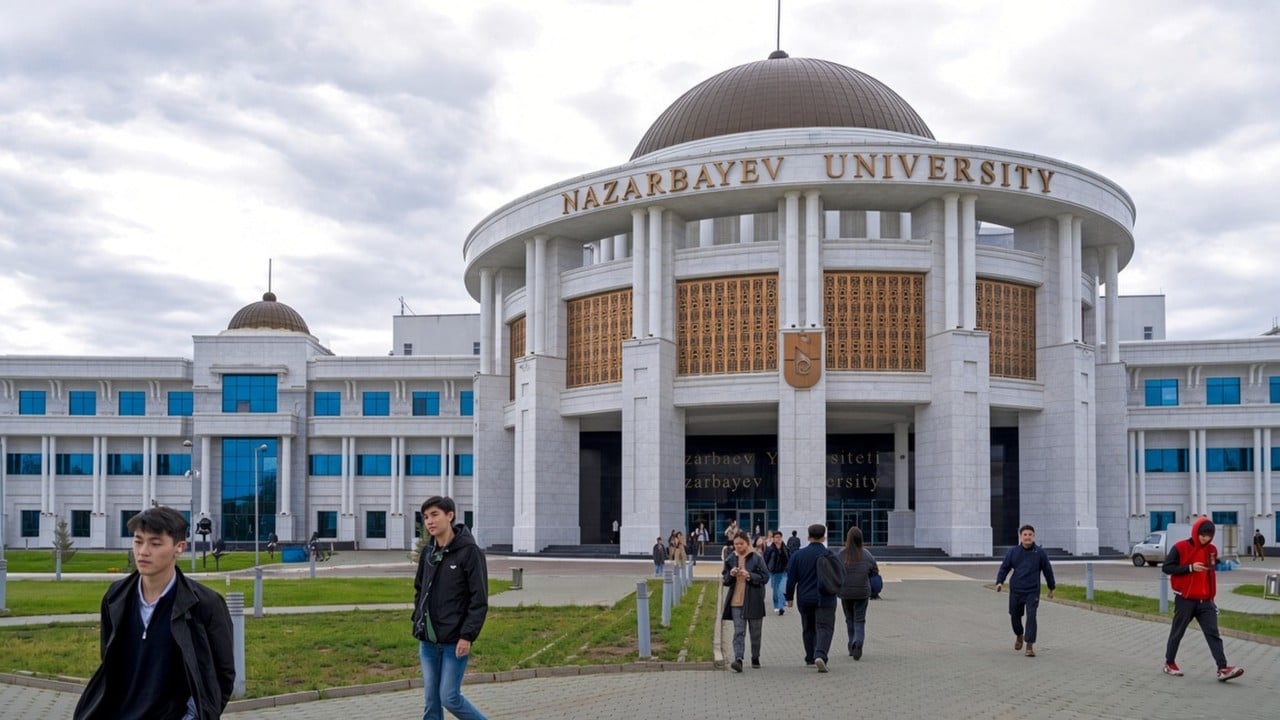
Kazakhstan wants to anchor Central Asia's academic future. State officials point to thirty thousand international students, dozens of incoming foreign university branches, and grand visions of an innovation-driven economy.
Yet structural fractures run deep beneath the glossy promotional brochures. The state is importing elite foreign degrees while the domestic labor market struggles to absorb the graduates it already produces.
Look past the diplomatic announcements and a stark disconnect emerges. Classrooms are filling up, but the economic machinery required to deploy that specialized talent remains stalled.
The Branch Campus Boom
Over the past four years, Astana has aggressively courted international higher education. Institutions like Cardiff University, Coventry University, and Arizona State University have planted flags across the steppe.
The strategy is straightforward on paper. By bringing British, European, and American curricula directly to Almaty and Astana, the government hopes to curb capital flight, retain domestic youth, and attract regional tuition dollars.
Parents no longer need to scrape together small fortunes to send their eighteen-year-olds to London or Boston. They can pay local rates for foreign credentials.
Enrollment numbers are climbing toward ambitious government targets. Higher education policy has become an instrument of soft power and economic diversification for a country historically tethered to hydrocarbon extraction.
The Structural Disconnect
Importing prestigious syllabi does not automatically create matching industrial demand. Kazakhstan's domestic economy remains dominated by extractive industries, logistics, and state-backed enterprises.
These sectors have finite absorption capacities for high-tech specialists, artificial intelligence researchers, and Western-trained policy analysts. A graduate holding a modern degree in data analytics often finds the local market offers entry-level administrative positions that require a fraction of those competencies.
This creates acute vertical and horizontal mismatches. Workers find themselves either radically over-qualified for their daily tasks or working entirely outside their specialized fields of study.
Consider a hypothetical mechanical engineer who completes a rigorous dual-degree program at an international branch campus in Kazakhstan. Upon graduation, local industrial firms may lack the advanced manufacturing lines or research budgets to utilize advanced prototyping skills. The engineer ends up maintaining legacy Soviet-era machinery or leaving the country entirely for employment in the Gulf or Europe.
State planners utilize forecasting instruments like the Atlas of New Jobs and Skills to map future market demands. However, bureaucratic inertia often means that academic curricula lag years behind rapid market shifts.
The Language and Access Divide
Internationalization campaigns hide an underlying geographic disparity. Elite branch campuses rely heavily on English-medium instruction.
Urban centers like Almaty and Astana boast specialized secondary schools where students achieve high English proficiency. Rural regions tell a different story.
National assessments consistently show that students from regional towns and villages face steep language barriers when attempting to clear the entry standards of transnational education programs. Without massive investments in foundational language training and regional bridging courses, the new academic hub risks becoming an exclusive enclave for urban elites.
The system risks manufacturing a two-tiered labor pool. One group trains in world-class international partnerships while the rest navigate underfunded provincial colleges detached from global standards.
Re-Engineering the Pipeline
Fixing this trajectory requires more than ribbon-cuttings for foreign university faculties. Private sector employers must transition from passive critics of the educational system to active co-designers of curricula.
Tax incentives for local industries that invest in domestic research and development could expand high-skill employment quotas. Without local high-tech jobs, educational investments act as an export pipeline for foreign economies.
The ambition to transform Kazakhstan into a regional intellectual capital is bold. Success will be measured not by how many foreign diplomas are printed within its borders, but by whether those degree holders find meaningful work at home.
The clock is ticking against a demographic wave that will double the pool of college-aged youth within a decade.