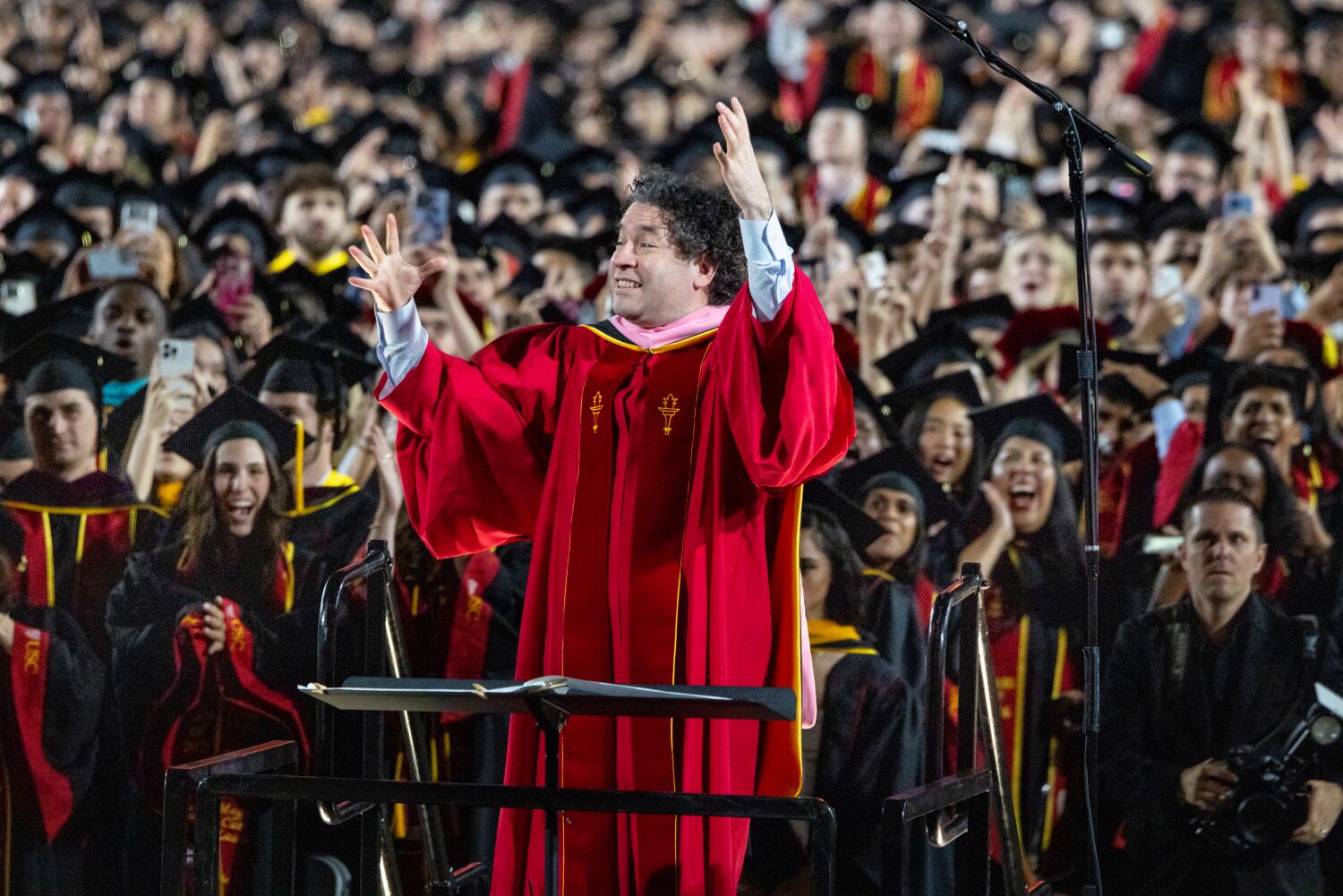
Gustavo Dudamel is entering his final stretch with the Los Angeles Philharmonic, preparing to assume the mantle of music director for the New York Philharmonic for the 2026-27 season. To the casual observer, this is a standard game of musical chairs at the summit of classical music. The local narrative frames it as a bittersweet departure, an amicable parting of ways where a beloved maestro simply seeks a new canvas while maintaining an eternal long-distance affection for Southern California.
That narrative is incomplete. It ignores the institutional exhaustion, the shifting tectonic plates of arts financing, and the calculated risk of an artist who realized he had achieved everything possible in one city. Dudamel is not just changing zip codes; he is fleeing the burden of being an entire metropolis's cultural savior.
The Glass Ceiling of Absolute Success
When Dudamel arrived in Los Angeles in 2009, he was a 28-year-old prodigy tasked with transforming a traditional orchestra into a modern civic institution. He succeeded. Under his watch, the LA Phil became the most financially secure, creatively ambitious, and culturally relevant orchestra in America.
That success created its own trap.
LA Phil Growth Metrics Under Dudamel (Peak Eras)
┌───────────────────────────┬───────────────────────────┐
│ Metric                    │ Status / Value            │
├───────────────────────────┼───────────────────────────┤
│ Annual Operating Budget   │ Approaching $150 Million  │
│ Economic Impact (2024)    │ $947.4 Million Statewide  │
│ Core Venues Managed       │ 3 (Disney Hall, Bowl,     │
│                           │   The Ford)               │
└───────────────────────────┴───────────────────────────┘
The organization grew into a billion-dollar economic engine for California. It expanded its footprint across the Hollywood Bowl, the Walt Disney Concert Hall, and The Ford, while aggressively funding Youth Orchestra Los Angeles (YOLA).
But an orchestra cannot grow indefinitely. By the turn of the decade, the LA Phil had reached operational saturation. The endowment was massive, the donor bases were locked in, and the programming had pushed boundaries to the absolute limit of subscription-audience tolerance. For an artistic director driven by reinvention, the question changed from How do we build this? to How do we avoid maintaining a monument?
Los Angeles offered Dudamel comfort, adulation, and a salary that peaked above $3.5 million before pandemic-era adjustments. It also offered stagnation. When you have achieved total dominance in a market, the only remaining direction is down.
The Ghost in the Executive Suite
To understand the timing of Dudamel’s exit, one must look away from the podium and toward the administrative offices. The architecture of the modern LA Phil was built by Deborah Borda, the formidable executive who originally recruited Dudamel from relative obscurity in Venezuela.
Borda left Los Angeles for the New York Philharmonic in 2017, inheriting a broken East Coast institution plagued by terrible acoustics, plummeting morale, and a toxic culture. She fixed the hall, stabilized the money, and then did what she always intended to do. She came back for Dudamel.
"When you are trying to recruit the most sought-after conductor in the world, you don't run a classic search," Borda remarked after pulling off the heist.
The institutional memory of an orchestra resides in its management. When Borda left Los Angeles, a subtle but permanent shift occurred in the internal chemistry of the LA Phil. The administrative shield that allowed Dudamel to be purely creative began to show hairline fractures through successive leadership transitions. In New York, the infrastructure was being rebuilt specifically to accommodate his arrival, backed by a freshly renovated David Geffen Hall that desperately needed a marquee name to justify its $550 million price tag.
New York did not just offer a new job. It offered the one thing Los Angeles could no longer provide: a rescue mission.
The El Sistema Paradox
The emotional anchor of Dudamel's tenure in California has always been YOLA. It was his attempt to transplant the egalitarian ideals of Venezuela’s El Sistema into the socio-economic reality of Southern California. The opening of the Judith and Thomas L. Beckmen YOLA Center in Inglewood was supposed to be the coronation of this effort.
Instead, it highlighted a profound systemic friction.
American orchestral outreach programs operate within a capitalistic framework that requires constant donor validation. In Venezuela, El Sistema was a state-funded social program where musical excellence was a byproduct of civic rescue. In Los Angeles, YOLA became a premier philanthropic product. It was highly effective, beautifully executed, but fundamentally transactional.
Dudamel found himself spending significant creative energy acting as the chief fundraising icon for an educational apparatus that required endless millions to sustain its scale. The administrative demands of keeping nearly 1,700 students supplied with free instruments, instruction, and facilities began to compete with the purely musical legacy Dudamel wanted to leave behind.
By moving to New York, he resets the clock. The New York Philharmonic has its own educational challenges, but it does not have an identical, deeply personalized social project tied directly to the maestro’s identity. He steps back into the role of a conductor, rather than a social architect.
The Succession Crisis Nobody Wants to Name
The LA Phil is putatively the most attractive conducting post in the world. Yet, as the countdown to the 2026-27 season ticks away, the search for a successor reveals an uncomfortable truth about the modern classical industry.
There is no second Dudamel.
The industry has failed to cultivate conductors who combine elite musical authority with global pop-culture currency. The modern maestro is often an intellectual specialist or an international nomad who splits time across three continents without ever embedding in a community. The LA Phil’s model requires a civic deity—someone who can command a board room of tech billionaires and Hollywood executives on Monday, conduct a grueling Mahler cycle on Thursday, and charm 17,000 people at the Hollywood Bowl on Saturday.
The Conductor Dilemma
┌───────────────────────────────────┬───────────────────────────────────┐
│ The Dudamel Model                 │ The Modern Standard               │
├───────────────────────────────────┼───────────────────────────────────┤
│ Deeply embedded civic icon        │ High-frequency guest conductor    │
│ Mass-market cultural appeal       │ Academic or niche reputation      │
│ Spans pop culture and high art    │ Rigidly focused on core canon     │
└───────────────────────────────────┴───────────────────────────────────┘
The candidate pool is shallow. Names floated in management circles either lack the institutional heft required to run an operation of this scale or lack the desire to step into a shadow as large as the one Dudamel leaves behind. The risk for the next artistic director is not failure; it is irrelevance in the face of an elite legacy.
The Long Goodbye
The transition will not be clean. Dudamel’s remaining commitments in Los Angeles are designed to project continuity, but the reality of an orchestra with a departing leader is one of lame-duck artistic policy. Decisions regarding commissions, recordings, and tenured hires are already being viewed through the lens of a post-Dudamel future.
Los Angeles will always claim a piece of his identity, and his statements will remain impeccably diplomatic, full of love for his "dear Angelenos." But the romanticism of the love affair hides a cold operational reality. Dudamel squeezed every drop of institutional potential out of the city, and the city squeezed every ounce of symbolic value out of him.
The move to New York is an admission that in the high-stakes world of major American culture, the only way to survive absolute success is to abandon it before the cracks start to show.