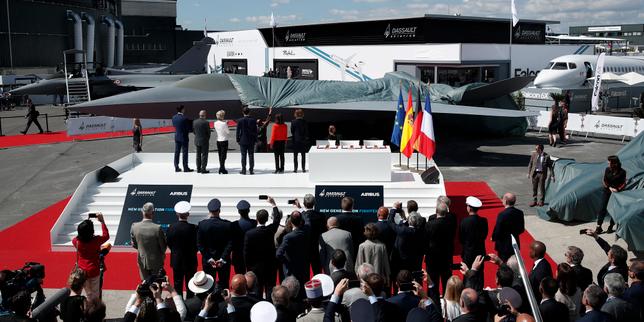
The ambitious Future Combat Air System (SCAF), meant to anchor European strategic autonomy, has run into a wall of irreconcilable national interests. Berlin and Paris have fundamentally different ideas about what a fighter jet should do, who should build it, and who gets to sell it. While political rhetoric frequently attempts to paper over these fractures, the operational reality tells a different story. The project is not just stalled; it is suffocating under the weight of conflicting industrial ambitions and military doctrines.
Europe cannot build a unified defense apparatus when its two primary powers are pulling the steering wheel in opposite directions.
Two Air Forces with Incompatible DNA
The core failure of SCAF does not stem from a lack of funding. It stems from a lack of shared purpose.
France views its air force through the lens of power projection and sovereign independence. For Paris, a fighter jet must be capable of carrying out carrier-borne operations from the sea. It must also accommodate the ASMP-A supersonic missile, the airborne component of France’s independent nuclear deterrent. These requirements dictate a specific airframe size, weight restriction, and structural design.
Germany operates under a completely different security paradigm. The Luftwaffe’s primary mission is territorial defense and NATO integration. Berlin does not need a carrier-capable aircraft. Furthermore, Germany participates in NATO’s nuclear sharing agreement, which relies on American-made B61 bombs. This operational reality already ties Germany’s nuclear strategy to Washington, not Paris.
When you try to design a single aircraft to satisfy both sets of requirements, you end up with an expensive compromise that pleases nobody. Designers are forced to make trade-offs that degrade performance. A jet optimized for carrier landings requires heavy reinforcement that adds dead weight for a land-based air force. Conversely, a jet optimized purely for long-range continental interception might lack the structural agility needed for naval deployment.
The Industrial Tug of War
Beneath the strategic disagreements lies a brutal fight over intellectual property and manufacturing jobs.
Dassault Aviation, the French aerospace giant, has decades of experience building successful fighters like the Mirage and the Rafale. Dassault engineers expect to lead the development of the Next Generation Fighter (NGF), the manned jet at the heart of SCAF. They argue that their proven track record makes them the natural choice for the captain's seat.
Airbus, representing German industrial interests, refuses to be a junior partner. Berlin is funding a massive portion of the bill and expects its domestic workforce to reap the high-tech manufacturing rewards. This creates a deadlock. Dassault is fiercely protective of its fly-by-wire technology and stealth designs, viewing them as French national crowns. Airbus demands full access to these proprietary systems to ensure technological parity.
"We cannot share our secrets with a partner who might become a competitor on the export market tomorrow," a senior French defense engineer noted during a recent industry forum.
This brings us to the thorny issue of export controls. France relies on international sales to make its domestic defense production economically viable. If Paris cannot sell a weapon system to clients in the Middle East or Asia, the unit cost for the French military skyrockets. Germany, driven by domestic political pressures and strict ethical guidelines, frequently blocks arms sales to non-NATO countries.
If SCAF contains German components, Berlin holds a veto over every single export contract France tries to sign. For Paris, this is an unacceptable infringement on sovereignty. For Berlin, easing export restrictions is a political non-starter.
The Eurofighter and Rafale Legacy of Failure
This is not the first time Europe has tried and failed to build a joint combat aircraft. History is repeating itself with terrifying accuracy.
In the 1980s, France, Germany, the UK, Italy, and Spain sat down to design a common fighter. That project collapsed for the exact same reasons we see today. France demanded a lighter, carrier-capable jet and a dominant industrial role. The other nations wanted a heavier interceptor. France walked away to build the Rafale on its own. The remaining partners built the Eurofighter Typhoon.
+------------------+-----------------------------+-----------------------------+
| Feature          | French Requirement (Rafale) | German Requirement (Typhoon)|
+------------------+-----------------------------+-----------------------------+
| Launch Capability| Carrier-capable & Land      | Land-based only             |
| Primary Mission  | Nuclear strike & Multi-role | Air superiority             |
| Export Strategy  | Highly aggressive           | Restrictive, regime-based   |
+------------------+-----------------------------+-----------------------------+
Splitting the market in two meant both programs suffered from lower production runs and higher per-unit costs than their American rivals. By failing to learn this lesson, the current SCAF program is on track to replicate the inefficiencies of the past, but at a much higher price point. The complexity of modern sixth-generation technology means the financial stakes are exponentially greater than they were forty years ago.
The Shadow of Washington and the F-35 Factor
While Paris and Berlin bicker over workshares, the market is moving on without them. The biggest threat to SCAF is not internal disagreement; it is the American defense industry.
Germany’s decision to buy the Lockheed Martin F-35 to replace its aging Tornado fleet sent shockwaves through Paris. Officially, Berlin claims the purchase is a stopgap measure to maintain its NATO nuclear sharing obligations until SCAF arrives. Unofficially, it signals a deeper truth. When the pressure is on, Germany trusts American hardware and the NATO umbrella more than it trusts vision statements from Paris.
The F-35 purchase undermines the economic foundation of SCAF. Every Euro Germany spends on American jets is a Euro that cannot be invested in European research and development. It also locks the Luftwaffe into the American data ecosystem. Modern air warfare relies on secure data links and cloud architecture. Integrating a French-led sixth-generation system with an American-led fifth-generation fleet is an engineering nightmare that neither side has fully figured out.
The Alternative Paths Forward
The current trajectory of SCAF leads to a zombie program: funded just enough to keep politicians from admitting defeat, but moving too slowly to field a relevant weapon system by the 2040 deadline.
There are only two realistic exits from this gridlock.
The first option is a clean break. France can take the lead on the manned fighter, self-funding the project or finding smaller, more compliant partners who do not challenge Dassault's authority. Germany could then pivot its focus toward the "remote carriers"—the unmanned loyal wingman drones that will accompany future jets—and the combat cloud network. This division of labor matches each nation's strengths but requires a painful surrender of industrial pride.
The second option is for Germany to abandon the project entirely and merge its efforts with the Global Combat Air Programme (GCAP), a rival sixth-generation project led by the UK, Italy, and Japan. GCAP is currently moving faster and with fewer public screaming matches than SCAF. If Berlin jumps ship, it would effectively end the dream of a unified continental defense industry, leaving France isolated.
European strategic autonomy cannot be bought with a signed treaty or a joint press conference. It requires a shared threat perception and a willingness to sacrifice domestic industrial interests for a collective goal. Right now, neither France nor Germany is willing to make that sacrifice, rendering the future of European air power dangerously fractured.