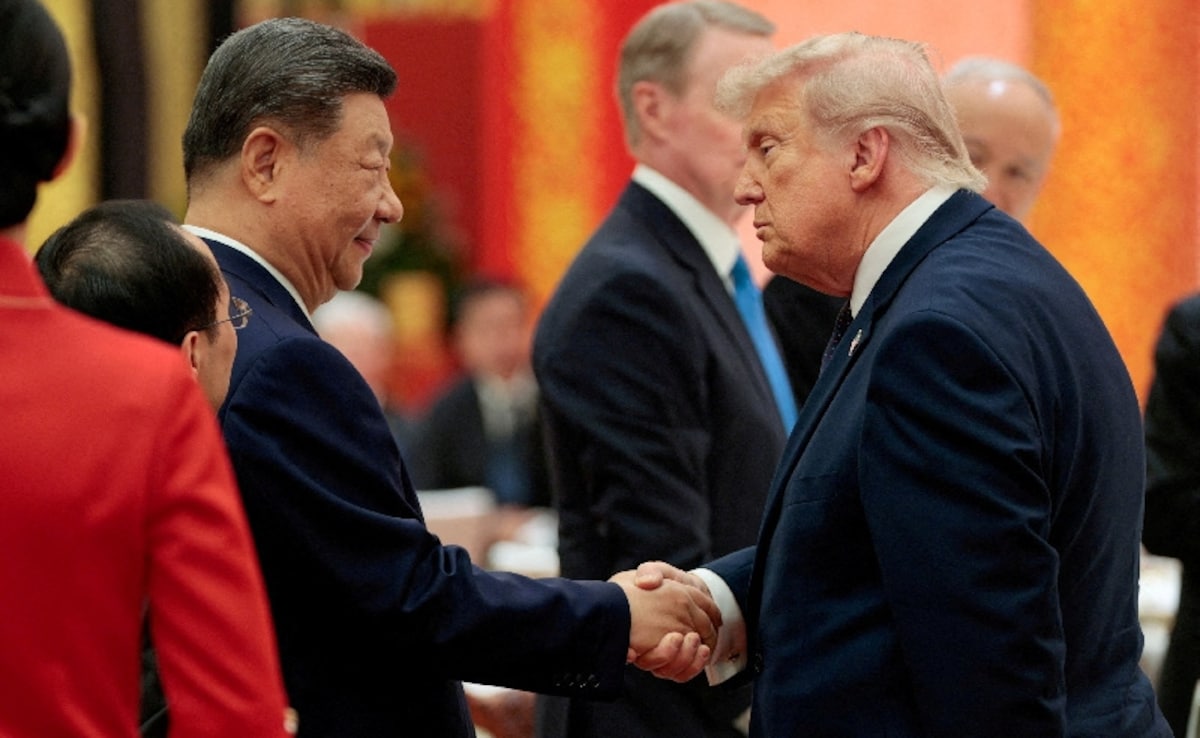
The dramatic image of U.S. Secret Service agents throwing press credentials, delegation pins, and burner phones into a plastic disposal bin at Beijing Capital Airport marks a critical escalation in the cyber warfare between Washington and Beijing. While the public face of the bilateral summit featured handshakes and broad trade commitments regarding Boeing aircraft and agricultural purchases, the abrupt departure protocol reveals the deep structural paranoia governing modern diplomacy. The purge was not a theatrical insult, but a mandatory counterintelligence sweep triggered by severe technical penetrations during the two-day visit.
The "bin order" executed before Air Force One left Chinese airspace represents a shift from passive counterespionage to aggressive, absolute zero-trust logistics.
Inside the Zero Trust Tarmac Purge
The operational reality of a presidential visit to an adversarial state involves a massive logistical footprint designed to isolate the commander-in-chief from local infrastructure.
Prior to the summit, the U.S. Air Force deployed seven C-17 transport aircraft to Beijing carrying 500 tons of equipment. This included specialized communications vehicles, localized cybersecurity nodes, and private medical facilities. The goal was to build a fortress.
Yet, human networks remain the primary vector for electronic compromise. Throughout the two-day summit, members of the White House staff, advance teams, and the traveling press pool were issued localized electronic equipment, temporary credentials, and commemorative items.
The immediate disposal of these items at the steps of the aircraft reflects an understanding that any physical object allowed near presidential communications infrastructure is a potential listening device, malware carrier, or tracking beacon.
The Mechanics of Supply Chain Interdiction
Modern espionage relies heavily on hardware-level modifications that cannot be detected via standard software scans.
- Acoustic Harvesting: Commemorative lapel pins or heavy metal credentials can be engineered with passive resonance technology. These devices require no internal battery; instead, they respond to external radio frequencies beamed from outside a room, vibrating in synchronicity with local speech.
- Firmware Flashing: Burner phones distributed by host nations frequently contain modified baseband firmware. Even when powered down, these modified chips can harvest ambient data, log keystrokes, and broadcast location data the moment they come within range of an unencrypted network.
- Malware Over-the-Air (OTA) Staging: Standard cryptographic tokens used for media access can hide minuscule near-field communication (NFC) chips programmed to execute automated scripts when placed near official government smartphones or laptops.
By enforcing an absolute ban on all host-issued materials, the Secret Service Technical Security Division removed the possibility of these physical components entering the pressurized cabin of Air Force One, which serves as a flying command center.
The Hidden Friction Behind the Optics
The public briefings presented an atmosphere of mutual respect, emphasizing structural negotiations to stabilize global trade. Behind the cameras, however, the security apparatuses of both superpowers engaged in physical and electronic confrontations.
The most notable incident occurred during a scheduled visit to the Temple of Heaven. A U.S. Secret Service agent assigned to the traveling press pool was barred from entering the venue by Chinese security personnel. The dispute centered on the agent carrying a standard-issue firearm, which ran counter to the host nation's immediate security protocols for the zone.
The resulting standoff delayed media access for nearly 90 minutes. This was not a bureaucratic misunderstanding; it was a deliberate test of operational boundaries.
A second flashpoint occurred during the departure sequence. Chinese authorities attempted to restrict the movement of the U.S. press pool, preventing them from immediately trailing the presidential motorcade.
American advance aides had to physically intervene to bypass the sudden security perimeter. These physical delays served as tactical distractions, creating windows where personnel were separated from their secure communications bubbles.
The Broader Context of Technological Separation
This tactical paranoia is a direct consequence of a decoupling process that has accelerated over the past decade.
The historical precedent for these security clashes dates back to the 2016 G20 Summit in Hangzhou, where American and Chinese officials openly argued on the tarmac over press access and aircraft stairs. Since then, the nature of the rivalry has shifted from diplomatic posturing to explicit systemic containment.
The economic backdrop of the summit explains why the technical stakes were so high. The administration came to Beijing attempting to resolve volatile tariff fluctuations that had severely impacted U.S. manufacturing supply chains, particularly companies reliant on Chinese specialized components and rare earth elements.
Simultaneously, the U.S. has maintained a strict embargo on sending high-end semiconductor chips to China, while Beijing has utilized its control over raw material exports as geopolitical leverage.
When the state banquet ended, the core contradictions remained unresolved. The administration secured tactical commercial pledges involving industrial goods and energy, but the fundamental structure of Chinese state capitalism and its long-term goals regarding Taiwan were untouched.
The absolute security purge at the airport steps confirms that despite any temporary commercial agreements, both capitals view the relationship as a zero-sum conflict across the fields of technology, espionage, and regional hegemony.