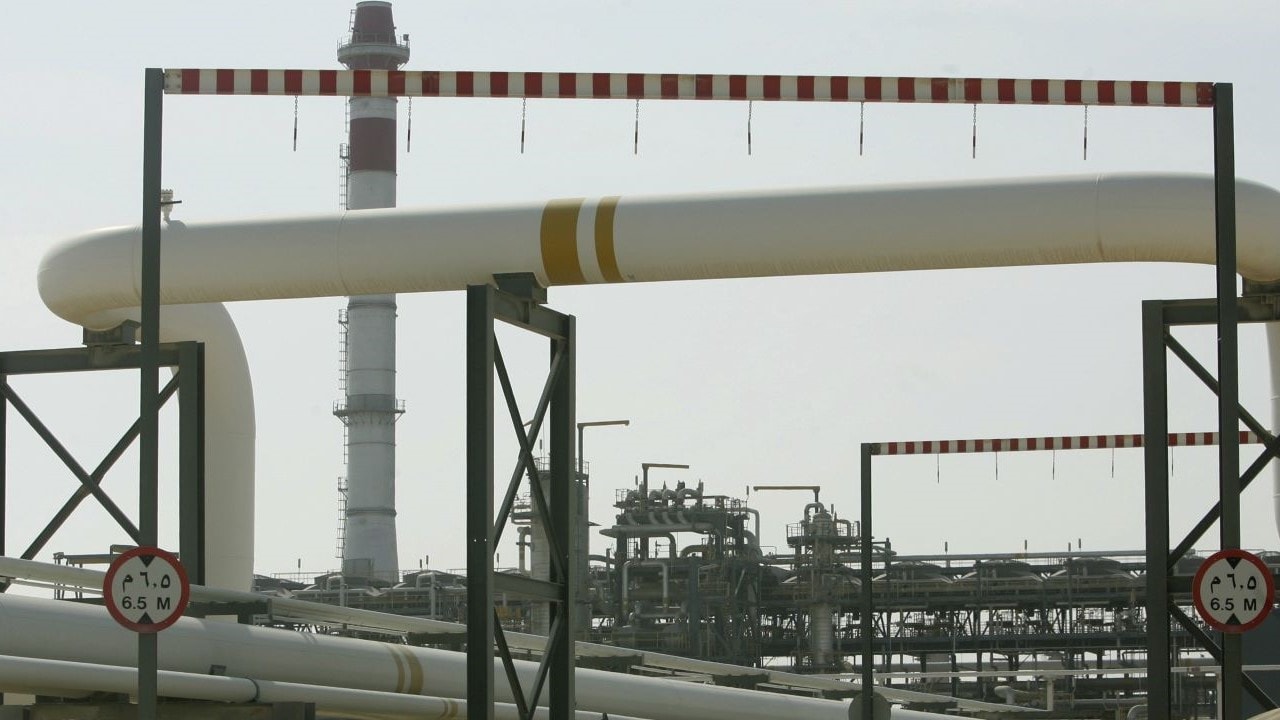
A total blockage of the Strait of Hormuz would instantly remove roughly 20 million barrels of oil per day from the global market, totaling more than 100 million barrels every single week. This is not a speculative "what-if" scenario whispered in backrooms; it is the official warning from Saudi Aramco CEO Amin Nasser. The math is simple, but the consequences are catastrophic. If the world’s most vital maritime chokepoint closes, the global economy does not just slow down. It breaks.
Energy security has long been treated as a background process, like the humming of a refrigerator that no one notices until it stops. But the Strait of Hormuz is the central artery of that system. At its narrowest point, the shipping lanes are only two miles wide. Through those lanes passes one-fifth of the world’s total liquid energy consumption. While politicians argue over green transitions and long-term climate goals, the physical reality of the present remains tethered to this single, vulnerable strip of water between Oman and Iran.
The Logistics of a Global Cardiac Arrest
When Nasser speaks of 100 million barrels lost per week, he is describing a supply shock that has no historical parallel. To put that number in perspective, the 1973 oil embargo involved a production cut of about 5 million barrels per day. The world spiraled into a decade of stagflation, gas lines, and geopolitical realignment. A Hormuz shutdown would be four times larger in volume and happen almost overnight.
The immediate reaction would be a total freeze in the physical oil market. Tankers currently in transit would be diverted or anchored, unable to secure insurance for high-risk zones. The "just-in-time" delivery model that powers modern refineries would collapse. Refineries in South Korea, China, Japan, and India—which rely on the Persian Gulf for the majority of their crude—would be forced to draw down strategic reserves within days.
Why the Buffer is a Myth
Many analysts point to the existence of Strategic Petroleum Reserves (SPR) in the United States and Europe as a safety net. This is a dangerous misunderstanding of how global markets function. The SPR is designed to mitigate localized disruptions or short-term shortages. It cannot replace 20% of global daily supply for any significant duration.
Furthermore, the logistical capacity to move oil out of storage and into the hands of end-users is limited by pipeline and terminal throughput. You cannot simply "turn on" a replacement for 100 million barrels a week. The infrastructure to bypass the Strait exists—primarily via the East-West Pipeline in Saudi Arabia and the Abu Dhabi Crude Oil Pipeline—but their combined spare capacity is less than 6 million barrels per day. That leaves a massive, unfillable deficit of 14 million barrels every day.
The Pricing Explosion Beyond the Pump
If the Strait closes, the price of Brent crude ceases to be a reflection of supply and demand and becomes a reflection of panic. Estimates suggest oil would soar past $200 per barrel within forty-eight hours. But focusing on the price of gasoline at a local station misses the broader destruction.
Modern agriculture is essentially a process of turning hydrocarbons into calories. Fertilizer production is energy-intensive. Global shipping—the backbone of every consumer good from iPhones to antibiotics—runs on heavy fuel oil. When the cost of moving a container ship triples because of fuel surcharges and insurance premiums, the inflationary pressure hits every shelf in every grocery store on the planet.
The Asian Dependency Factor
The United States has achieved a level of energy independence through shale production that it didn't have thirty years ago, but it is not an island. The global price of oil is set on a world market. More importantly, the primary customers for Gulf oil are the engines of the global supply chain: China, India, Japan, and South Korea.
If the manufacturing hubs of East Asia lose their energy supply, the flow of finished goods to the West stops. This is the "hidden" cost of a Hormuz shutdown. You might have gas in your tank because of domestic production, but the parts required to fix your car, the electronics for your business, and the medical supplies for your hospital will be stuck on the other side of a broken ocean.
Military Reality Versus Economic Theory
The primary reason the Strait remains open is the presence of the U.S. Fifth Fleet and a complex web of international naval cooperation. However, the nature of maritime warfare has changed. The threat is no longer just conventional blue-water navies. It is asymmetric.
Low-cost drones, sea mines, and shore-to-ship missiles have made the cost of denying access much lower than the cost of securing it. A single successful strike on a Very Large Crude Carrier (VLCC) would effectively shut the Strait by making the area uninsurable. Lloyd’s of London and other major insurers would pull coverage instantly. Without insurance, no commercial vessel sails.
This creates a scenario where a state or non-state actor doesn't need to physically block the water with ships; they only need to make the risk of transit mathematically impossible for commercial enterprises.
The Aramco Perspective and the Spare Capacity Lie
Nasser’s warning also serves as a subtle critique of global underinvestment in oil production. For years, the narrative has been that the world is moving away from oil, leading to a decline in capital expenditure for new projects. Saudi Aramco has argued that this creates a "thin" market with very little spare capacity.
In a well-supplied market, a disruption in one area can be offset by increasing production elsewhere. But today, almost all the world's spare capacity resides within the very borders that would be cut off by a Hormuz closure. If the Strait is blocked, the world's "fire extinguisher"—the extra barrels Saudi Arabia and the UAE keep in reserve—is trapped inside the burning building.
The Failed Promise of Redirection
There have been perennial talks about building more pipelines across the Arabian Peninsula to the Red Sea or the Gulf of Oman. These projects are expensive, politically sensitive, and technically difficult. Most importantly, they are nowhere near the scale required to handle 100 million barrels a week.
Even if every planned pipeline were completed today, the vast majority of the world's energy would still need to pass through the "Mouth of the Lion." We have built a global civilization on a foundation of cheap, flowing energy, yet we have allowed the most critical link in that chain to remain a single point of failure.
The Geopolitical Fallout of a Prolonged Freeze
A week-long shutdown is a global recession. A month-long shutdown is a total restructuring of the world order.
In this scenario, nations would quickly pivot from cooperation to hoarding. We saw a preview of this behavior during the early days of the COVID-19 pandemic with face masks and vaccines. With energy, the stakes are existential. Governments would likely nationalize energy stocks and ban exports. The globalized trade system, which relies on the predictable movement of goods and energy, would fracture into regional blocs.
The China-Iran Variable
The relationship between the world's largest oil importer (China) and the country holding the "key" to the Strait (Iran) cannot be ignored. China has invested heavily in Iranian infrastructure and signed long-term energy deals. In the event of a crisis, Beijing’s influence may be the only thing capable of reopening the lanes, potentially shifting the balance of power in the Middle East away from Western influence for good.
Hard Truths for the Energy Transition
The volatility of the Strait of Hormuz is often used as an argument for a faster transition to renewables. While logically sound in the long term, it offers no comfort in the immediate term. You cannot build enough wind turbines or solar panels in a week to replace 100 million barrels of oil.
The transition itself requires an immense amount of energy—energy for mining lithium, for smelting steel, and for transporting components. A Hormuz crisis would actually stall the green transition by destroying the economic surplus required to fund it. We are stuck in a paradox: we must move away from oil to be secure, but we need the oil to remain secure enough to make the move.
Navigating the Unavoidable Risk
There is no "fix" for the geography of the Middle East. The Strait of Hormuz will always be where it is, and the oil will remain where it is until the reservoirs run dry. The only variable we control is our level of preparedness and our honesty about the risks.
The 100 million barrels lost every week isn't just a statistic; it’s a timer. Every day the Strait remains closed, the clock ticks closer to a global systemic failure that no central bank can print its way out of. We have spent decades optimizing for efficiency and low costs, stripping away the redundancies that keep a civilization resilient. Now, we face the reality that our entire way of life depends on two miles of water and the shaky hope that no one is desperate enough to close them.
The world must stop viewing energy security as a commodity to be traded and start seeing it as a national security imperative that requires physical, not just financial, solutions. If the flow stops, the debate ends. Build more pipelines that bypass the chokepoint, diversify the sources of energy production, and stop pretending that the strategic reserve is a bottomless well. Physical problems require physical infrastructure, not market maneuvers.