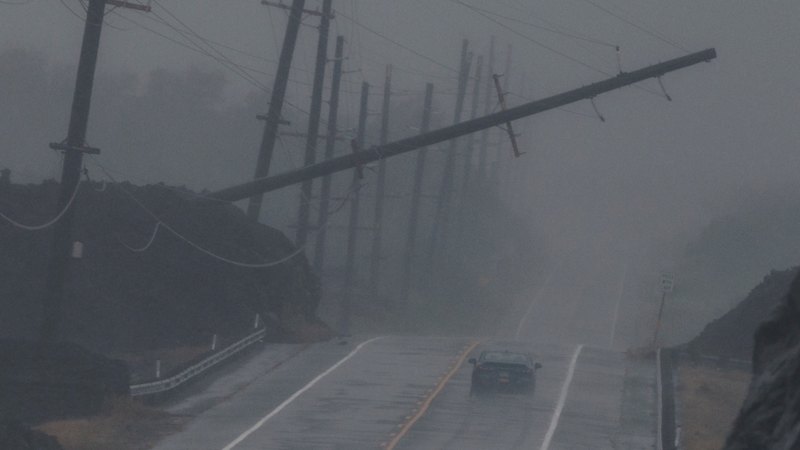
The sirens stop first. That is always the initial mercy of a tropical storm. The wailing pitch that has dug into your eardrums for eighteen hours simply ceases, leaving behind an eerie, heavy silence punctuated only by the drip of water from overloaded gutters.
On the windward side of Oahu, Kiana woke up to that silence. Read more on a related subject: this related article.
She did not check her phone immediately. She looked out the bedroom window, where the banana trees lay horizontal, their broad green leaves beaten into frayed ribbons against the muddy sod. The sky was not the bruised, furious violet of the night before; it was a flat, exhausted gray, the color of a wet slate shingle. Hurricane Lala had tracked just north enough. Just far enough away to spare Honolulu the catastrophic structural blows that meteorologists had whispered about in terrified tones on the evening news. The roofs were on. The power lines were mostly intact, dangling like tired jump ropes.
They had dodged it. Everyone said so. The official bulletins began to downgrade the alerts by dawn. Additional analysis by The New York Times delves into similar views on the subject.
Kiana stepped outside onto her porch, barefoot, and felt the water. It was not falling from the sky anymore. It was rising from the earth.
Water has a memory, and it always returns to where it once lived.
To understand what happened in Hawaii when Hurricane Lala skirted the islands, you have to forget the wind maps. Forget the swirling satellite imagery that turns red and yellow on cable news, mesmerizing millions with its spinning geometry. Wind makes good television. Wind rips off corrugated tin and snaps telephone poles like dry twigs. Wind leaves wreckage that can be measured in insured losses and captured by drone cameras before the noon broadcast.
Water is quieter. Water is patient.
When a storm like Lala approaches the Hawaiian archipelago, the sheer mountain peaks—the jagged pali that rise thousands of feet straight out of emerald valleys—act as colossal wringers. They catch the moisture-laden trade winds, force them upward into the freezing upper atmosphere, and squeeze them dry.
Drop by drop. Million by million.
The storm’s center might be fifty miles offshore, safely churning away into the open blue of the Pacific. But the feeder bands—those long, coiling ribbons of clouds trailing behind the eye—keep hammering the same mountain ridges for hours after the worst is declared over. The soil on those slopes is volcanic, porous, and ancient, but it has a saturation point. Everything has a limit.
Consider a sponge that has been soaking in a bucket all night. At first, it drinks. Then, it holds. Finally, without warning or extra pressure, it simply lets go. The water starts to pour from every pore because it can no longer pretend to contain what it has absorbed.
That was the reality across parts of Maui and the Big Island while tourists in Waikiki cautiously stepped back onto the sand to test the temperature of the surf.
Up in the valleys, streams that usually gurgle pleasantly over smooth basalt rocks transformed overnight into gray, roaring freight trains. They did not look like water anymore. They looked like liquid chocolate mixed with gravel, tearing down ancient terraces, ripping up wild ginger plants, and carrying entire sections of rural access roads into the churning brown froth of the ocean.
Kiana knew this sound. It was a deep, guttural thrum that vibrated right through the soles of her feet. It was the sound of the mountain unmaking itself.
Down the road, Officer Marcus sat in his idling cruiser, watching a culvert choke on debris. He had been on duty for thirty-six hours straight. His eyes burned with the specific, gritty fatigue of men who spend disasters waiting for emergencies that might never arrive—or might arrive all at once.
"People see the sun coming out through a break in the clouds and they think the movie is over," Marcus would say later, wiping a damp forearm across his forehead. "That is when they try to drive home. That is when the culverts back up and turn a driveway into a six-foot-deep sluice gate."
The statistics from emergency management agencies will tell you that the hurricane caused zero direct fatalities. They will list the wind speeds at peak gust. They will tally the thousands of homes left temporarily without electricity. Those numbers are accurate. They are also dangerously incomplete.
Because the real hazard of a near-miss storm isn't the tempest itself. It is the complacency that follows the clearing of the air.
When the local government downgraded the flood warnings from red to orange, the psychological shift was instantaneous. The tension in the air evaporated. People opened their windows to air out the humidity. Families walked down to the shorelines to look at the churning, chocolate-milk surf kicked up by distant swells. They wanted to see nature flexing its muscles now that it was safe to watch from behind a safe barrier.
Yet, three miles inland, saturated hillsides were quietly sliding.
Soil mechanics are remarkably simple at their core. Gravity is a constant, unyielding creditor. When you add water to a slope, you do two things: you increase the weight of the mass, and you lubricate the microscopic planes between the earth particles until friction gives up the ghost.
A hillside does not collapse because it is angry. It collapses because it is heavy.
In a secluded gulch outside of Hilo, a section of red dirt the size of a two-story house detached itself from the ridge with a sound like a distant cannon shot. It didn't rush; it flowed, a thick, sluggish tongue of mud and ancient tree roots that swallowed a historic wooden bridge whole before sliding silently into the swollen river below.
No one was hurt there. No camera crews were rolling tape. The event didn't make the national feeds because nobody famous lived in that gulch. Just families whose great-grandparents had planted taro in the same rich bottoms, people who knew every bend of the stream by heart.
They knew the water. But they had never seen it this angry this late in the game.
We live in an era that worships the climax. We want the Hollywood version of disaster: the sudden strike, the dramatic struggle, the immediate aftermath where the hero stands amid the rubble and looks toward a restored horizon. We struggle with the aftermath that lingers for days. We struggle with the gray days when the storm has technically passed, but the rivers are still swallowing the bridges, and the insurance adjusters haven't arrived yet, and the mud in the front yard is drying into a crust as hard as concrete.
This is the invisible tax of living in places of breathtaking beauty. Paradise comes with a maintenance fee, and sometimes payment is demanded in installments of mud, sweat, and sleepless nights.
By mid-afternoon, the sun finally burned through the upper layers of moisture on Oahu. The light hit the drenched vegetation, turning the hillsides into a blinding, steam-bath green. The air smelled intensely of crushed eucalyptus, wet earth, and salt spray.
Kiana was out on her driveway with a flat-edged shovel, scraping away the slick brown silt that had pooled against her garage door. Her muscles ached with a deep, satisfying fatigue. Her shoes were ruined. Her garden was a flattened memory of what it had been yesterday morning.
She paused, leaning on the handle of the shovel, and looked out past her property line toward the ocean.
The water out there was calming down, smoothing out into those long, rolling swells that surfers travel thousands of miles to ride. The horizon was clean and sharp, cutting a brilliant blue line against the sky.
Lala was gone. Out in the vast, indifferent reaches of the Pacific, the storm was spinning itself out into harmless mist over colder waters, its fury spent and forgotten by the atmosphere that birthed it.
The storm was dead. But down here in the mud, life was just beginning to figure out how to dig its way back up to the light.
Kiana turned back to the shovel, planted her boot against the steel edge, and pushed it into the wet earth once more.


