Grassroots defiance alone cannot topple Narendra Modi’s Bharatiya Janata Party because Indian elections are won through booth-level data networks, state-funded welfare delivery, and disciplined ideological cadre, not street marches. While Rahul Gandhi has successfully rehabilitated his public image through cross-country yatras and aggressive parliamentary confrontation, turning viral street momentum into parliamentary seats requires an organizational apparatus the Indian National Congress largely lacks.
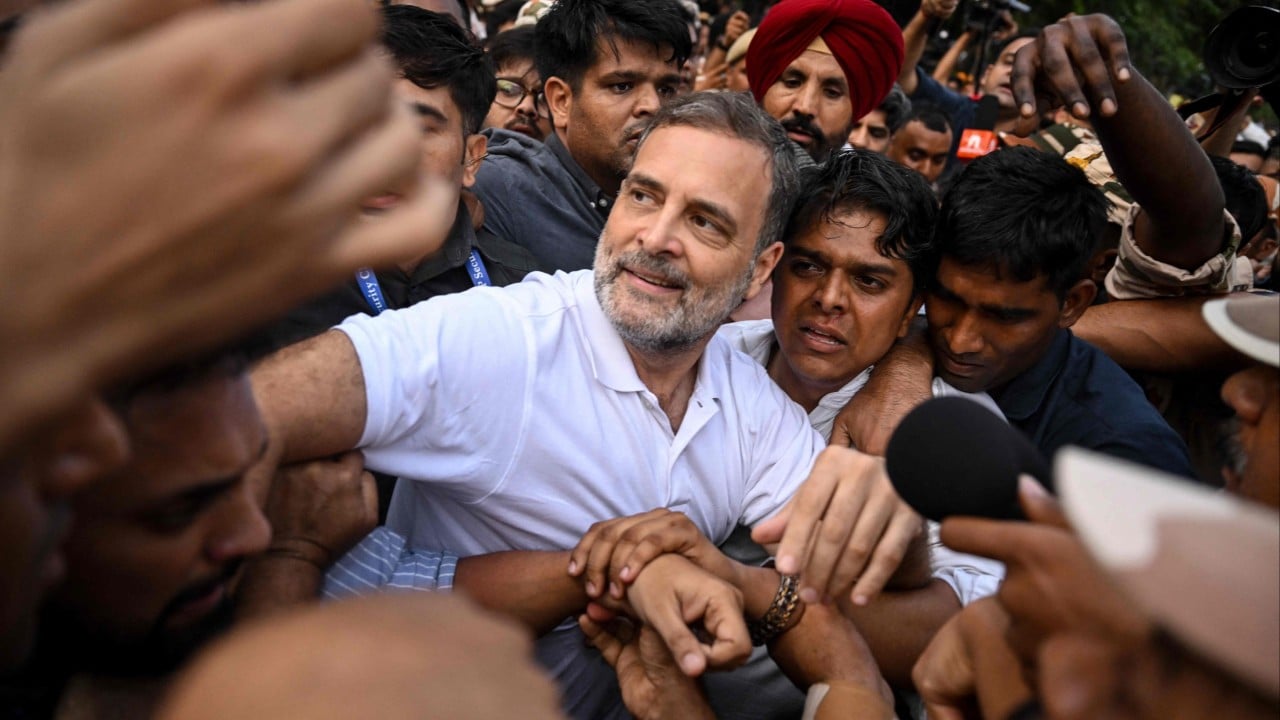
Street politics generates noise. Elections require math. For over a decade, observers of Indian democracy have confused the visibility of anti-incumbency rallies with actual electoral vulnerability. When Rahul Gandhi walks thousands of kilometers through rural districts or confronts government ministers over regulatory capture and crony capitalism, television cameras follow. Social media algorithms reward the friction. Yet when the ballot boxes open, the BJP’s structural advantages—built painstakingly over forty years by the Rashtriya Swayamsevak Sangh (RSS)—consistently absorb the shock of street-level dissent. If you liked this piece, you should read: this related article.
The Anatomy of Modern Indian Campaigning
To understand why physical mobilization hits a ceiling in contemporary India, you have to look at how the BJP actually wins constituencies. It is not merely a personality cult around Narendra Modi, though his personal appeal remains the party's primary vote-multiplier. Beneath the prime minister’s rallies sits a hyper-local, data-driven machinery that treats every polling booth as a distinct battlefield.
Consider the Panna Pramukh system. Literally translating to "page in-charge," a Panna Pramukh is a party worker responsible for a single page of the electoral roll—usually around 30 to 60 voters. This worker knows the caste, economic status, welfare benefits received, and political leanings of every person on that sheet. On election day, their sole job is to ensure favorable voters physically reach the polling station. For another angle on this development, check out the latest update from Reuters.
Compare this to the Congress party's traditional mode of operation. Historically, the Grand Old Party relied on local notables—regional strongmen, cooperative barons, and entrenched caste leaders—to deliver votes in bulk. That model worked when media was scarce and voter loyalties were generational. It collapses against a party that bypasses traditional gatekeepers to communicate directly with individual households via WhatsApp groups and targeted welfare transfers.
The Welfare Cushion
You cannot understand Modi’s resilience without examining Labharthi (beneficiary) politics. Over the past decade, the central government has digitized and streamlined the delivery of tangible assets directly to bank accounts and doorsteps. Cooking gas cylinders, rural housing, toilets, direct cash transfers for farmers, and free grain rations reach hundreds of millions of citizens without the traditional leakage that once plagued Indian bureaucracy.
When a voter receives a concrete roof over their head or monthly grain rations stamped with the prime minister's image, abstract arguments about institutional decay or cronyism lose their bite. Rahul Gandhi’s speeches frequently target big business monopolies and alleged regulatory favoritism. To an urban economist or an editorial writer in New Delhi, these are urgent constitutional crises. To a marginal farmer in Uttar Pradesh or Madhya Pradesh, they are distant abstractions compared to the immediate security of a subsidized bank transfer.
What the Bharat Jodo Yatras Actually Achieved
Dismissing Rahul Gandhi’s street campaigns entirely would be a mistake. His two cross-country marches—the Bharat Jodo Yatra and the Bharat Jodo Nyay Yatra—accomplished something political strategists thought impossible five years ago. They dismantled the caricature of him as a reluctant, part-time politician.
For years, the BJP’s multi-million-dollar communications apparatus successfully branded Gandhi as entitled and out of touch. By walking through heat, rain, and dust, meeting daily-wage laborers, mechanics, and small traders, Gandhi forced a reset of his public persona. He projected physical endurance and genuine empathy. Within the Congress party itself, the marches injected oxygen into a demoralized rank and file that had suffered consecutive existential defeats.
The Organizational Vacuum
The problem is what happens the morning after the caravan leaves town. A yatra is an event. An election is an audit.
When Gandhi’s entourage passes through a district, thousands turn out to wave flags and take selfies. Local leaders jostle for proximity to the leadership to secure future party tickets. Once the media trucks roll on to the next state, the newly energized crowd has nowhere to go. In vast swathes of northern and western India—states like Uttar Pradesh, Bihar, Gujarat, and Madhya Pradesh—the Congress simply does not have functional district or block-level committees to capture that enthusiasm and convert it into voter registration drives or booth-level committees.
In politics, energy without structure dissipates. It is the equivalent of pouring high-octane fuel onto the ground instead of into an engine.
The Coalition Paradox and Regional Friction
Rahul Gandhi’s defiance has increasingly leaned on two pillars: aggressive social justice rhetoric—specifically the demand for a nationwide caste census—and building a broad opposition front, the INDIA bloc. Both strategies carry severe internal contradictions that weaken their punch at the ballot box.
The push for a caste census and the removal of the 50 percent cap on affirmative action reservations is a calculated attempt to fracture the BJP’s broad Hindu consolidation. By appealing directly to Other Backward Classes (OBCs), Dalits, and Adivasis, Gandhi hopes to recreate the caste coalitions that kept the Congress in power during the twentieth century.
Yet this message lands unevenly. While it resonates with segments of voters looking for greater representation in government jobs and universities, it alienates upper-caste voters who still form a critical swing demographic in several states. Worse, in the Hindi heartland, regional parties like the Samajwadi Party and the Rashtriya Janata Dal already own the social justice franchise. Voters looking for caste-based representation tend to prefer the regional originals over a national party trying to reinvent itself.
Allies as Competitors
The opposition alliance itself suffers from a fundamental geographical mismatch. The Congress is strongest when facing the BJP directly in two-horse races across states like Rajasthan, Chhattisgarh, Madhya Pradesh, and Karnataka. However, in the states that hold the key to parliamentary majorities—Uttar Pradesh, West Bengal, Maharashtra, Bihar, and Tamil Nadu—the Congress is a junior partner or a marginal player.
Every seat the Congress demands in these states comes directly at the expense of its own allies. Regional leaders like Mamata Banerjee in West Bengal or Arvind Kejriwal’s Aam Aadmi Party in Delhi and Punjab view a resurgent Congress not as a partner, but as an existential threat to their own local turf. Street defiance against Modi unites them on a stage in New Delhi; seat-sharing negotiations tear them apart in the districts.
The Asymmetry of Resources and Narrative
Any honest assessment of Indian electoral mechanics must account for the sheer asymmetry in financial and media power. Campaigning across a nation of nearly a billion eligible voters is an extraordinarily expensive enterprise. Through mechanisms like the now-scrapped electoral bonds scheme and traditional corporate fundraising, the BJP accumulated a war chest that dwarfed the combined resources of the entire opposition.
Money buys helicopters, rally infrastructure, digital ad saturation, and logistical support for local workers. During the 2024 general election cycle, the Congress faced frozen bank accounts over tax disputes right as campaigning peaked, severely hampering its ability to fund candidates in marginal constituencies. You cannot fight a modern, capital-intensive election campaign solely with grassroots enthusiasm when your opponent outspends you by an order of magnitude in every media market.
The Media Ecosystem
The information environment is equally tilted. Mainstream television news in India largely amplifies the government’s framing of events while subjecting opposition leaders to relentless scrutiny. When Rahul Gandhi raises questions about unemployment, inflation, or border tensions with China, those narratives rarely dominate prime-time debates. Instead, the airwaves focus on cultural nationalism, welfare milestones, and opposition infighting.
To bypass this blockade, Gandhi has leaned heavily into YouTube, independent digital journalists, and short-form video platforms. His candid interviews with farmers, truck drivers, and artisans generate millions of views. This digital guerrilla warfare has broken the BJP’s total monopoly over the national narrative, particularly among younger, internet-savvy voters. Still, digital reach struggles to penetrate the deep rural interiors where state-run television, regional newspapers, and local WhatsApp networks dictated by ruling-party operatives remain the primary sources of truth.
Where Defiance Actually Works
Despite these structural headwinds, the narrative of BJP invincibility has cracked. The 2024 Lok Sabha results proved that Modi’s aura is not absolute. When the BJP lost its single-party majority and was forced to rely on coalition partners like the Telugu Desam Party and Janata Dal (United) to form a government, it demonstrated that sustained street pressure can yield results under specific conditions.
Where the opposition succeeded, three factors were present:
- Hyper-local economic distress: In regions suffering from acute agrarian crisis, falling crop prices, or youth unemployment—such as parts of rural Maharashtra, Haryana, and Uttar Pradesh—welfare schemes failed to offset anger over shrinking household incomes.
- Constitutional anxiety: Gandhi’s repeated warning that a massive BJP supermajority would lead to the rewriting of the Constitution and the end of affirmative action successfully mobilized Dalit voters, particularly in Uttar Pradesh, shifting crucial percentage points away from the ruling party.
- Unified candidate selection: In constituencies where the opposition avoided splitting the anti-BJP vote and fielded a single, credible candidate with local roots, street momentum translated directly into victories.
This proves that grassroots mobilization is not useless. It is a catalyst. When economic pain reaches a boiling point, street defiance gives angry voters a focal point and a vocabulary to express their frustration.
The Unfinished Rebuild
The central flaw in the Congress party’s strategy remains its obsession with top-down spectacle at the expense of bottom-up institution building. Rahul Gandhi has shown immense personal courage in taking on a powerful state apparatus, refusing to back down despite defamation convictions, brief parliamentary disqualification, and relentless investigative agency pressure on opposition figures.
Courage, however, is not an organizational chart. In states like Gujarat, where the Congress has been out of power for nearly three decades, or Odisha and West Bengal, where its vote share has collapsed into single digits, the party lacks the basic human infrastructure required to monitor polling booths or challenge electoral roll deletions.
Until the Congress leadership forces its state units to abandon factional infighting, empower younger district-level organizers, and build permanent year-round contact with voters outside of election cycles, its street campaigns will remain episodic surges. The crowds will continue to gather to watch Rahul Gandhi march, listen to his speeches, and cheer his defiance—and then walk into polling booths dominated by a rival machine that never stopped working while the cameras were away.