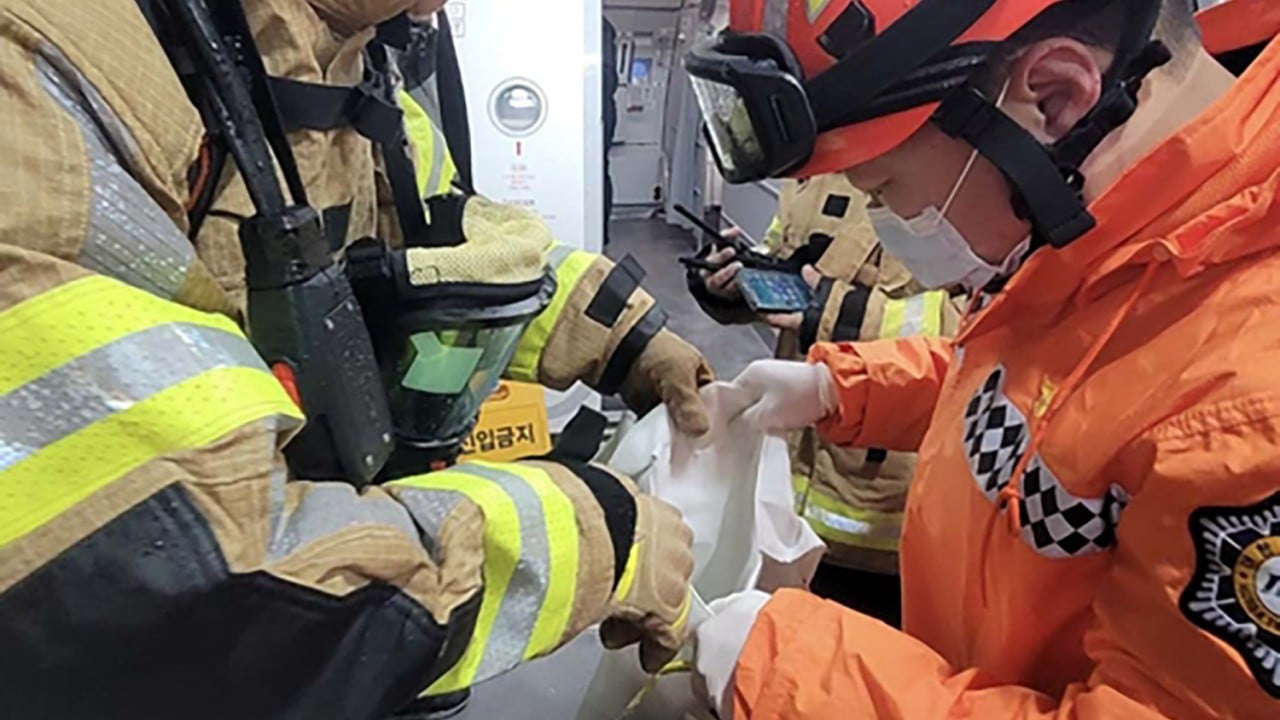
An HK Express passenger recently suffered injuries after a portable power bank overheated mid-flight on a route from Hong Kong to Jeju, South Korea, forcing cabin crew to intervene with emergency containment procedures while tens of thousands of feet in the air. While the aircraft landed safely without catastrophic structural damage, the incident exposes a massive, escalating vulnerability in modern commercial aviation. Millions of unregulated, damaged, or cheaply manufactured lithium-ion batteries enter aircraft cabins every single day, operating entirely outside the reach of airport security scanners designed to catch metal weapons rather than unstable chemical reactions.
Aviation safety regulators have spent two decades tightening the rules around lithium batteries, yet the baseline risk inside the passenger cabin continues to climb. Walk down the aisle of any commercial flight today and count the devices. Passengers carry smartphones, tablets, laptops, noise-canceling headphones, smartwatches, e-readers, and at least one high-capacity portable power bank to keep everything running. We have effectively turned pressurized aluminum tubes into flying warehouses of volatile chemical energy. Meanwhile, you can find similar stories here: The Quiet Danger Behind the Locked Airbnb Door.
The Physics of Thermal Runaway at 35,000 Feet
To understand why a small plastic brick in a seatback pocket poses a grave threat to a commercial airliner, you have to look at the chemistry inside the casing. Lithium-ion batteries pack an extraordinary amount of energy into a tiny, lightweight footprint. They achieve this density by separating a positive cathode and a negative anode with an ultra-thin, permeable polymer membrane—often thinner than a human hair—submerged in a flammable liquid electrolyte.
When that battery is dropped on a concrete airport floor, crushed inside an overhead bin by a heavy roller bag, or subjected to a cheap, poorly soldered internal circuit, that microscopic separator can tear or degrade. Once the anode and cathode make direct physical contact, an internal short circuit occurs. To see the complete picture, check out the excellent analysis by The Points Guy.
The reaction is instantaneous and violent. Electrical energy converts directly into heat, boiling the liquid electrolyte and pressurizing the sealed battery cell until it vents toxic, flammable gases. This triggers thermal runaway—a self-sustaining chemical chain reaction where the heat generated by one failing cell ignites the neighboring cells inside the power bank. Temperatures inside a battery undergoing thermal runaway routinely exceed 1,000 degrees Fahrenheit (537 degrees Celsius).
Even worse, standard aircraft halon fire extinguishers—the gold standard for fighting conventional cabin fires—cannot stop the chemical reaction inside a lithium-ion battery. Halon works by displacing oxygen, which suffocates a normal fire. A lithium-ion cell in thermal runaway generates its own oxygen as the cathode breaks down. Flight attendants can knock down the visible flames, only for the battery to violently reignite minutes later unless it is completely submerged in water or sealed inside a specialized thermal containment bag to dissipate the heat.
Why Airport Security Misses the Real Danger
Most travelers assume that if a device makes it past the X-ray belt at the security checkpoint, it is safe to fly. That assumption is completely false.
Airport security screening protocols, governed by agencies like the TSA in the United States, the Civil Aviation Department in Hong Kong, and the Ministry of Land, Infrastructure and Transport in South Korea, are built primarily to detect prohibited items based on capacity limits and overt physical threats. Under International Civil Aviation Organization (ICAO) guidelines, passengers are permitted to carry spare lithium-ion batteries and power banks in their carry-on luggage as long as they do not exceed 100 watt-hours (Wh)—roughly equivalent to a 27,000 mAh power bank. Batteries between 100 Wh and 160 Wh require explicit airline approval, and anything larger is strictly banned.
Here is the glaring blind spot in that system. An X-ray machine shows a security officer the silhouette of a battery pack, its wiring, and its physical size. It cannot see internal dendrite growth—microscopic metallic lithium filaments that form inside an aging battery over hundreds of charge cycles and eventually pierce the separator. An X-ray scanner cannot detect a counterfeit battery cell wrapped in a stolen brand-name label, nor can it identify a power bank that suffered internal structural damage when a passenger accidentally sat on it in the terminal lounge.
Furthermore, the global market is flooded with ultra-cheap, uncertified power banks sold through third-party online marketplaces. To cut manufacturing costs by a few cents per unit, rogue factories routinely bypass mandatory safety mechanisms like Battery Management Systems (BMS), thermal cutoff switches, and pressure relief vents. Some counterfeit manufacturers even print fake capacity ratings and bogus safety certifications—such as counterfeit UL or CE marks—directly onto the plastic housing. A checkpoint agent looking at a stamped label has zero way of verifying whether the circuitry inside meets basic international safety standards or is a ticking chemical time bomb.
The Cabin Crew Reality When Smoke Fills the Aisle
When a power bank fails mid-flight, the response window is measured in seconds, not minutes. On a packed narrow-body aircraft like the Airbus A320 or A321—the workhorses of regional carriers like HK Express—a sudden burst of acrid, white lithium smoke triggers immediate panic. The fumes released during thermal runaway contain hydrogen fluoride, carbon monoxide, and volatile organic compounds that burn the eyes, throat, and lungs within breaths.
Flight attendants are trained extensively for these scenarios, following strict In-Flight Fire Fighting (IFF) drills. When a lithium battery overheats, the protocol requires crew members to don Protective Breathing Equipment (PBE) and fire-resistant gloves, douse the device with water or any non-alcoholic liquid available in the galley to cool the cells, and transfer the smoking unit into a heavy-duty fire containment bag designed to withstand extreme heat without melting.
Consider the practical hurdles of executing that textbook procedure in a real-world cabin.
Imagine a hypothetical scenario on a crowded red-eye flight. A passenger falls asleep with their phone plugged into a cheap power bank wedged deep between the seat cushion and the fuselage wall. As the battery swells and ignites, the passenger wakes up in a panic, drops the burning device onto the carpet, and kicks it under the seat in front of them while passengers in the surrounding rows scramble out of their seats, blocking the narrow single aisle. Flight attendants must fight their way against a wall of panicked travelers, locate a superheated, spitting brick of metal wedged beneath tangled backpack straps, and extract it without burning their hands—all while the pilots evaluate whether to initiate an emergency diversion over open water or rugged terrain.
The reason carriers like HK Express, Cathay Pacific, Korean Air, and major Western airlines strictly forbid placing power banks in checked baggage is precisely because of this human intervention factor. In the cargo hold, an automated fire suppression system cannot cool a lithium-ion battery in thermal runaway; a fire down below can compromise flight control systems or burn through the fuselage before the aircraft can descend. Keeping batteries in the cabin ensures someone will smell the smoke and see the flames immediately. That policy is sound, yet it transfers the frontline firefighting burden directly onto flight attendants and places the hazard inches away from passengers.
The Regulatory Tug-of-War Over In-Flight Charging
The HK Express incident highlights a growing divide among airlines regarding how passengers actually use these devices once the seatbelt sign turns off. Historically, regulators focused simply on getting the batteries out of the cargo hold and into the cabin. Now, aviation authorities are realizing that how passengers handle power banks during the flight is just as critical as where they pack them.
Several major Asian carriers—including EVA Air, China Airlines, and Thai Airways—have already implemented strict bans prohibiting passengers from using or charging power banks during flights. Under these rules, you can carry the battery in your cabin bag, but it must remain unplugged from takeoff to touchdown. In South Korea, following a high-profile cabin fire incident involving an Air Busan Airbus A321 in early 2025, transport authorities moved rapidly to tighten restrictions, mandating that passengers keep power banks on their person or in visible seatback pockets rather than stowing them out of sight in overhead compartments, while banning active charging via seatback USB ports.
Western carriers and many regional budget airlines have been slower to adopt outright usage bans, largely due to customer pushback and enforcement headaches. Budget airlines frequently strip out in-seat power outlets and seatback entertainment screens to save weight and fuel costs. On a three-to-four-hour flight from Hong Kong to Jeju, passengers rely entirely on their personal phones and tablets for entertainment, and they depend on power banks to keep those screens lit. Banning power bank usage without providing in-seat power creates immediate friction between cabin crew and paying customers.
Enforcement is another massive hurdle. Flight attendants cannot physically patrol every row every two minutes to verify whether a cable running into a backpack is connected to a power bank or an e-reader. Many travelers simply ignore pre-flight safety announcements, burying active charging setups beneath blankets, jackets, or pillows—the worst possible environment for a battery generating heat, as fabric traps thermal energy and accelerates the path to thermal runaway.
What Aviation Insiders Know About Battery Hygiene
If you fly regularly, relying on airline compliance checks or airport security to protect you from a battery fire is a losing strategy. Safety starts with understanding how lithium-ion cells degrade and taking basic precautions that most travelers completely overlook.
First, stop burying charging devices. Heat is the primary catalyst for battery failure. Leaving a power bank plugged into your phone inside a closed backpack, under a blanket, or wedged into a tight seat pocket prevents ambient cabin air from cooling the casing. Keep the battery on your tray table or in plain sight while it is actively discharging so you can immediately feel if it becomes abnormally hot or notice the faint, sweet chemical odor that precedes venting.
Second, inspect your gear before you pack. A lithium-ion battery that has suffered a hard drop onto concrete, sustained a deep dent in its aluminum shell, or started to bulge—even slightly—is structurally compromised. Swelling occurs when internal gases build up due to electrolyte decomposition. Never bring a swollen power bank onto an airplane, and never attempt to puncture or compress it to make it fit into a case.
Third, scrutinize what you buy. Stick exclusively to established manufacturers that publish verifiable safety certifications (such as UL 2056 in North America or equivalent regional standards) and integrate multi-stage thermal protection circuits. When a 20,000 mAh power bank sells online for a fraction of the price of a reputable brand, the manufacturer saved that money by stripping out the exact internal safeguards designed to stop a short circuit from turning into a blowtorch.
Aviation regulators will continue to debate whether global bans on in-flight power bank usage are necessary, and battery engineers are working steadily toward solid-state chemistries that eliminate flammable liquid electrolytes altogether. Until solid-state batteries replace the lithium-ion cells currently sitting in millions of carry-on bags, every commercial flight relies on the vigilance of the person holding the charger and the speed of the crew trained to put it out.