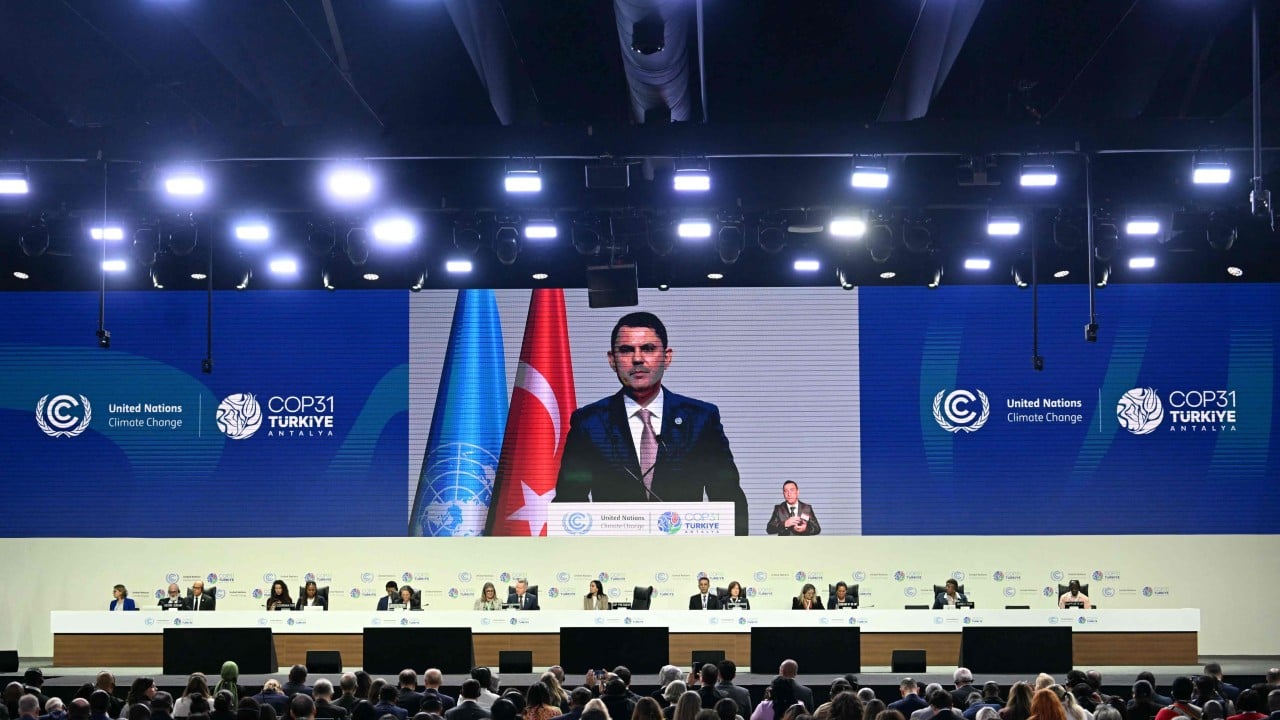
The air inside a high-stakes climate summit always smells the same. Recycled oxygen. Cold coffee. Wet wool coats drying on the backs of ergonomic chairs.
If you have ever sat in the back row of an international plenary hall at three in the morning, you know the peculiar vertigo that sets in when exhaustion meets existential math. Outside, a city sleeps. Inside, exhausted diplomats in rumpled suits argue over the placement of a single comma in a draft text, knowing full well that comma might dictate whether an island nation remains above the tide line or whether a farmer in the Mediterranean can afford crop insurance next spring.
This is the reality behind the dry headlines. When news wires flash the standard bulletin—that COP31 leaders are urging the world to accelerate the fight against global warming—the words slide right off our screens. We have become numb to the phrasing. Urge. Accelerate. Fight. They sound like background static, another distant bureaucratic exercise disconnected from the price of olive oil at the corner market or the erratic heatwaves turning summer nights into sleepless, humid marathons.
To understand what actually happened when COP31 leaders stepped up to those microphones, you have to strip away the diplomatic jargon and look at the invisible ledger sitting on the table between them.
The Architecture of a Delayed Promise
Consider a hypothetical scenario that mirrors the exact math keeping energy ministers awake right now.
Meet Elena, a mid-level grid engineer in a coastal European city, and Tariq, who manages a logistics fleet in Southeast Asia. Neither of them holds a diplomatic passport. Neither of them gave a speech at the COP31 summit. Yet every single clause negotiated by those world leaders lands directly on their desks within eighteen months.
For years, global climate policy operated like a student putting off a term paper until the night before it is due. Governments signed grand pledges in Paris, applauded in Glasgow, debated in Dubai, and promised to turn the corner in Baku and Belém. The core objective—limiting global temperature rise to 1.5 degrees Celsius above pre-industrial levels—was treated as a distant horizon.
At COP31, that horizon collapsed into the present tense.
The urgency voiced by COP31 leaders is not theatrical posturing; it is an admission that the buffer is gone. In climate science, inertia works like a massive cargo ship. Even if the captain throws the engines into full reverse today, the vessel keeps moving forward for miles before it stops. The greenhouse gases already accumulated in the upper atmosphere act as a thermal blanket that continues trapping heat for decades. When summit leaders warn that the world must accelerate its transition, they are staring at telemetry showing that the ship is dangerously close to the reef, and the rudder is responding too slowly.
Why does the pace feel so sluggish when solar panels are cheaper than ever and electric vehicles are multiplying on highways?
Because replacing the engine of the global economy while the plane is still flying is terrifyingly complex.
The Hidden Friction of the Transition
If you listen closely to the debates echoing through the COP31 corridors, you hear three distinct anxieties colliding in real time.
First, there is the sheer scale of infrastructure required. Building renewable energy capacity is only half the battle. Think of clean electricity like water pouring out of a massive reservoir; without copper wires, high-voltage transmission lines, and industrial-scale batteries to carry and store it, that energy spills onto the ground unused. In dozens of countries, gigawatts of wind and solar projects sit waiting in permitting queues because the electrical grids designed in the twentieth century cannot handle the decentralized, fluctuating power of the twenty-first.
Second, there is the financial chasm between wealthy nations and developing economies. This is where the emotional temperature in the negotiation rooms spikes. Developing nations point out a simple, undeniable historical ledger: industrialized nations built their wealth by burning fossil fuels for over a century, filling the atmospheric carbon budget in the process. Now, emerging economies need cheap, reliable energy to lift millions out of poverty, build hospitals, and power factories—yet they are being asked to leapfrog straight to clean technologies while facing borrowing costs twice or three times higher than those in New York, Frankfurt, or Tokyo.
When COP31 leaders call for acceleration, they are implicitly confronting this trust deficit. Without predictable climate finance—real capital flowing into grid modernization, resilient agriculture, and clean industrial manufacturing—pledges remain ink on paper.
Third, there is the quiet resistance of daily habit.
I remember standing in a flooded basement in southern Europe two autumns ago, helping a neighbor haul waterlogged boxes of family photographs up the stairs after a storm dropped four months of rain in six hours. The water smelled of mud, diesel from a submerged heating tank, and ruined drywall. Nobody in that basement was talking about carbon parts per million or gigaton reductions. They were asking why the municipal drains failed, why insurance premiums had doubled, and how they were going to pay for a new boiler before winter.
That is the human translation of a fraction of a degree. Climate change rarely arrives as a cinematic tidal wave; it arrives as an administrative and financial grind. It shows up as a bruised apple harvest after a late frost, a brownout during an August heat dome, a mortgage lender quietly redlining a coastal zip code.
What Acceleration Actually Looks Like on the Ground
When headlines report that summit leaders demand faster action, skeptics understandably roll their eyes. What does faster mean in practice? How do you compress a thirty-year industrial overhaul into a handful of years without breaking the global supply chain?
The answer lies in three structural shifts that COP31 delegates have pushed to the center of the table.
- Tripling renewable capacity while slashing fossil fuel subsidies: For decades, governments have tried to run a race with one foot on the accelerator and the other on the brake—funding clean energy research on Monday while subsidizing coal, oil, and gas consumption on Tuesday. True acceleration requires redirecting those capital flows so clean electrons become the default, lowest-cost option everywhere, not just in wealthy markets.
- Decarbonizing heavy industry, not just passenger cars: Electric sedans grab the headlines, yet steel, cement, shipping, and aviation account for a massive share of global emissions. COP31 discussions have placed unprecedented weight on green hydrogen, industrial electrification, and carbon capture for sectors where plugging into a standard wall outlet simply isn't an option.
- Treating adaptation as an immediate economic necessity: For a long time, focusing on climate adaptation—building seawalls, breeding drought-resistant crops, redesigning cities to shed heat—was viewed almost as an admission of defeat. That mindset is dead. Leaders now recognize that even under the best-case emission scenarios, the weather systems of the mid-twentieth century are gone. Protecting communities from the warming already locked into the system is just as urgent as preventing future warming.
The Metaphor of the Thermostat
To grasp why every tenth of a degree matters so fiercely to the scientists briefing COP31 leaders, imagine the Earth's climate system as a home thermostat where the wiring has frayed.
In a normal house, if you set the dial to 21 degrees, the furnace kicks on and off gently to keep the room comfortable. With greenhouse gases thickening the atmosphere, we haven't just turned the dial up; we have jammed the relay switch so the furnace keeps firing even when the windows are sweating.
Going from 1.5 degrees of warming to 2.0 degrees does not mean a gentle, uniform half-degree nudge across the globe. It means crossing biological and physical thresholds. Coral reefs that nurture a quarter of all marine life face near-total collapse. Mountain glaciers that feed the major rivers of Asia and South America shrink past the point of seasonal recovery. Permafrost thaws, releasing ancient stores of methane that amplify the warming even further, completely independent of human smokestacks.
This non-linear escalation is what terrifies climatologists. You can negotiate with a finance minister. You can lobby a parliament. You cannot negotiate with the melting point of ice.
Why Cynicism Is the Most Expensive Luxury
It is easy—almost fashionable—to look at international climate summits with weary cynicism. Private jets still land at host airports. Lobbyists still roam the corridors. Final communiqués still rely on carefully hedged verbs like transition away instead of hard deadlines.
I have felt that frustration myself, watching live streams of closing plenaries drag hours past their scheduled end while watered-down clauses get gavelled through to cheers that feel hollow. It is tempting to conclude that the machinery of global cooperation is simply too slow for the speed of planetary physics.
Yet abandoning the table is a luxury none of us can afford.
Look closely at the trajectory of the past decade, and a different picture emerges beneath the noise. Ten years ago, baseline projections pointed toward a catastrophic four or five degrees of warming by the end of the century. Today, because of policies hammered out in these imperfect, exhausting rooms—and the subsequent explosion in clean technology manufacturing—those worst-case trajectories have bent downward. Not enough. Nowhere near fast enough. Still, the curve has moved.
Every wind turbine spinning in the North Sea, every utility-scale battery farm coming online in the desert, every building code tightened to withstand extreme heat traces its lineage back to targets set in these negotiations. The summit does not lay the bricks, nor does it string the copper wire. It sets the market signal that tells trillions of dollars of pension funds, sovereign wealth managers, and corporate boards where the future is heading—and where stranded assets lie waiting to burn careless investors.
Returning to the Engineer and the Fleet Manager
Think back to Elena, our grid engineer, and Tariq, our logistics manager.
When COP31 leaders step away from the podium and return to their capitals, the real test begins in the quiet months that follow. If those speeches translate into streamlined permitting laws, Elena gets the green light to upgrade the regional substations before next summer's peak demand hits. If the climate finance mechanisms unlocked at the summit actually reach regional banks, Tariq secures the low-interest loan needed to replace forty aging diesel trucks with electric rigs, clearing the air in the port neighborhoods where his own children go to school.
Neither of them will ever read the final forty-page COP31 declaration. They don't need to. They will feel its success or failure in the reliability of the power grid, the stability of food prices, and the quiet predictability of the seasons.
Late on the final night of a climate summit, after the television cameras have packed up and the translators have removed their headsets, the plenary hall goes remarkably silent. Cleaners move through the rows, gathering discarded water bottles and forgotten briefing binders. Outside, dawn begins to break over the city—the exact same sun rising over coastal villages, parched farmlands, and sprawling megacities across the globe.
The speeches are over, the microphones are cold, and the only question left hanging in the morning air is whether we will match the speed of our promises to the speed of the wind.