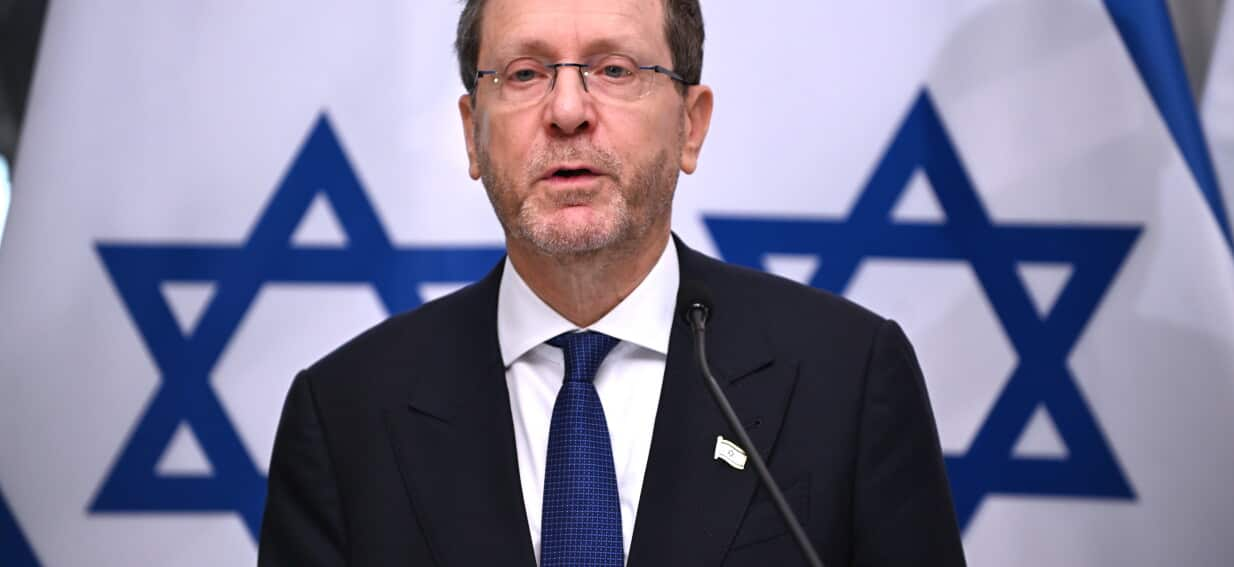
The velvet chairs at Beit HaNassi, the official residence of the President of Israel in Jerusalem, are deceptively comfortable. Yet anyone who has watched the televised procession of party leaders filing through those doors after a deadlocked election knows the room is thick with invisible tension. Cameras click. Handshakes are held a fraction of a second too long for the photographers. Behind the polite smiles lies a brutal mathematical reality that no amount of ceremonial grace can soften.
Sixty-one.
That is the number that haunts Israeli politics. Out of the 120 seats in the Knesset, Israel’s parliament, a governing coalition needs at least 61 votes to survive. Not 60. Not a plurality. A strict, unforgiving majority. When the ballots are counted and no single bloc crosses that threshold, the country enters a strange, suspended state—a political purgatory where the fate of millions rests on closed-door negotiations between rivals who spent the previous three months swearing they would never sit in the same room.
Standard news coverage treats the start of presidential coalition talks like a dry procedural box-ticking exercise. Party A recommends Candidate X. Party B recommends Candidate Y. The president tallies the endorsements and hands out a mandate. On paper, it looks like simple addition. In reality, it is closer to defusing a bomb while the people holding the pliers argue over who gets to keep the wire cutters.
The Kitchen Table Cost of Deadlock
To understand why these consultations at the presidential residence carry such heavy emotional weight, step away from Jerusalem for a moment. Consider a hypothetical family—let’s call them David and Maya—living in a three-bedroom apartment in Rishon LeZion.
David teaches high school civics; Maya manages logistics for a mid-sized medical supply firm. On the morning after an inconclusive election, they do not wake up thinking about constitutional law or Knesset committee chairmanships. They wake up wondering whether the national budget will pass before the next school year, whether infrastructure projects meant to ease their daily commute will remain frozen in caretaker limbo, and whether the deep social fractures exposed during the campaign will spill over into their neighborhood grocery store.
When a government cannot be formed, the state does not simply pause. It drifts. Under Israeli Basic Law, a caretaker government lacks the full legislative mandate and political capital to enact sweeping structural reforms. Major policy decisions are delayed. Municipal grants stall. Public trust erodes, drop by drop, every time a fourth or fifth election cycle looms on the horizon. For citizens like David and Maya, the consultations at Beit HaNassi are not a distant spectacle; they are the difference between a functioning state and another six months of paralysis.
I have sat in living rooms in Tel Aviv and Haifa during these post-election weeks, watching the broadcast on mute while friends argue over bowls of roasted sunflower seeds. The mood is rarely triumphant, even for voters whose preferred party gained seats. Instead, there is an exhaustion that settles into the bones—a collective holding of breath while politicians trade away campaign promises for ministerial portfolios.
How the Mandate Actually Works
The mechanics of Israel’s parliamentary system are famously misunderstood outside the region, largely because they operate so differently from presidential systems like the United States. Israelis do not vote directly for a prime minister. They vote for a closed party list under a system of pure proportional representation.
Think of the Knesset as a 120-piece puzzle where the pieces are cut fresh after every election, and none of the edges naturally lock together. Any party that crosses the 3.25 percent electoral threshold wins seats proportional to its share of the national vote. Because that threshold is relatively low, the Knesset routinely fractures into ten, twelve, or even fourteen distinct factions—ranging from secular centrists and free-market conservatives to ultra-Orthodox religious parties, nationalist right-wingers, left-wing social democrats, and parties representing Israel’s Arab citizens.
In the entire history of the State of Israel, since its founding in 1948, no single party has ever won 61 seats on its own. Every Israeli government has been a coalition.
This is where the President of Israel steps onto the stage. Though the presidency is largely ceremonial—designed to stand above partisan brawls as a symbol of national unity—the post-election consultation process is the one moment when the office wields decisive constitutional influence.
Over two or three days, representatives from every faction elected to the Knesset arrive at Beit HaNassi in descending order of party size. The meetings are broadcast live, a transparency measure introduced in recent years to pull back the curtain on backroom dealing. Each delegation sits across from the president, states which Knesset member they recommend to form the next government, and explains their reasoning.
The Illusion of the Numbers
On the surface, the president’s job looks straightforward: count the recommendations and give the mandate to whoever has the most.
Look closer, and the math turns treacherous.
Suppose Candidate A receives 59 recommendations and Candidate B receives 56, while a smaller faction of five seats refuses to recommend anyone at all. Giving the nod to Candidate A seems obvious. Yet what if three of the parties backing Candidate A have irreconcilable red lines? One demands sweeping judicial changes; another vows to topple any government that touches the courts. One insists on strict Sabbath observance laws; another campaigned entirely on secular civil rights.
A recommendation at the president’s residence is not a binding contract. It is an opening bid.
The president must weigh not just who has the highest number of endorsements on Tuesday afternoon, but who actually possesses a realistic path to assembling 61 sworn votes within the strict statutory window. Under Israeli law, once a Knesset member is tasked with forming a government, the clock starts ticking immediately. They have 28 days to assemble a coalition, with the possibility of a single 14-day extension granted at the president’s discretion.
Forty-two days maximum. Six weeks to bridge ideological chasms that have divided Israeli society for decades.
Shadows of Past Deadlocks
History hangs heavy over the velvet chairs in Jerusalem. Between 2019 and 2022, Israel experienced an unprecedented political tailspin—five national elections in less than four years. Each cycle followed a depressingly familiar script. Voters went to the polls, the results produced a near-even split between pro-Netanyahu and anti-Netanyahu blocs, and the president’s consultations turned into a high-stakes game of chicken.
During that era, every political norm was tested. Party leaders who had sworn never to sit together formed short-lived unity governments that collapsed under the weight of their own contradictions. The 2021 "change coalition," which spanned eight parties from the nationalist right to the Islamist Ra'am party, proved that ideological opposites could briefly unite around a shared desire to break a stalemate—and also proved how fragile such a mosaic becomes when the margins are razor-thin. A single defection, one disillusioned backbencher deciding they can no longer justify a compromise to their base, is enough to bring the entire structure crashing down.
It is easy to judge politicians harshly from the outside, to dismiss their maneuvering as pure cynicism. And certainly, ambition and ego play their part. Yet spending time studying parliamentary coalitions reveals a more uncomfortable truth: compromise in a proportional system always looks like betrayal to the purists who voted for you.
If a party leader promises voters they will never sit with a rival faction, and then enters a coalition with that rival to prevent a costly repeat election, are they breaking faith with their voters or fulfilling a higher duty to keep the country governable? There is no clean answer. Every choice carries a moral and political price tag.
What Happens If the Talks Fail?
When the president hands the mandate to the first candidate, the real negotiations move away from the cameras and into hotel suites, Knesset offices, and private homes. Coalition agreements in Israel are massive, exhaustive documents. They do not merely divide up cabinet ministries like Defense, Finance, and Foreign Affairs; they lock in granular policy commitments, budget allocations for specific constituencies, and veto powers over future legislation.
If the first candidate fails to reach 61 seats before their 28 or 42 days expire, the mandate returns to the president. At that point, the president has two options: hand the mandate to a second Knesset member—who gets a strict, non-extendable 28-day window—or inform the Speaker of the Knesset that no viable coalition exists.
Should the second candidate also fail, the process enters its final, desperate phase. For 21 days, any member of the Knesset can try to gather the signatures of 61 lawmakers asking the president to task them with forming a government. It is a parliamentary free-for-all, a last-ditch scramble to avert disaster. If those 21 days pass without 61 signatures, the Knesset dissolves automatically, and the country is plunged back into another expensive, exhausting election campaign.
The Human Weight of a Signature
It is worth pausing to appreciate what happens in the quiet hours just before a deadline expires. Imagine being a veteran lawmaker sitting in a dimly lit Knesset office at two in the morning. Your phone is buzzing with messages from party activists warning you not to give an inch, alongside calls from mayors and business leaders begging you to just get a government sworn in so the economy can breathe.
In front of you sits a draft coalition agreement. Half of it advances causes you have fought for your entire adult life. The other half contains concessions that make your stomach turn.
This is the unspoken reality behind every headline announcing that the Israeli president is beginning coalition talks. The process is designed to force synthesis out of fragmentation. Israel’s founders deliberately chose pure proportional representation so that every community in a deeply diverse, immigrant nation—religious and secular, Ashkenazi and Mizrahi, Jewish and Arab—would have a voice in the parliament. They wanted a mirror of society, not a winner-take-all steamroller.
What they created was a system that guarantees representation at the cost of stability. Every voice is heard, which means no single voice can command the room alone.
As the delegations step out of their black sedans at Beit HaNassi and walk up the stone steps toward the waiting microphones, the ritual begins anew. The spokespeople will recite their talking points. The commentators will draw arrows on television touchscreens, adding and subtracting seats like sports analysts breaking down playoff scenarios.
Somewhere in Rishon LeZion, David and Maya will glance at the evening news while clearing dinner plates from the table, watching the same familiar faces enter the president’s residence, waiting to see if sixty-one pieces of a fractured puzzle can somehow be forced to fit.


