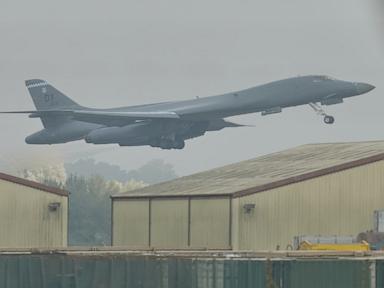
Every defense analyst with a Twitter account and a subscription to an open-source flight tracker is currently screaming about the exact same hallucination. When the United States military pulled its rotational B-1B Lancers out of Royal Air Force Fairford in Gloucestershire, the headlines wrote themselves. The lazy consensus hit the wire services within minutes: Washington is blinking in the face of Iranian escalation. Analysts claimed the withdrawal signals a retreat under pressure, a cowardly shuffle of assets to appease jittery allies or dodge incoming regional drone swarms.
It is a completely inverted read of modern air warfare.
I have watched defense pundits fall into the static-base trap for decades. They equate the physical presence of massive aluminum tubes on a tarmac with deterrence, ignoring the entire evolution of long-range strike architecture. Shuffling those Bones out of Fairford is not a sign of weakness or de-escalation; it is an acknowledgment that parking multi-million-dollar supersonic bombers at a predictable, heavily mapped European outpost in an era of precision hypersonics and saturation missile barrages is professional malpractice.
Let us dismantle the panic.
The Geography of Vulnerability
Fairford is historic. It is storied. It is also a giant neon bulls-eye.
During the Cold War, static European forward operating locations made sense because the adversary had to launch complex, multi-stage bomber or ballistic sorties across vast distances with limited initial telemetry. Today, the Middle Eastern and European periphery is saturated with persistent surveillance, high-altitude synthetic aperture radar, and cheap, highly networked loitering munitions. Keeping rotational strategic bombers at a fixed base like Fairford turns them into sitting ducks before they ever taxi to the active runway.
When you leave a squadron of B-1Bs sitting in Gloucestershire, you are anchoring high-value assets to a fixed coordinate that every adversary has pre-programmed into their targeting computers. The illusion of deterrence relies entirely on the enemy believing you are willing to absorb a devastating first strike on your own parking ramp. That is not deterrence. That is a hostage situation.
The decision to pull those aircraft back or disperse them across dynamic, non-traditional operating nodes reflects a hard-nosed operational reality. Flexibility beats mass every single time when your opponent can see your driveway from space.
Range is an Illusion Without Agility
The common refrain from the armchair generals is that removing the B-1 from the UK theatre guts America's rapid response capability against Iranian proxy networks or domestic military infrastructure. This ignores the defining characteristic of the Lancer airframe: intercontinental reach paired with an internal and external payload capacity that defies logic.
A B-1B does not need to sit in the UK to hit targets in the Middle East. It never truly did. Operating from continental United States bases with robust aerial refuelling pipelines, or utilizing dispersed expeditionary footprints, provides a layer of strategic ambiguity that static European basing simply cannot match.
When an adversary has to guess whether a strike package is launching from Missouri, a remote Indian Ocean atoll, or an undisclosed austere strip, their air defense network has to stay turned on, burning through maintenance lifecycles, radar components, and interceptor inventories. Predictability is the enemy of effectiveness. By clearing out of Fairford, the Pentagon has reintroduced fog and friction into the adversary's planning cycle. They no longer know where the punch is coming from, only that the fist is long enough to reach them.
The Maintenance Nightmare of the Lancer
We also need to talk about the physical state of the fleet, because the mainstream media routinely ignores the unglamorous mechanics of aviation sustainment in favor of geopolitical melodrama.
The B-1B is an elderly, overworked thoroughbred. Designed in the cold calculation of the late Cold War to skim treetops at Mach 1.2, it has spent the last thirty years being flown into the ground across the deserts of the Middle East, dropping conventional ordnance in roles its designers never remotely envisioned. Variable-sweep wings, complex hydraulic actuators, and aging airframes demand staggering man-hours of maintenance for every single flight hour logged.
Pushing these aircraft into secondary forward operating locations like Fairford without an ironclad, permanent logistics tail creates a cascading readiness crisis. Spare parts do not magically materialize in Gloucestershire. Specialized low-observable maintenance requires climate-controlled environments and pristine hangar space that are at a premium.
Pulling the aircraft back to stateside depots where engineers can actually perform deep structural remediation and avionics overhauls is not a retreat. It is triage. You cannot project power with an airframe that is spending more time on jacks in a damp British hangar than it is in the air.
The Real Deterrence Calculus
Deterrence is not measured by the number of grey tails visible to plane-spotters outside the perimeter fence of an RAF base. It is measured by the enemy's certainty that your capability to retaliate is resilient, distributed, and entirely decoupled from any single point of failure.
By clearing out Fairford, the United States is quietly pivoting toward Agile Combat Employment principles that treat fixed bases as temporary transit stops rather than permanent homes. It forces Iran and its regional proxies to realize that targeting a single European air base achieves precisely nothing. The capability remains intact, dispersed, and out of reach.
Stop looking at the empty tarmac and start looking at the logistics chain. The era of parking sitting ducks to prove a point is over. The only people panicking about Fairford are the ones who still think wars are won by how many bombers you can line up for a photocall.