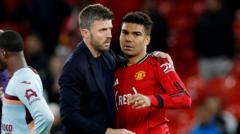
The air inside Old Trafford carries a specific weight when the European nights are absent. It is the weight of silence, of a stage set for a play that never starts. For the better part of a year, the most storied patch of grass in English football has felt like a grand ballroom with the chandeliers dimmed. But as the season tilts toward its end, the lights are beginning to flicker back to life. Manchester United stands on the precipice of the Champions League, almost close enough to touch the velvet of the anthem.
Yet, there is a ghost at the feast.
To the casual observer, the math is simple. Points on a board lead to a seat at the high table. For a club that measures its heartbeat in continental trophies, returning to Europe’s elite competition should feel like a homecoming. Instead, it feels like a heavy interrogation. Success in this sport is often a mask that hides the rot, and for those sitting in the leather chairs of the United boardroom, the impending qualification is less a finish line and more a starting gun for a series of brutal, uncomfortable choices.
Consider the man in the dugout. Erik ten Hag has spent his tenure trying to impose order on a house built on shifting sands. He has been the disciplinarian, the tactician, and at times, the human lightning rod for a decade of institutional frustration. If he secures that top-four spot, he has technically fulfilled the brief. He has dragged the giant back into the light. But football has a short memory for yesterday’s miracles when tomorrow’s requirements are so demanding.
The tension is visible in every post-match press conference. It is in the way he adjusts his tie when asked about the squad’s depth, or lack thereof. He knows what everyone else is starting to realize: the current roster is a patchwork quilt of different eras, different philosophies, and different failures. Getting this group into the Champions League is an achievement; winning it with them is a fantasy.
The Financial Tightrope
Football at this level is a game of numbers hidden behind a game of emotions. The Champions League brings a deluge of cash—television rights, gate receipts, and the kind of global visibility that keeps sponsors’ pens moving. But that money is already spent in the minds of those who see the cracks in the foundation.
The wage bill at United is a sprawling, chaotic ledger. It represents a history of panic buys and legacy contracts given to players who have long since peaked. Qualification creates a paradox. To compete with the likes of Real Madrid or Manchester City, the club must spend. To spend within the tightening constraints of financial sustainability rules, they must first purge.
This is where the human element becomes cold and clinical. There are names on that sheet—loyal servants, former stars, and expensive gambles—who no longer fit the blueprint. Moving them on is not just about clearing space on the pitch; it is about reclaiming the club's financial soul. Every week a veteran sits on the bench earning a king's ransom is a week the club loses its grip on the future.
Imagine a young scout sitting in a cold stadium in Lisbon or Dortmund, watching a nineteen-year-old phenom. He knows that player is the missing piece of the United puzzle. But he also knows that until a certain defender or a specific midfielder is moved off the books, that phenom remains a dream. The "big decisions" aren't just about who to buy. They are about who to let go, often at a loss that stings the pride of those who signed the checks.
The Identity Crisis in the Dressing Room
Culture is a word thrown around until it loses all meaning, but in a dressing room, it is the only thing that matters. For years, the United identity has been a blur. Are they a counter-attacking side? A possession-heavy machine? A collection of individuals capable of moments of magic but incapable of sustained dominance?
Ten Hag has tried to install a DNA of discipline. You see it in the benching of superstars and the promotion of hungry, albeit less experienced, youth. But as the Champions League looms, the pressure to revert to "star power" grows. The elite competition demands world-class talent, but world-class talent often comes with world-class egos.
The invisible stakes here involve the very soul of the team. If they qualify, do they double down on the manager’s rigid, collective system? Or do they chase the shiny object—the Ballon d'Or contender who might sell shirts but might also disrupt the delicate ecosystem Ten Hag has spent months cultivating?
There is a specific kind of silence that falls over a training ground when players know the hierarchy is about to shift. You can sense it in the tackles, the lingering looks at the assistant coaches, the way a player walks to his car. They know that "getting back to the top" means some of them will be left behind at the base of the mountain.
The Ownership Shadow
Hanging over every tactical tweak and every transfer rumor is the long, dark shadow of the ownership saga. For the fans, the Glazer era has been a long winter. The potential of new investment or a total sale is the hope they cling to, even as the process drags on with the agonizing pace of a legal thriller.
The timing could not be more precarious. A club needs a clear head to navigate the Champions League market. It needs a unified vision from the boardroom to the boot room. Instead, United is a house in mid-sale. Decisions that require boldness are being weighed against the uncertainty of who will be holding the keys in six months.
It is easy to look at a league table and see a team on the rise. It is much harder to look at the infrastructure—the leaking roof of the stadium, the aging training facilities, the disjointed scouting network—and realize that qualifying for Europe is like putting a fresh coat of paint on a house with a cracked foundation. The glory of the Champions League is a distraction from the work that actually needs to be done.
The Weight of Expectation
The fans are the heart of this narrative, and their relationship with the club is currently a mixture of cautious optimism and deep-seated trauma. They have seen false dawns before. They remember the post-Fergie era as a series of "rebuilds" that never actually resulted in a finished building.
For the supporters, the Champions League isn't just a tournament; it is their birthright. But there is a growing realization among the more cynical—or perhaps the more realistic—sections of the Stretford End. They know that if the club qualifies and fails to make the "big decisions" correctly, they are simply setting themselves up for a more public, more expensive humiliation on a Tuesday night in Munich or Paris.
They want the anthem. They want the lights. But they also want a team that belongs there.
The Turning Point
We are approaching a moment of truth that will define the next decade of the club. The points will likely be secured. The logo will be stitched onto the sleeves. The fans will roar as the players walk out under the floodlights.
But the real story isn't happening on the grass. It’s happening in the quiet offices where contracts are being scrutinized. It’s happening in the hushed conversations between the manager and his staff about who can be trusted when the pressure is at its peak. It’s happening in the mind of every player who wonders if his best is good enough for where this club needs to go.
The "big decisions" aren't upcoming; they are already here. They are the silent passengers on the team bus. They are the unspoken tension in the tunnel. Manchester United is coming back to the Champions League, but the version of Manchester United that arrives there must be fundamentally different from the one that left.
Success is a demanding master. It doesn't just ask for your effort; it asks for your evolution. It requires the courage to cut ties with the past, even the parts of the past that were comfortable. It requires an honesty that is often missing in the hyper-inflated world of modern football.
The lights are coming on. The stage is being set. The actors are taking their places. But as the curtain begins to rise, the question remains: is the lead actor ready for the role, or are we just watching a very expensive rehearsal for a play that has already been seen?
The answer won't be found in the final score of the season. It will be found in the ruthlessness of the summer. It will be found in the eyes of the man in the dugout when he realizes that getting back to the top was the easy part. Staying there is where the real blood is spilled.
The roar of the crowd is building, a tidal wave of sound that masks the grinding of the gears behind the scenes. Old Trafford is ready. The world is watching. The decisions are looming, and there is no longer any place to hide.
The path back to greatness is paved with the difficult choices that no one wants to make, but everyone knows are necessary.