Heinrich remembers the smell of grease and wet wool inside a barracks that smelled permanently of stale coffee and damp pine. He spent twenty-seven years wearing the uniform of the German Bundeswehr, watching grease turn to rust on tracked vehicles that spent more time on jack stands than they did on the training fields of Lower Saxony.
When Heinrich retired, he left behind a garage full of mothballed spare parts and a quiet consensus among politicians in Berlin that the long, hard winter of European history had finally ended. Tanks were relics. Borders were permanent lines drawn in ink rather than carved with bayonets. The continent had chosen trade over trenches, and for a long time, the math seemed to work. Gas flowed from the east, cheap cars rolled toward the west, and the defense budget became a convenient piggy bank to fund domestic promises. Recently making waves in this space: Anatomy of a Resource Transfer The Mechanics of the Venezuelan Oil Concessions.
Then the illusion shattered.
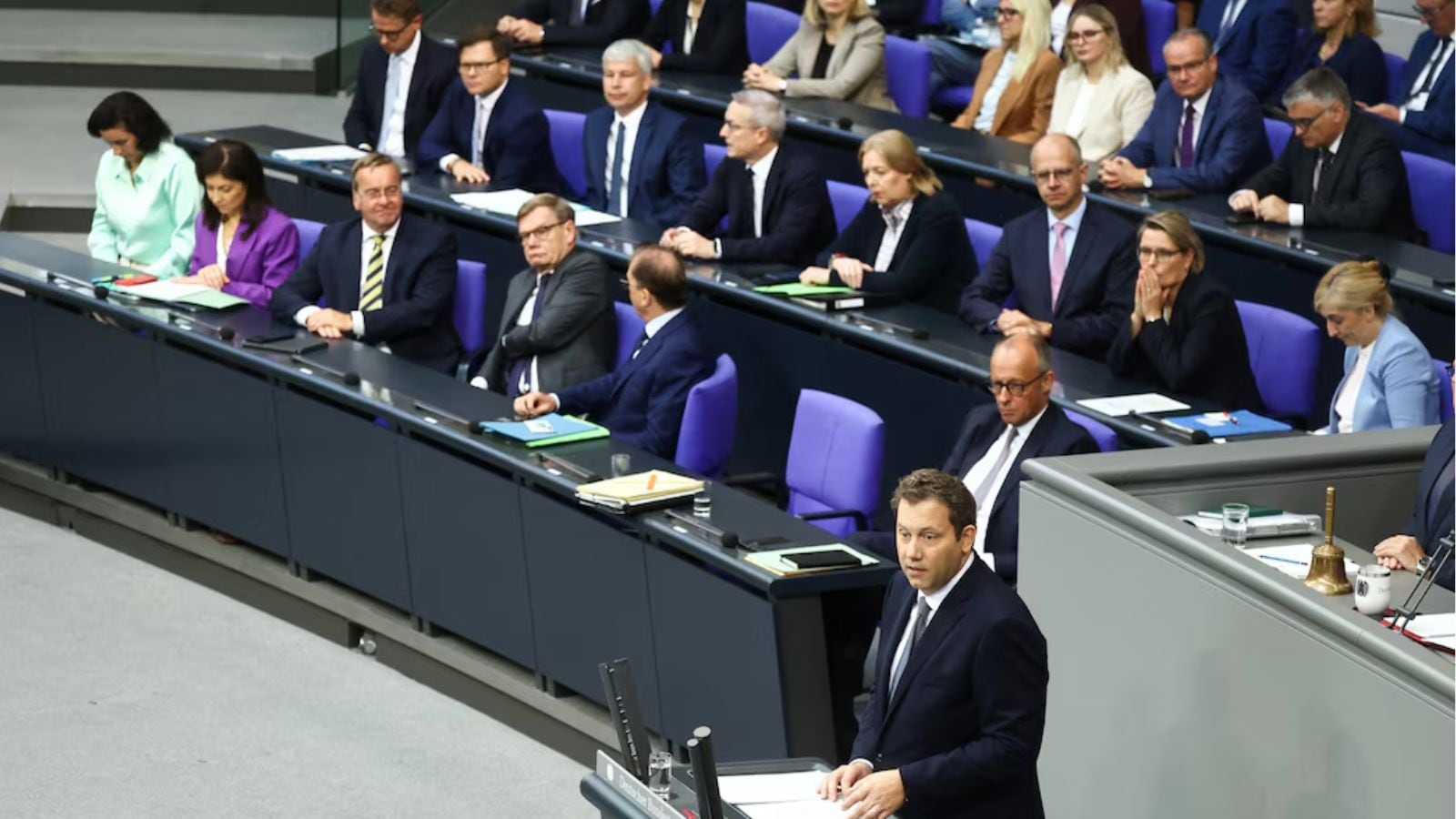
To understand why the German finance minister is now sounding alarms about new debt, you have to stand where Heinrich stood. You have to look at an artillery shell not as an abstract line item in a federal ledger, but as a perishable commodity of survival. Germany, the economic engine of Europe, finds itself staring down an uncomfortable mirror. Decades of fiscal discipline, prized like a sacred national religion, have left its military cupboards bare. The steel is aging. The radios crackle with thirty-year-old technology. The soldiers are waiting for gear that sits perpetually on backorder. Additional information on this are explored by Associated Press.
Money is the only thing standing between an industrialized democracy and strategic irrelevance. Yet, money in Berlin is bound by chains of constitutional self-restraint.
Consider the debt brake. Enshrined in the German Basic Law in 2009, this fiscal rule was born out of a desire to prevent future generations from drowning in red ink. It limits the federal structural deficit to a microscopic fraction of gross domestic product. It is a monument to prudence. But prudence, when applied to a burning house, looks a lot like paralysis.
Imagine a homeowner who refuses to take out a loan to fix a rotting roof because they promised themselves they would never carry a mortgage again. A summer storm approaches. The neighbors point out the structural flaws. The homeowner insists that thrift is the ultimate virtue, even as the ceiling begins to sag under the weight of the coming rain.
That is the current predicament of the German state.
The finance minister argues that national defense is an existential baseline, not a discretionary luxury item that can be funded out of spare change left over after social programs and infrastructure maintenance. Without borrowing—without suspending or creatively navigating the sacred debt rules that define modern German governance—the military cannot procure the modern systems required to deter an increasingly volatile neighbor.
This is where the abstract world of macroeconomics collides with human reality.
In a hypothetical workshop outside of Munich, engineers look at blueprints for drone interception technology. They have the talent. They have the industrial capacity. What they do not have is a signed contract backed by guaranteed capital. Contracts require appropriations. Appropriations require budgets. Budgets require political consensus in a fractured parliament where every euro spent on a howitzer is a euro taken away from a hospital, a school, or a pension fund.
The public feels this tension in their bones. Walk down a street in Berlin or Frankfurt, and you will hear the whispers of anxiety. People remember the twentieth century too well. They know what happens when great powers stumble, when deterrence fails, when the machinery of peace rusts into the machinery of chaos. At the same time, generations have grown up trusting that the social safety net is untouchable. Asking citizens to accept new national debt—to mortgage their children's future for the sake of soldiers they rarely see—feels like a betrayal of a peaceful pact.
Except the peace was rented, not owned.
The numbers tell a stark story, but numbers do not bleed. When military analysts point out that ammunition stockpiles would last mere days in a high-intensity conflict, they are not speaking in metaphors. They are describing a logistical vacuum. Filling that vacuum requires billions upon billions of euros spent on steel, microchips, fuel, and training. It requires factories running around the clock. It requires a fundamental shift in how a pacifist-leaning democracy perceives its place in a dangerous world.
Critics of new borrowing argue that fiscal discipline is the true bedrock of national security. A bankrupt state, they point out, cannot defend anyone. They warn that opening the floodgates of debt will trigger inflation, devalue the currency, and erode the economic strength that makes Germany powerful in the first place. It is a coherent argument rooted in the trauma of past hyperinflation and economic collapse.
Yet, the counter-argument is brutally simple. What is the value of a balanced budget if there is no country left to govern?
The finance minister is caught in the middle of this philosophical tug-of-war. He is the guardian of the vault, telling a nation that has forgotten how to be afraid that the locks are broken. He is demanding that politicians look past the next election cycle and confront the math of geopolitics.
The journey forward is narrow and steep. It requires rewriting unwritten rules. It requires convincing voters that taking on debt for defense is not an act of fiscal irresponsibility, but an insurance policy against catastrophe.
Heinrich watches the news from his kitchen table, his weathered hands wrapped around a mug of black coffee. He sees the debates on the television screen, the furrowed brows of politicians, the protests in the streets, the endless cycles of talk radio. He doesn't care much for political posturing or legalistic jargon about deficit limits. He looks at his grandson, who is currently considering whether to follow his grandfather's footsteps into the service.
He wonders if the uniform his grandson might wear will be backed by the full weight of a protected nation, or if it will be just another hollow promise stitched into fading cloth. The clock is ticking, the ledger is open, and the price of safety is waiting to be paid.