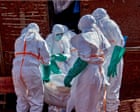
The heat in the transit hubs along the border between the Democratic Republic of the Congo and Uganda does not just sit in the air. It sticks. It weighs on the throat, heavy with the scent of red dust, exhaust fumes, and the sharp, metallic tang of anxiety.
Every single day, tens of thousands of people move through these checkpoints. Traders carry heavy sacks of cassava. Mothers balance plastic basins of fruit on their heads. Children weave through the legs of the crowds, chasing stray chickens or each other. To the untrained eye, it is just the chaotic, vibrant pulse of commerce. But to epidemiologists, this is a network of biological highways.
When a virus like Ebola hits this grid, the map lights up like an electrical short circuit.
A virus does not care about national sovereignty. It does not recognize the line where the DRC ends and Uganda begins. It only looks for a cellular doorway. When the Centers for Disease Control and Prevention announced they were moving 107 million dollars from an emergency reserve to confront the spreading threat, the headline read like a corporate accounting ledger. A dry transfer of capital.
But money in a federal bank account in Atlanta does not stop a virus. What matters is how that capital transforms into boots on the ground, plastic gloves, and infrared thermometers at a dusty outpost five thousand miles away.
Imagine a health worker named Sarah. She stands at a border crossing in western Uganda for twelve hours a day. Her uniform is a heavy, yellow gown of protective equipment that feels like a personal sauna. Her job is deceptively simple: look at hands. Look at eyes. Watch for the telltale stumble of extreme fatigue, the glassy stare of a rising fever, or the subtle tremor of a body beginning to lose its battle with a hemorrhagic fever.
If Sarah misses one person—just one trader who thinks they only have a mild malaria bout and needs to get their goods to market—the firewall breaches.
This 107 million dollars is not a gift. It is a defense budget for a war fought under microscopes.
The funding comes from a specific legislative tool: the Infectious Diseases Rapid Response Reserve Fund. It is a financial reservoir Congress created so health agencies do not have to wait for a political debate while a pathogen is actively replicating. Waiting weeks for an appropriation bill can mean the difference between a contained cluster of twelve cases and an uncontrollable multi-province disaster.
The mechanics of this response are split down two distinct lines of intervention.
First, there is active surveillance. This means paying for the fuel to send motorcycles into remote villages when a local chief reports an unusual cluster of deaths. It means buying the reagents for mobile laboratory trailers so blood samples can be analyzed in hours rather than waiting days for a courier to fly them to a capital city.
Second, it is about the cold chain. The modern vaccines used to combat Ebola require ultra-low temperature storage. They must be kept colder than a deep winter night in the Arctic. Delivering those fragile vials across tropical rainforests, where the electrical grid is a luxury and roads turn to mud rivers during the rainy season, requires immense logistical muscle. Generators, solar-powered freezers, and specialized transport cases are the literal infrastructure of survival.
The stakes are invisible until they are suddenly, catastrophically obvious.
When an outbreak gains momentum, it hollows out entire communities from the inside out. It forces hospitals to shut down because doctors and nurses are among the first to get infected. It halts trade, closes markets, and triggers a economic paralysis that can starve a region faster than the virus itself. The memory of the West African epidemic a decade ago still hangs over global health institutions like a ghost—a reminder of what happens when the international community hesitates, over-analyzes, and acts too late.
The release of these funds is an admission of vulnerability. It is a confession that isolationism is a biological impossibility. In an interconnected global economy, a pathogen in a remote forest clearing is less than twenty-four hours away from any international airport lounge.
Back at the border crossing, the afternoon storm clouds begin to bruise the sky. Sarah reaches for a new box of gloves as the next line of travelers approaches the checkpoint. The money has been approved in Washington, the press releases have been archived, and the spreadsheets have been updated. But here, where the red dirt meets the sky, the true value of that 107 million dollars is measured one person, one temperature check, and one heartbeat at a time.