The ice at Rogers Place in late June isn't ice at all. It is a concrete floor, gray and cavernous, smelling faintly of stale beer and forklift exhaust. But if you stand near the baseline where the boards usually curve into the corner, you can still feel the ghost of the winter chill. You can still hear the phantom rattle of Plexiglas.
For a professional hockey player, that empty concrete is where reality catches up. The cheering stops. The adrenaline evaporates. What remains is a piece of paper, a pen, and a five-year commitment that alters the trajectory of a human life. In similar news, read about: Why Manchester United Just Blew Their Opening Premier League Statement at Hull.
When the Edmonton Oilers announced a five-year contract extension for defenceman Connor Murphy, the sports tickers did what they always do. They reduced a man's existence to a string of digits and a salary cap hit. They spoke of structural depth, blue-line pairings, and unrestricted free agency years bought out. They treated Murphy like a highly specialized piece of industrial machinery acquired to fix a specific leak in the defensive zone.
They missed the point entirely. Sky Sports has also covered this fascinating subject in great detail.
Hockey is a game of violent velocity played by people who spend their lives trying to slow time down. To understand what this five-year extension actually means, you have to look past the spreadsheet. You have to look at the bruises that never quite fade, the quiet anxiety of a moving truck parked in a suburban driveway, and the heavy burden of playing in a city where hockey isn't entertainment.
It is oxygen.
The Long Walk to Stability
Consider the life of an NHL journeyman. Even for a high-caliber blueliner, the career is a series of temporary hotel rooms and short-term leases. You pack your life into duffel bags. Your family learns to navigate new school districts on three days' notice. Every mistake on the ice feels like a potential eviction notice.
Then comes the call.
Five years. In the lexicon of professional sports, five years is an eternity. It is a lifetime. For Murphy, a player whose career has been defined by the hard, unglamorous work of blocking shots and clearing the crease, those five years represent something far scarcer than money.
They represent gravity.
Imagine the psychological shift that occurs when the background noise of career insecurity suddenly falls silent. A five-year deal means you can buy a house. It means your kids can make friends they won't have to say goodbye to next April. It means when you take a puck off the ankle in January, you don't have to hide the fracture from the medical staff out of fear that a dip in your performance will cost you your next contract. You can heal. You can breathe.
But that security comes with a hidden tax. The moment the ink dries on a long-term extension in Edmonton, the relationship between the player and the community changes. You are no longer a guest. You are an investment. And in a town that remembers the glory of five Stanley Cups like they happened yesterday, the expectations are suffocating.
The Anatomy of a Defensive Heartbeat
The casual fan watches the puck. They follow the blinding speed of the superstars, the poetic cross-ice passes, the explosive snipes into the top corner.
The purist watches the dark spaces.
Defending in the modern NHL is an exercise in controlled panic. The game moves too fast for conscious thought. A puck leaves a stick at over one hundred miles per hour. A two-hundred-pound winger bears down on you at twenty-five miles per hour with his elbows up. If you stop to analyze the geometry of the play, you have already lost.
Instead, players like Murphy rely on muscle memory and an internal clock that ticks in milliseconds. It is about the subtle angling of the hips to force a forward toward the boards. It is about using a stick blade to disrupt a passing lane by a fraction of an inch. It is an art form of erasure. When a stay-at-home defenceman plays a perfect game, you barely notice he was on the ice. He neutralizes danger before it becomes a highlight reel.
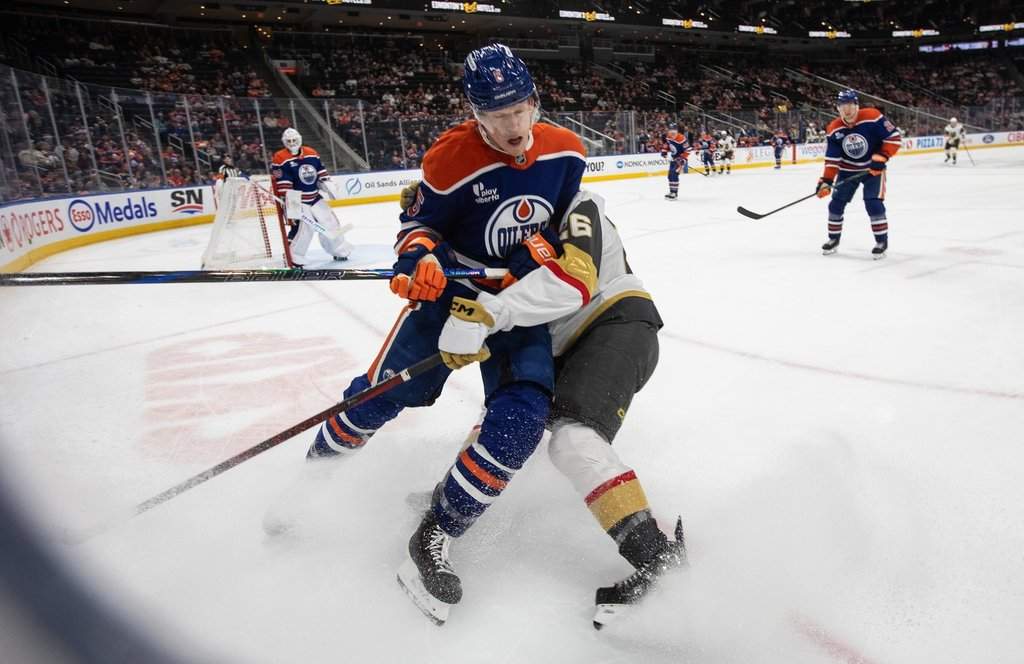
But erasure is exhausting. It requires a willingness to subject one's body to a nightly demolition derby. Every blocked shot is a calculated gamble against bone density. Every battle along the boards is a wrestling match where the floor is solid ice and the walls are hard plastic.
By locking Murphy down for five years, the Oilers management isn't just buying goal prevention. They are buying a culture of sacrifice. They are sending a message to the rest of the dressing room: this is the tax required to win. We value the bruises as much as the goals.
The Heavy Northern Sky
There is a unique pressure that comes with playing hockey in Canada, but Edmonton is a distinct crucible. The winters are long, dark, and bitterly cold. The sun dips below the horizon before the afternoon rush hour even begins.
During those freezing months, the arena becomes the literal and figurative center of the city's emotional life. If the Oilers win on a Tuesday night, the entire city feels a collective lift on Wednesday morning. The barista smiles. The traffic feels a little lighter. If they lose, a gray pall hangs over the streets.
To wear the blue and orange for half a decade is to accept a role in this civic drama. You cannot hide in Edmonton. You cannot slip away to a quiet restaurant after a bad game and expect to be left alone. The people in the grocery store know your plus-minus rating. The guy pumping your gas has opinions on your gap control.
Some players break under that scrutiny. They prefer the anonymity of sunbelt markets where they can walk the beach unnoticed after a loss. They want the paycheck without the passion.
By committing to a five-year extension, Murphy has looked that intense, obsessive hockey culture in the eye and said yes. He has chosen the pressure. He has embraced the freezing dark of northern Alberta because he knows that if you win here, you are immortal.
The Calculus of the Window
The Oilers are a team operating in a very specific temporal window. They possess generational talents at the peak of their powers, but peak performance is a perishable commodity. The clock is ticking. Every season that doesn't end with a parade is a massive, irreplaceable opportunity squandered.
Management cannot afford to experiment. They cannot waste years waiting for prospects to develop the defensive awareness that only comes from hundreds of games in the NHL trenches. They need certainty. They need a known quantity who can log twenty tough minutes a night against the opponent's top line without blinking.
This contract extension is a manifestation of that urgency. It is an acknowledgment that while flair wins headlines, structure wins championships.
Look at what happens to teams that neglect the unsexy elements of their roster. They fly high in October, scoring goals at will, looking invincible. But when April arrives, and the referees put their whistles away, and the space on the ice shrinks to the size of a postage stamp, those teams crumble. They get pushed off the puck. They lose the battles in front of the net. They get eliminated by teams that know how to suffer.
Murphy is an insurance policy against that fragility. He is the anchor thrown into the storm to keep the ship from drifting into the rocks.
The Silent Pact
When the news broke, the radio talk shows immediately began analyzing the cap hit. Callers debated whether the team paid a fraction too much or if the term was a year too long. They used terms like efficiency and asset management.
But hockey isn't played on a spreadsheet, and it isn't decided by accountants.
It is decided by twenty people in a room who have agreed to pull in the exact same direction, regardless of the cost. When a player signs a five-year deal, he isn't just entering a contract with an owner. He is entering a silent pact with his teammates. He is telling them that he is in the trenches with them for the long haul. He is saying that their broken bones are his broken bones, and their triumphs are his triumphs.
The concrete floor of Rogers Place will soon be covered in ice once again. The lines will be painted crisp and bright. The logos will be frozen into place. And when the puck drops on a cold November night, the statistics will fade into the background.
What will remain is a veteran defenceman standing on his own blue line, looking down the ice at a rushing forward. He will adjust his grip on his stick. He will angle his shoulders. He will prepare for the collision, knowing exactly where he belongs for the next five years.