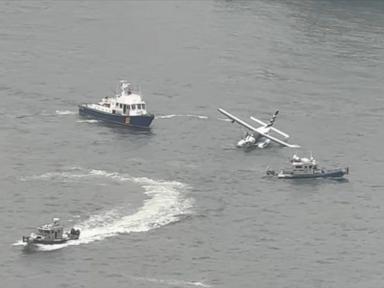
The local news loves a weeping commuter. Give them a minor mechanical hiccup, a splash of river water, and a handful of shaken tech executives on an East River pier, and you have a viral headline.
The recent collective meltdown over a seaplane making a "hard landing" in New York City is a masterclass in public ignorance. Passengers spoke to cameras with trembling voices, recounting the horror of a sudden, jarring thud. The media framed it as a near-catastrophe, a terrifying brush with mortality for the elite flying into Manhattan from the Hamptons.
It is a lie.
That jarring thud did not almost kill them. It saved them.
The lazy consensus surrounding amphibious aviation treats every non-pillowy touchdown as a pilot error or a structural failure. In reality, a crisp, aggressive, and decidedly firm impact with the water is often the exact mechanical choice required to prevent a catastrophic event. If you are flying in a floatplane, you should pray for a hard landing. A soft one is how you flip upside down and drown.
The Physics of Fluid Dynamics Do Not Care About Your Comfort
Asphalt is predictable. Water is a treacherous, constantly shifting fluid matrix. When a standard commercial jet touches down on a runway, the tires transition from static friction to kinetic friction on a flat plane.
When a floatplane meets a river, it is dealing with hydrodynamic drag, surface tension, and micro-swells.
Every floatplane hull or pontoon is designed with a specific geometric feature known as the "step." This is a sharp break in the profile of the float's bottom. The entire purpose of the step is to break the surface tension of the water, allowing the aircraft to rise up on the step and eventually take flight, or conversely, to decelerate without turning into a submarine.
Imagine a scenario where a pilot tries to grease a landing on choppy water, touching down as gently as possible to avoid spilling a passenger's iced matcha latte.
The floats skim the surface lightly. The surface tension of the water does not break. Instead of penetrating the surface layer and establishing stable hydrodynamic tracking, the floats act like a stone skipped across a pond. The aircraft skips, loses aerodynamic lift, stalls out a few feet above the water, and drops like a safe.
Worse, if the nose of the floats catches a wave at a soft, shallow angle, the water grips the aluminum skin with immense suction. This creates an immediate pivoting moment. The tail comes up, the nose digs in, and the entire aircraft flips inverted in a split second.
A hard landing is a decisive landing. It forces the floats through the surface tension, establishes immediate hydrodynamic drag, and anchors the aircraft safely into the water column. It rattles your teeth, but it keeps the wings pointing toward the sky.
The Myth of the Traumatized Passenger
We have fostered a culture of hyper-fragility in commercial transit. Passengers expect an aluminum tube traveling at 140 miles per hour to settle onto the earth like a feather dropping onto a velvet couch. When that expectation meets the realities of regional utility aviation, the result is performative trauma.
I have spent two decades analyzing regional aviation logistics and accident data. The NTSB records are clear: true amphibious accidents in urban waterways rarely stem from firm touchdowns. They stem from pilot hesitation, shifting winds, and wake encounters from maritime traffic.
Yet, when the East River flight came down firmly, the immediate reaction was an outcry over safety protocols.
Let us look at the data the panic-mongers ignore. The aircraft in question—typically a Cessna Caravan or a Twin Otter on floats—is built like an agricultural tractor. These are not delicate composite jets. They are rugged utility vehicles designed to operate in the Alaskan bush, landing on un-surveyed glacial lakes and rough coastal waters. Their rigging is over-engineered to absorb massive vertical loads.
A hard hit on a river might feel violent to an executive who spends their day sitting in an ergonomic chair, but to the airframe, it is just Tuesday. The landing gear struts and float spreader bars are engineered to flex and dissipate that energy. The fact that the plane taxied to the pier under its own power proves the structure functioned exactly as intended. The only things bruised were egos and expectations.
The Real Threat Is Not the Air, It Is the Water
The media fixates on the sky because planes are dramatic. But if you want to look at the real danger in urban amphibious aviation, look down. The East River is not an airport; it is an unregulated, chaotic marine circus.
While commercial pilots operating out of a designated Seaplane Base are bound by strict FAA regulations, rigid checklist disciplines, and mandatory drug testing, the waterway itself is populated by an array of amateurs. On any given afternoon, a seaplane pilot trying to manage a landing profile must contend with:
- Commuter ferries throwing massive three-foot wakes at irregular intervals.
- Private yachts operating without a clear understanding of aviation right-of-way rules.
- Jet skis darting blindly across the landing lanes.
- Floating debris, logs, and urban refuse capable of tearing open a buoyancy chamber.
When a pilot is on final approach into this environment, they do not have the luxury of aiming for a smooth ride. They are hunting for a clear patch of water between wakes and wakes-creators. If they find a clean window, they must plant the aircraft down immediately and aggressively to claim that space before a ferry cuts them off.
A smooth, protracted flare where the plane floats above the water for hundreds of yards is an extreme hazard. It increases the exposure time to hidden wakes and surface debris. A rapid, firm planting of the floats limits the landing footprint and brings the aircraft under marine control faster.
The public scolds the pilot for a rough ride, completely blind to the fact that the pilot just threaded a needle between a Circle Line cruise boat and a rogue piece of dock timber.
Stop Treating Commuter Aviation Like a Luxury Spa
The fundamental misunderstanding comes down to branding. Because seaplane services in major metropolitan areas charge premium prices, passengers mistake the high fare for a luxury guarantee. They assume that paying five hundred dollars for a twenty-minute flight entitles them to a seamless, sensory-deprived transit experience.
This is a delusion. You are paying for time, not luxury.
You are paying to bypass hours of gridlock on the Long Island Expressway or the Midtown Tunnel. You are buying a shortcut through three-dimensional space. The vehicle delivering this shortcut is a high-wing turboprop strapped to two giant aluminum pontoons. It is loud, it is bumpy, and it reacts violently to wind shear.
If you want a sterile, cushioned environment, stay in the back of an Uber Black and spend three hours breathing exhaust fumes on the bridge. If you choose to land on a tidal estuary in a machine heavy enough to crack concrete, accept the mechanical reality of your choice.
Amphibious aviation is an exercise in compromise. To make a plane fly off water, you must strip away the heavy shock absorbers of land-based gear and rely on the shape of the hull to manage deceleration. It is raw physics, unvarnished by corporate PR.
The next time you strap into a commuter floatplane and feel the aircraft slam into the river with enough force to drop your phone from your hands, do not rush to file a complaint or call a news desk. Take a breath. Look out the window at the upright horizon. And recognize that the bone-shaking impact you just felt was the sound of engineering working exactly the way it was designed to keep you alive.