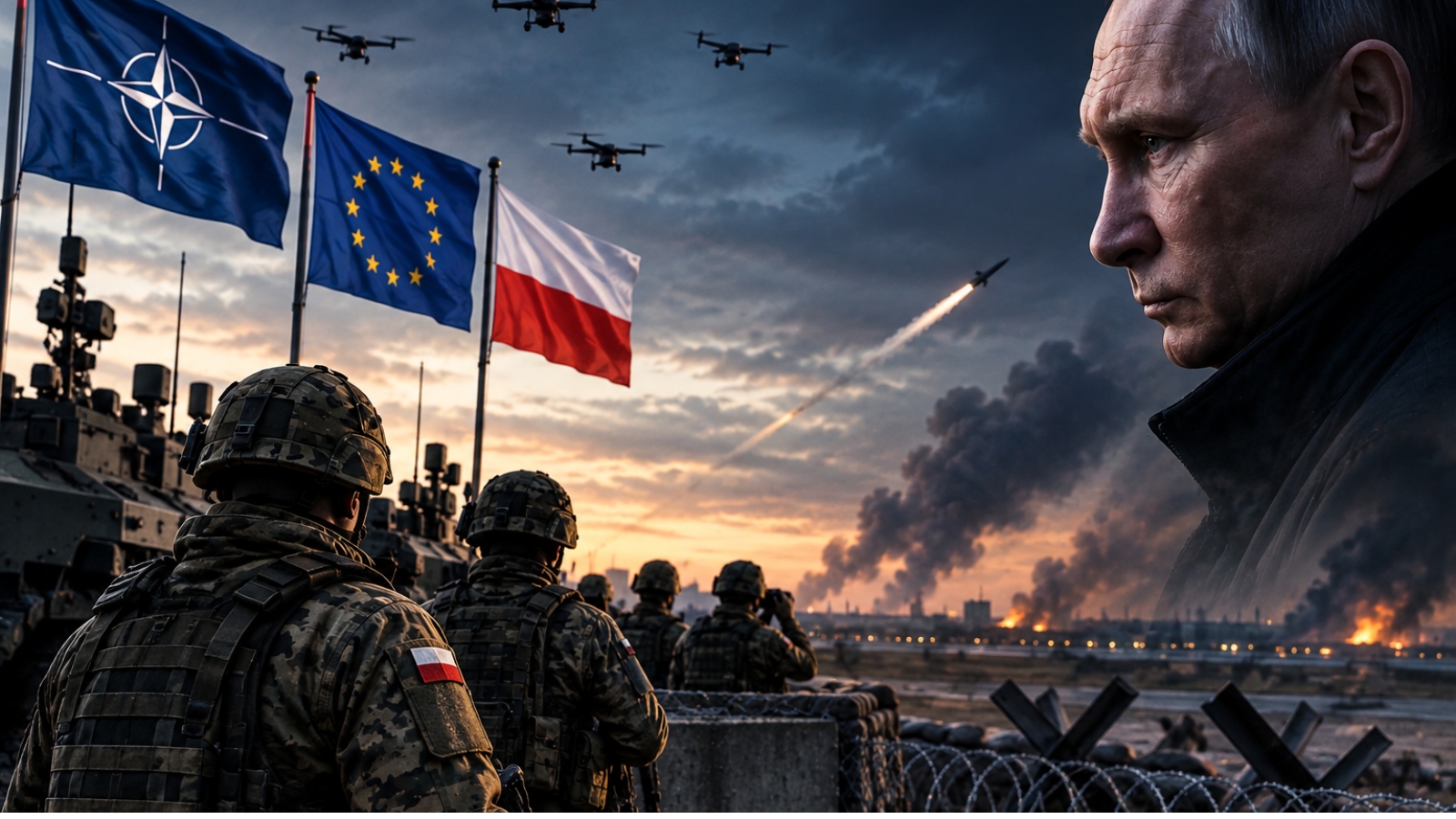
Every desk in Brussels and Paris is currently buried under crisis memos detailing how Moscow is supposedly about to bleed across NATO borders. Warsaw increases defense spending to numbers that would have seemed insane five years ago, while French officials grandstand about European strategic autonomy, warning that the eastern flank is buckling. The mainstream narrative treats this as an imminent conventional invasion, a 1939 rerun waiting for a green light from the Kremlin.
It is a comfortable delusion. It allows defense contractors to secure multi-year procurement pipelines and politicians to play wartime statesmen without facing the messy, unglamorous reality of how modern conflict actually operates.
Russia is not planning a pan-European tank charge through the Fulda Gap. That theater died the day drone operators started turning multi-million-dollar armor into scrap metal with off-the-shelf electronics. The spillover everyone is panicking about—the stray missiles, the border friction, the nervous saber-rattling—is noise. The real war crossed into European capitals years ago, and Western intelligence agencies are losing it while staring blindly at the Polish border.
The Lazy Consensus and Why It Collapses
The foundational premise of the current European security panic is that escalation works on a linear dial. Turn it up, and you get a wider conventional war. But escalation is no longer a dial; it is a fractured grid of gray-zone subversion, infrastructure sabotage, cyber infiltration, and weaponized migration.
When Warsaw raises the alarm over airspace violations or minor border incursions, it treats them as precursor indicators of a massive territorial push. This is a category error. Russia does not need to occupy Berlin or Warsaw to achieve its strategic objectives. It needs to paralyze decision-making, exhaust European treasuries through defensive over-allocation, and break the political consensus holding the European Union together.
I have watched policy shops spend millions modeling conventional cross-border artillery duels while their own fiber-optic cables and subsea power grids sit completely exposed to sabotage that leaves no diplomatic footprint. The panic over a kinetic spillover is a brilliant misdirection—and Western capitals are falling for it hook, line, and sinker.
The Mechanics of Real Subversion
To understand why France and Poland are looking in the wrong direction, you have to look at the anatomy of modern asymmetric pressure. Kinetic war is expensive, messy, and triggers automatic Article 5 tripwires. Sub-threshold warfare is cheap, deniable, and devastatingly effective.
Consider how state-backed actors manipulate migration routes across the Belarusian and Russian borders into Poland and the Baltics. This is not a humanitarian crisis engineered by accident; it is an ergonomic weapon designed to test border enforcement limits, drain fiscal resources, and inflame domestic political polarization. When Poland militarizes its frontier with razor wire and riot police, it solves a tactical optics problem while walking straight into a strategic trap. Every euro spent on static border walls is a euro not spent on electronic warfare resilience, counter-intelligence, or domestic grid hardening.
Meanwhile, in Western Europe, the threat matrix is entirely different. France loves to talk about sovereign defense capabilities, yet French critical infrastructure remains vulnerable to cyber campaigns that quietly map operational control systems. You do not need to drop a bomb on a Parisian water treatment plant if you can corrupt its telemetry data or lock its valves remotely with zero attribution. The French defense establishment treats cyber and kinetic threats as separate administrative domains, an institutional failure born of bureaucratic inertia.
The Cost of Misdiagnosing the Threat
When governments misdiagnose a threat, they misallocate capital. The current European military buildup is heavily skewed toward legacy hardware—heavy armor, artillery shells, and traditional air defense batteries. While these are necessary for high-intensity territorial defense in Ukraine, treating them as the universal panacea for European security is strategic malpractice.
If you prepare to fight yesterday's war while your adversary is executing a multi-domain campaign involving information warfare, economic coercion, and industrial sabotage, you will win the specific battle you prepared for while losing the war you are actually in.
The honest truth that no defense minister wants to admit is that Europe’s current security architecture is brittle. It is built for a world of nation-state transparency that no longer exists.
Rewriting the Playbook
If Poland and France actually want to secure themselves against modern spillover, they need to abandon their obsession with conventional border alarms and execute three radical shifts:
First, dissolve the artificial wall between domestic intelligence and military defense. In a gray-zone conflict, a compromised logistics hub or a corrupted municipal utility network is a military target. Intelligence sharing across European borders remains plagued by institutional paranoia and sovereignty-guarding. Until domestic police forces, intelligence services, and military commands share a unified operational picture in real-time, Russia will continue to operate with impunity in the gaps between agencies.
Second, pivot defense spending away from long-lead legacy platforms toward resilient, decentralized infrastructure. A massive fleet of main battle tanks is useless against economic warfare, targeted arson of logistics centers, or GPS spoofing over the Baltic Sea. Resilience means redundancy, decentralized energy grids, and hardened supply chains.
Third, stop reacting to every tactical provocation with strategic panic. Escalation dominance requires cold calculation, not theatrical outrage. When political leaders scream about every minor airspace brush, they hand the adversary free psychological leverage, signaling weakness and internal panic to foreign capitals.
The security of Europe will not be decided in the trenches of the eastern borderlands. It will be decided in corporate boardrooms, server farms, intelligence cells, and energy ministries across the continent. Until Paris, Warsaw, and the rest of the European security apparatus wake up to that reality, they are just shadowboxing while the real damage is already done.