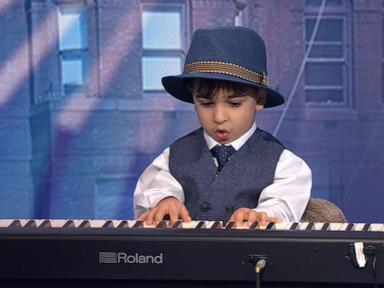
Watching a four-year-old mimic a Chopin Nocturne isn't a miracle. It’s a mechanical feat of muscle memory, no different from training a Border Collie to fetch a very specific set of slippers. We see a toddler’s tiny fingers fly across ivory keys and we rush to label them a "prodigy," a "genius," or a "once-in-a-generation talent."
We are wrong.
By celebrating the parlor trick of early childhood virtuosity, we are actually devaluing the very art form we claim to admire. The viral obsession with "baby Mozarts" ignores a fundamental truth about music: technical proficiency without lived experience is just high-fidelity noise.
The Mimicry Trap
Most people see a child playing Liszt and assume they are witnessing a profound connection to the divine. In reality, you are witnessing the result of thousands of hours of repetitive stress. At four years old, the human brain hasn't even developed the executive function required for complex emotional nuance.
When a child "perfects" a tune, they aren't interpreting the music. They are executing a sequence. They are a biological player piano.
The industry loves these stories because they sell. They provide a "feel-good" dopamine hit for a public that prefers spectacle over substance. But I have spent decades in the orbit of conservatories and high-level performance circles. I have seen the "prodigies" hit age fifteen and realize they have no voice of their own. They have spent their formative years being puppets for ambitious parents and teachers, and when the novelty of their age wears off, they are left with a skill set that is entirely derivative.
Complexity is Not Artistry
There is a massive difference between technical difficulty and artistic merit.
- Kinesthetic Accuracy: The ability to hit the right note at the right time. This can be taught to almost anyone with enough repetition.
- Interpretative Depth: The ability to understand the harmonic tension, the historical context, and the emotional weight of a piece. This cannot be taught to a preschooler.
When we applaud a four-year-old for "perfecting" a tune, we are lowering the bar for what "perfection" means. Perfection in music isn't about zero missed notes. It’s about the spaces between the notes. It’s about the phrasing that makes a listener catch their breath. A toddler lacks the life experience to understand grief, longing, or triumph—the very ingredients that make the Great Works "great."
If you want to see a master at work, watch a 70-year-old pianist play a simple C-major scale. The weight, the intention, and the resonance in that single scale will outweigh every flashy arpeggio a child prodigy can muster.
The Cost of the Early Start
The "prodigy" narrative isn't just annoying; it’s destructive. We are witnessing a trend of "musical specialization" that mirrors the "sports specialization" crisis in youth athletics.
Research into neuroplasticity suggests that while the "window" for language and music is open early, forced hyper-focus on a single instrument can lead to cognitive rigidity. We are trading a child’s broad-based creative development for a singular, marketable skill.
I’ve watched families dump tens of thousands of dollars into elite coaching for toddlers, hoping to catch the lightning of a concert career. They cite the "10,000-hour rule," a concept popularized by Malcolm Gladwell that has been widely misinterpreted. Gladwell wasn't suggesting that 10,000 hours of mindless repetition makes you a genius; he was highlighting the role of opportunity and deliberate practice.
Forcing 10,000 hours of piano onto a child before they reach puberty doesn't create a master. It creates a burnt-out teenager who hates the sound of a metronome.
The Wrong Questions We Ask
People often ask, "How can I tell if my child is a prodigy?"
That is the wrong question. The right question is: "Why does it matter?"
If the goal is to "perfect tunes" by age four, you are treating music like a video game. You are looking for high scores, not high art. If the goal is to cultivate a lifelong love of expression, then the speed at which they master a repertoire is irrelevant.
- Premise: "They have a gift from God."
- Truth: They have a high degree of neuroplasticity and likely a parent who doesn't let them play outside.
- Premise: "They are the next Mozart."
- Truth: Mozart was a freak of nature, but he also lived in an era where music was the primary form of entertainment and intellectual pursuit. Even he struggled with the "child star" transition into adulthood.
The Professional Reality
The classical music world is littered with the corpses of former prodigies. The transition from "cute kid who plays fast" to "serious adult artist" is a valley of death.
To survive that transition, an artist needs more than fast fingers. They need:
- An understanding of music theory (which requires a level of abstract thinking most four-year-olds don't possess).
- A personal philosophy.
- The resilience to handle a world that no longer finds their age impressive.
When we over-hype these children, we set them up for a massive identity crisis. When the applause fades because they are now twelve and "just another good pianist," the psychological fallout is devastating.
Stop Clapping for the Wrong Reasons
We need to stop sharing these videos as if they represent the pinnacle of human achievement. They represent a specific type of disciplined training, yes. They represent impressive motor coordination, sure. But they do not represent the "perfection" of music.
If we want to support the arts, we should stop obsessing over the age of the performer and start focusing on the quality of the performance. We should celebrate the student who struggles with a piece but eventually finds their own unique way to play it, rather than the one who can photocopy a recording with their hands.
The "prodigy" is a product. The "musician" is a person.
We have enough products. We need more people who actually understand why the music was written in the first place. Put the camera away, let the kid go play in the dirt, and stop pretending that a four-year-old has anything meaningful to say about the human condition through a Steinway.
Music is a marathon, not a sprint to the first viral video.