A standard sporting dream doesn't usually end with an 11-hour interrogation in a windowless room at Miami International Airport. But for Omar Abdulkadir Artan, Africa's top football match official, that was exactly the breaking point.
The 34-year-old was set to make history as the first Somali referee to officiate at a FIFA World Cup. Instead, he found himself flying back to Istanbul, caught in the geopolitical machinery of strict immigration policy. Meanwhile, you can explore similar events here: The Political Economy of Sports Promotion: Analyzing the UFC White House Partnership.
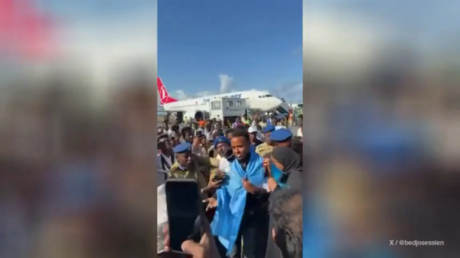
When he touched down at Aden Abdulle Osman International Airport in Mogadishu, the vibe wasn't one of defeat. It was a massive celebration. Thousands of fans, national team players, and government ministers packed the tarmac and the stadium, turning a bureaucratic rejection into a masterclass in national pride.
The Tarmac interrogation that broke a dream
Artan arrived in Miami over the weekend with everything that should have guaranteed safe passage. He had a valid tournament visa processed in Kenya. He held a diplomatic passport from his government. He had official FIFA credentials. To understand the bigger picture, check out the detailed report by Yahoo Sports.
None of it mattered. U.S. Customs and Border Protection pulled him aside for what they called an "additional inspection."
For 11 grueling hours, border agents grilled Artan. They didn't ask much about offside rules or VAR protocols. They asked about Somali politics. They asked about al-Shabab, the militant group fighting an insurgency in the region. Artan showed them photos of his refereeing career. He showed them official FIFA documentation.
The response was a one-way ticket back to Turkey.
The Trump administration later justified the move, pointing to strict vetting rules. An administration official confirmed that border agents uncovered what they termed "derogatory information," specifically alleging an "association with suspected members of terror organizations."
CBP Commissioner Rodney Scott doubled down on the decision. "I don't really care what you do for a living," Scott noted during a Washington event. "The law is still the law. If you don't meet the qualifications to come into the country, we're not letting you in just because we want you to referee a game."
Why the security narrative misses the mark
To anyone familiar with global football governance, the U.S. government's narrative feels incredibly thin. Artan isn't a random traveler. He is the Confederation of African Football's (CAF) Referee of the Year for 2025.
To reach that level, officials undergo immense scrutiny from both regional bodies and FIFA. You don't get to run lines or blow whistles in major international matches if you are a security threat.
The reality points toward a broader systemic hurdle. Somalia is one of 12 nations facing near-total travel restrictions under current U.S. policy. While the administration promised exemptions for World Cup athletes and staff, individual border agents retain absolute discretion at the gate.
Isse Aden Abshir, a senior adviser to the Somalia sports ministry and former national team captain, hit the nail on the head. He noted that the rejection likely stems from sweeping national restrictions rather than any credible, individual accusation against Artan. It is a classic case of guilt by geography.
FIFA walks away while Mogadishu steps up
If you expected football's global governing body to fight for its own, you haven't been paying attention to modern sports politics. FIFA washed its hands of the situation almost immediately.
Because all 52 refereeing pairs need to train together at a central hub in Miami, Artan's inability to step foot on American soil meant an automatic removal from the tournament roster.
"FIFA is not involved in host country immigration processes," a spokesperson stated, effectively closing the book. FIFA leadership has spent years building close ties with the U.S. government to ensure a smooth multi-nation tournament. They weren't about to risk that political capital for a single referee from East Africa.
But where FIFA chose bureaucracy, the Somali public chose solidarity.
The scene in Mogadishu on Wednesday was electric. Patriotic songs blasted through the stadium. Fans waved the sky-blue national flag, completely drowning out the disappointment of the previous days.
Prime Minister Hamza Abdi Barre hosted Artan personally, making it clear that the country viewed the referee's selection as a historic victory, regardless of what happened in Miami.
Artan handled the moment with absolute class. Standing before the roaring crowd, wrapped in his national flag, he didn't sound like a victim.
"Somalia belongs to us, whether it is in a bad state or a good state," Artan told the crowd. "That flag belongs to us, and that passport belongs to us. I want the Somali public to take comfort in this and remain confident. I promise you, God willing, that I will attend the next one."
The real cost of political football
This situation exposes a massive flaw in how major sporting events are hosted. When countries win the right to host a World Cup, they supposedly guarantee entry to the qualified participants. If a host nation can selectively bar elite officials or athletes based on sweeping geopolitical bans, it destroys the concept of competitive integrity.
Artan isn't the only one feeling the squeeze. Several Iranian football officials have faced massive visa delays, and an Iraqi player was recently detained at O'Hare International Airport. The tournament is supposed to be a global celebration, but the entry points are acting like political filters.
The lesson here is simple. You can bar an elite official from entering your borders, but you can't strip away the respect he earned on the pitch. Omar Artan went to the U.S. as a historic refereeing candidate, but he returned to Somalia as something far bigger: a national icon who reminded his country that their dignity isn't subject to approval by foreign border agents.
Keep an eye on the CAF Champions League and upcoming international qualifiers. Artan will be back on the pitch, blowing his whistle and proving exactly why he belonged on the world stage in the first place. Turn your attention to the local leagues and continental matches where true talent operates without needing a political stamp of approval.