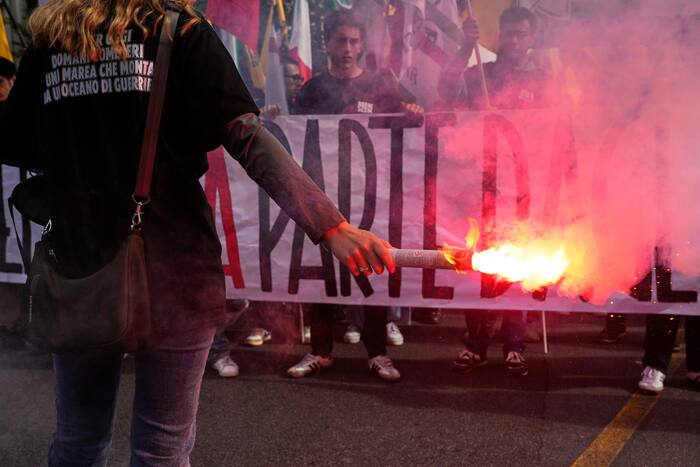
Seeing armored vehicles and camouflage fatigues outside the Duomo di Milano always triggers the same knee-jerk reaction on social media. People see headlines about hundreds of soldiers sent to Milan as protests are planned across Europe, and they immediately assume martial law is imminent.
They're wrong. Dead wrong.
If you actually spend time covering European security policy—or even just talking to locals walking past Milano Centrale—you realize military deployments in Italian cities aren't a sudden panic button. They're part of a massive, years-long logistical machine that most international news outlets completely misread when protests heat up.
Why Italy Deploys Troops During European Protests
Let's clear up the biggest misconception first. When Rome sends hundreds of soldiers into Milan ahead of continent-wide demonstrations, those troops aren't there to act as riot police. They don't carry tear gas launchers, they don't charge crowds with batons, and they aren't making arrests on street corners.
That's the job of the Polizia di Stato and the Carabinieri.
Instead, the Italian Army operates under a long-standing domestic security framework known as Operation Safe Streets (Operazione Strade Sicure). Launched back in 2008, this mission puts thousands of military personnel across major Italian cities to guard static, high-value targets. Think train stations, embassies, synagogues, airports, and iconic landmarks like the Galleria Vittorio Emanuele II.
Here is the real math behind a troop surge during major European protests. When intelligence agencies warn of coordinated demonstrations across capitals like Paris, Berlin, Brussels, and Milan, local police forces get stretched thin. Every cop standing guard outside a consulate or a subway hub is a cop who can't manage crowd control along a protest route.
By shifting hundreds of soldiers to stand watch over critical infrastructure, the Interior Ministry frees up regular police units to handle the actual demonstrations. It's a manpower shell game, plain and simple.
The Difference Between Static Guard Duty and Crowd Control
Most casual observers lump everyone in a uniform together, which leads to terrible reporting. In Italy, the legal boundary between military duties and public order policing is razor-sharp.
Soldiers deployed under Operazione Strade Sicure hold the legal status of agenti di pubblica sicurezza (public security agents), not judicial police. They can check IDs, detain someone actively committing a violent crime until police arrive, and protect physical perimeters. They cannot investigate crimes, and they aren't trained for dynamic riot suppression.
Honestly, putting regular infantry in the middle of a volatile street protest is a recipe for disaster, and Italian commanders know it. That's why the Carabinieri—who are technically a military branch with full policing powers—and specialized riot squads from the Polizia di Stato take the front lines whenever marches turn tense. The army stays back at the sensitive sites.
What Fuels the Wave of Protests Across Europe
You can't look at troop movements in northern Italy without looking at the broader pressure cooker across the European Union. Protests rarely happen in a vacuum. When demonstrations are scheduled simultaneously across multiple European cities, they usually stem from overlapping economic, geopolitical, and environmental flashpoints.
Across the continent, demonstrators have repeatedly mobilized over several core issues:
- Cost-of-living and inflation squeezes: Even as headline inflation cools compared to the spikes of 2022 and 2023, housing costs and energy bills in cities like Milan, Paris, and Munich remain brutally high relative to stagnant wages.
- Agricultural and climate policy clashes: Farmers from France to Italy have spent recent years blockading highways and dumping produce outside government buildings to protest EU Green Deal regulations, rising fuel taxes, and cheap foreign imports.
- Geopolitical solidarity marches: Major foreign policy crises—whether involving conflicts in the Middle East or ongoing support for Ukraine—routinely bring tens of thousands of people into European city centers on short notice.
- Labor union strikes: In Italy specifically, transport and public sector unions call scioperi (strikes) with clockwork regularity, often pairing transit shutdowns with street rallies in Milan's Piazza Fontana or Piazza della Scala.
Milan sits right at the crossroads of all these tensions. It's Italy's financial engine, a major European transit hub, and home to dozens of foreign diplomatic missions. If an activist network wants international media coverage, Milan is always on the short list.
The Real Impact on Milan Residents and Travelers
If you're living in Milan or passing through during a high-alert protest weekend, what does an influx of hundreds of soldiers actually mean for your day? Usually, much less than cable news makes it sound.
Life in the city keeps moving, though friction points definitely pop up. You'll notice heavier screening around Milano Centrale, Piazza del Duomo, and Porta Garibaldi. Commuters often face sudden metro station closures—especially at Duomo, Cordusio, or Cairoli—when prefecture officials decide to reroute marches away from sensitive buildings.
For travelers, the biggest headache isn't the soldiers standing quietly near the ticket gates. It's the transit disruption. A coordinated European day of action frequently overlaps with local union walkouts, turning a routine 20-minute subway ride into a two-hour trek on foot.
Businesses in the historic center also take precautions. Luxury boutiques along Via Montenapoleone and banks near Piazza Cordusio routinely pull down metal shutters hours before a march begins, even when organizers promise a peaceful rally. Better safe than replacing shattered plate glass.
Why Media Coverage Gets European Security Wrong
The biggest flaw in how English-language outlets cover European deployments comes down to framing. Because the competitor URL for this topic isn't accessible—and many viral posts strip away context—readers are left filling in the blanks with their own assumptions.
In the United States or the UK, sending hundreds of soldiers into a major financial city is an extraordinary, last-resort measure. Think National Guard deployments during major civil unrest. Because readers bring that mental model to European news, a routine reinforcement of Operazione Strade Sicure sounds like the city is on the brink of collapse.
In continental Europe, military presence in public transit hubs has been normalized for nearly two decades. France runs Opération Sentinelle, which keeps thousands of soldiers patrolling train stations, airports, and tourist sites year-round. Belgium has used similar deployments in Brussels. Italy's Strade Sicure has operated continuously since 2008, with parliament regularly renewing and adjusting troop caps between 5,000 and 7,000 personnel nationwide.
When tensions rise ahead of planned European protests, boosting Milan's contingent by a few hundred troops is basically turning a dial from six to eight. It's a calculated preventive move, not an emergency breakdown of civil order.
The Political Debate Inside Italy
That doesn't mean everyone in Italy loves the strategy. Far from it. Inside Rome, the deployment of soldiers on city streets sparks fierce arguments every time the budget comes up for renewal.
Critics—including several military unions and opposition lawmakers—argue that standing outside a train station for eight hours a day ruins combat readiness. Soldiers trained for mechanized warfare or international peacekeeping end up doing monotonous static guard duty. Military union representatives have pointed out for years that continuous domestic deployments strain personnel rotation and burn out troops who didn't enlist to act as glorified security guards.
On the flip side, mayors across northern Italy—regardless of party affiliation—constantly beg the Interior Ministry for more soldiers, not fewer. Municipal leaders love Strade Sicure because the national government foots the bill, and visible uniforms reassure voters worried about street crime and petty theft around transit hubs.
When major protests loom across Europe, the political calculus becomes obvious. No Interior Minister wants to be accused of under-preparing if a peaceful demonstration gets hijacked by violent black bloc agitators—a group that famously caused millions of euros in damage in Milan during the Expo 2015 opening protests. Sending in extra soldiers is cheap political insurance.
How to Navigate Milan and Major European Cities During Planned Protests
Whether you're a resident commuting to work, a business owner managing logistics, or a traveler caught in the middle of a European protest weekend, panicking over troop headlines won't help you. Practical preparation will.
- Check the Prefettura and ATM alerts first. In Milan, the Prefettura di Milano publishes official traffic and security advisories ahead of major demonstrations, while ATM (Azienda Trasporti Milanesi) posts real-time metro and tram diversions on its app and X feed. Check these before leaving your hotel or apartment.
- Avoid protest bottlenecks between 10:00 AM and 4:00 PM. Most major European marches gather mid-morning and disperse by late afternoon. In Milan, steer clear of the corridor stretching from Porta Venezia through Piazza San Babila to Piazza del Duomo during peak rally hours.
- Build massive buffer times for train connections. Heavy military and police screening at Milano Centrale and Milano Rogoredo slows down passenger flow into the platforms. Add at least 30 extra minutes if you're catching a high-speed Frecciarossa or Italo train.
- Keep physical identification on you. Under Italian law, police and Strade Sicure personnel can demand ID at any time. Carrying your passport or European national ID card avoids unnecessary delays at station checkpoints.
- Rely on local European sources over viral aggregators. Before sharing dramatic clips of armored vehicles in European cities, verify whether the footage comes from routine static guard rotations or actual riot control operations.
Treat military deployments in Milan for what they actually are: a standard European pressure-release valve designed to keep transit hubs open while police manage the streets.