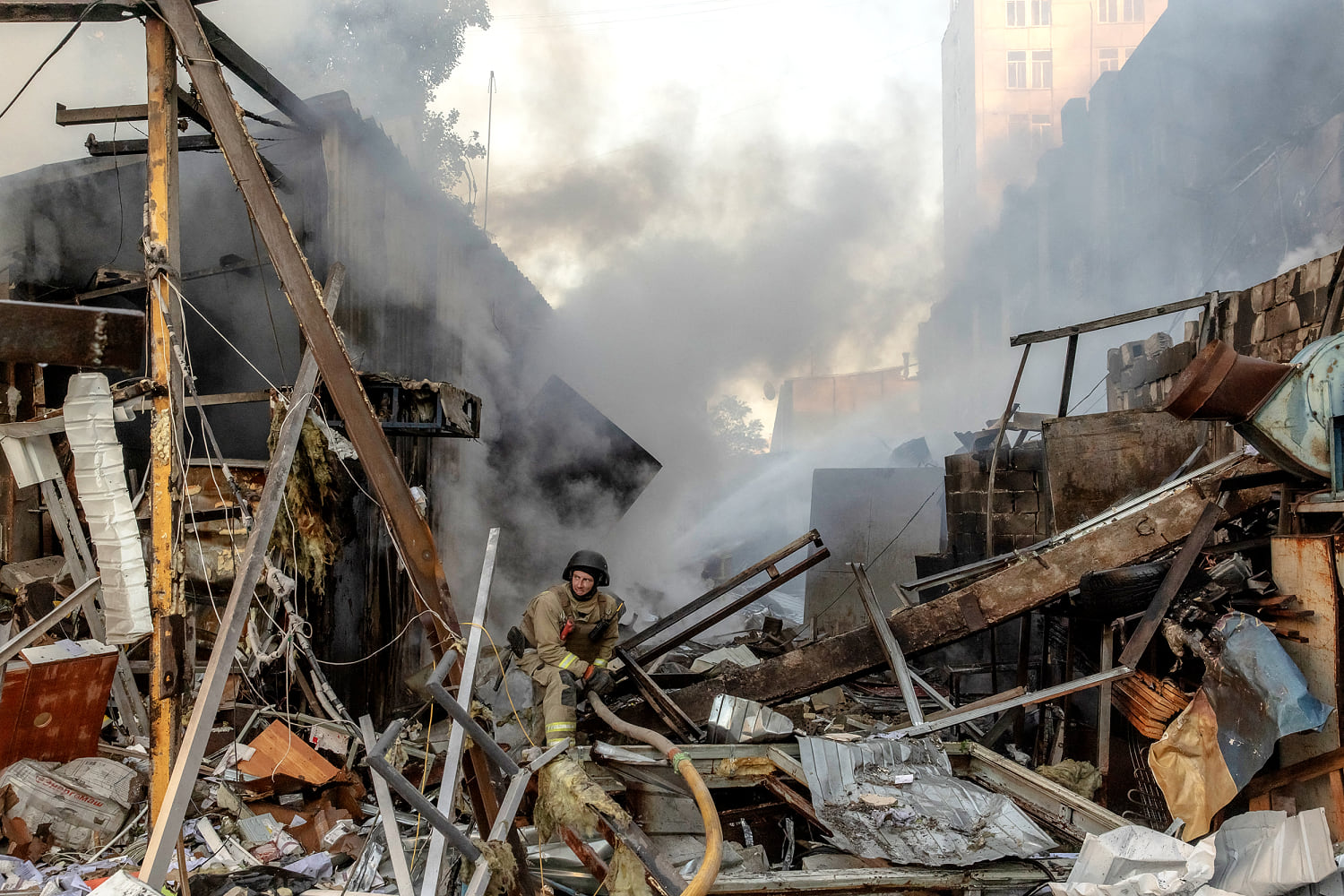
The pre-dawn bombardment of Ukrainian cities on June 2, 2026, which claimed at least 18 lives and wounded over a hundred civilians, was not merely another tragic entry in a four-year timeline of attrition. It was a sophisticated, multi-axis demonstration of a brutal reality that Kyiv and Washington have spent months trying to ignore. By launching a massive wave of 656 drones alongside 73 cruise and ballistic missiles, including eight hypersonic Tsirkon missiles, Moscow exposed a critical systemic failure. Ukraine is running out of Patriot interceptors, and the White House is realizing that its political leverage over the conflict is inextricably bound to an industrial bottleneck it cannot easily fix.
President Volodymyr Zelenskyy reacted to the strikes on Kyiv, Dnipro, Zaporizhzhia, Poltava, and Kharkiv with an immediate, direct appeal to U.S. President Donald Trump for urgent shipments of Patriot PAC-3 missiles. The optics are stark. Debris-strewn streets and rescuers digging out the bodies of young children in Dnipro provide a grim backdrop to a complex geopolitical transaction. Kyiv’s appeals are shifting from a narrative of shared democratic values to a transactional request tailored for a Washington administration focused on rapid deal-making.
Yet, treating this crisis as a simple matter of political will ignores the severe math governing global air defense supply chains. The true bottleneck is not found in the halls of Congress or the Oval Office, but on the factory floors of defense contractors.
The Production Math Defying Diplomacy
The Western strategy of treating the Patriot system as an impenetrable shield has run into a hard wall of industrial reality. A standard Patriot battery utilizes complex radar and command stations to fire interceptors that cost approximately $4 million to $5 million per unit. Against a coordinated swarm of low-cost, Iranian-designed Shahed drones and varied missile salvos, the economic and logistical asymmetry is crushing.
[Typical Strike Salvo Asymmetry]
Russian Salvo: 600+ Cheap Drones ($20k each) + Hypersonic Missiles
   VS
Ukrainian Defense: Finite Patriot Interceptors ($4M+ each) -> Depleted Stocks
The United States produces around 500 Patriot advanced capability interceptors annually, with plans to scale upward over the next several years. That total output is intended to supply not just Ukraine, but also the U.S. Army and a long line of foreign military sales clients, including nations across Europe, East Asia, and the Middle East. When Russia launches hundreds of aerial threats in a single night, the consumption rate of interceptor missiles outpaces global manufacturing capabilities by a factor of weeks, if not months.
This depletion has been exacerbated by competing global security priorities. The eruption of regional conflicts involving U.S. allies elsewhere has further constrained available global stocks of specialized radar components and interceptor inventory. Zelenskyy’s public letters and social media pleas are not just calls to an ally; they are frantic bids to cut to the front of a global supply queue that is completely jammed.
Moscow’s Calculated Strategy of Attrition
The Kremlin’s current strategy relies heavily on this logistical disparity. Western intelligence analysts note that recent Russian barrages are deliberately structured to exploit known gaps in Ukraine’s air defense coverage. By mixing high-volume, low-velocity drone swarms with ultra-fast, maneuverable Tsirkon ballistic missiles, Russian planners force Ukrainian air defense teams into an impossible calculation. They must decide whether to hold fire and risk civilian infrastructure damage, or deploy their remaining premium interceptors against decoy targets, leaving major cities vulnerable to follow-up ballistic strikes.
This tactic explains why Moscow deliberately warned foreign embassies to evacuate Kyiv days before the June 2 strikes. The warning was not a humanitarian gesture. It was a calculated psychological operation designed to signal absolute confidence in their ability to penetrate the capital’s defenses, highlighting to both domestic audiences and international onlookers that the Western-supplied shield is fracturing.
Furthermore, the timing of these massive assaults reveals a clear political intent. The strikes occurred immediately following high-level diplomatic maneuvers and nominal ceasefire discussions championed by Washington. By escalating the violence on the ground, Russian President Vladimir Putin is signaling that Moscow will not be pressured into an unconditional settlement, using raw kinetic power to dictate terms before any formal negotiations can begin.
The Limits of Transactional Deterrence
Kyiv's explicit targeting of the current U.S. administration reflects a calculated gamble. Zelenskyy is gambling that a direct request for defensive hardware aligns with Washington’s preference for tangible, discrete military aid over open-ended financial commitments. The argument presented by Ukrainian officials is straightforward: provide the tools to freeze the frontlines, or face a complete collapse of European security architecture that will ultimately force direct, costly American intervention.
However, this approach faces significant strategic hurdles. The White House has consistently maintained that its primary objective is achieving an immediate end to hostilities, frequently suggesting that both sides must accept painful compromises. From Washington’s perspective, transferring precious, irreplaceable air defense assets to Kyiv right now might actually prolong the war by giving Ukraine the confidence to resist territorial concessions, thereby complicating the administration's stated goal of a swift diplomatic resolution.
This creates an acute security paradox for Ukraine.
Without a steady supply of U.S. interceptors, Ukraine's major industrial hubs, energy grids, and civilian population centers remain entirely exposed to devastation. Yet, receiving those very missiles depends on convincing a highly skeptical Washington that the aid will directly accelerate an end to the fighting, rather than extending a war of attrition indefinitely.
The European Strategic Vacuum
The ongoing crisis exposes a glaring vulnerability in Europe’s own security structure. For over two years, continental leaders have promised to transition toward strategic autonomy, pledging to build independent defense manufacturing lines capable of sustaining a localized conflict. The June 2 strikes prove that these promises have largely failed to materialize on the timeline required by the battlefield.
European nations remain overwhelmingly dependent on American production lines for high-tier anti-ballistic missile technology. While some initiatives to co-produce lower-tier air defense systems are underway, they lack the capacity to intercept high-speed, modern Russian ballistic missiles. Zelenskyy noted this gap in his post-attack statement, bluntly pointing out that Europe needs its own anti-ballistic missile production capacity if it ever hopes to achieve genuine geopolitical stability.
As winter approaches and Russia systematically targets what remains of Ukraine’s energy infrastructure, the lack of European self-sufficiency means that every major attack in Ukraine instantly converts into a direct political crisis for the United States.
The tragic reality of the 18 civilians lost in the June 2 bombardment is that their safety was entirely dependent on an overstretched supply chain located thousands of miles away. Kyiv cannot afford to stop pleading for American interceptors, but Washington cannot manufacture them fast enough to alter the brutal geometry of the conflict. The war is not failing due to a lack of tactical resolve on the ground, but because the Western industrial engine was never built to sustain a high-intensity conflict against a peer adversary determined to win by sheer material exhaustion.