Silence.
That is the sound of a shipping container sitting on a sun-baked dock in Mumbai while a monsoon squall gathers over the Arabian Sea, waiting for a single sheet of stamped paper that failed to arrive before five o’clock on a Friday.
I have stood on those concrete aprons. I have watched the sweat run down the neck of a freight forwarder as he refreshed an email inbox on a cracked phone screen, praying for a customs clearance code while refrigerated fruit inside a forty-foot steel box ticked closer to spoilage. People talk about international trade in the sterile vocabulary of spreadsheets—tariffs, bilateral deficits, macroeconomic headwinds—but down at the port, global commerce comes down to ink, stamps, and whether a harried clerk across town signed a document on time.
For years, selling Indian goods to buyers in New Zealand meant surviving a bureaucratic obstacle course before your cargo ever touched saltwater. Even when a trade agreement existed on paper to lower import duties, claiming those tariff reductions required proving, beyond a shadow of a doubt, that your goods were genuinely made in India. That proof lives inside a document called a Certificate of Origin. Without it, a shipment of handcrafted leather goods from Kanpur or precision auto parts from Pune arrives in Auckland only to be slapped with full standard import taxes—wiping out a thin profit margin in an instant.
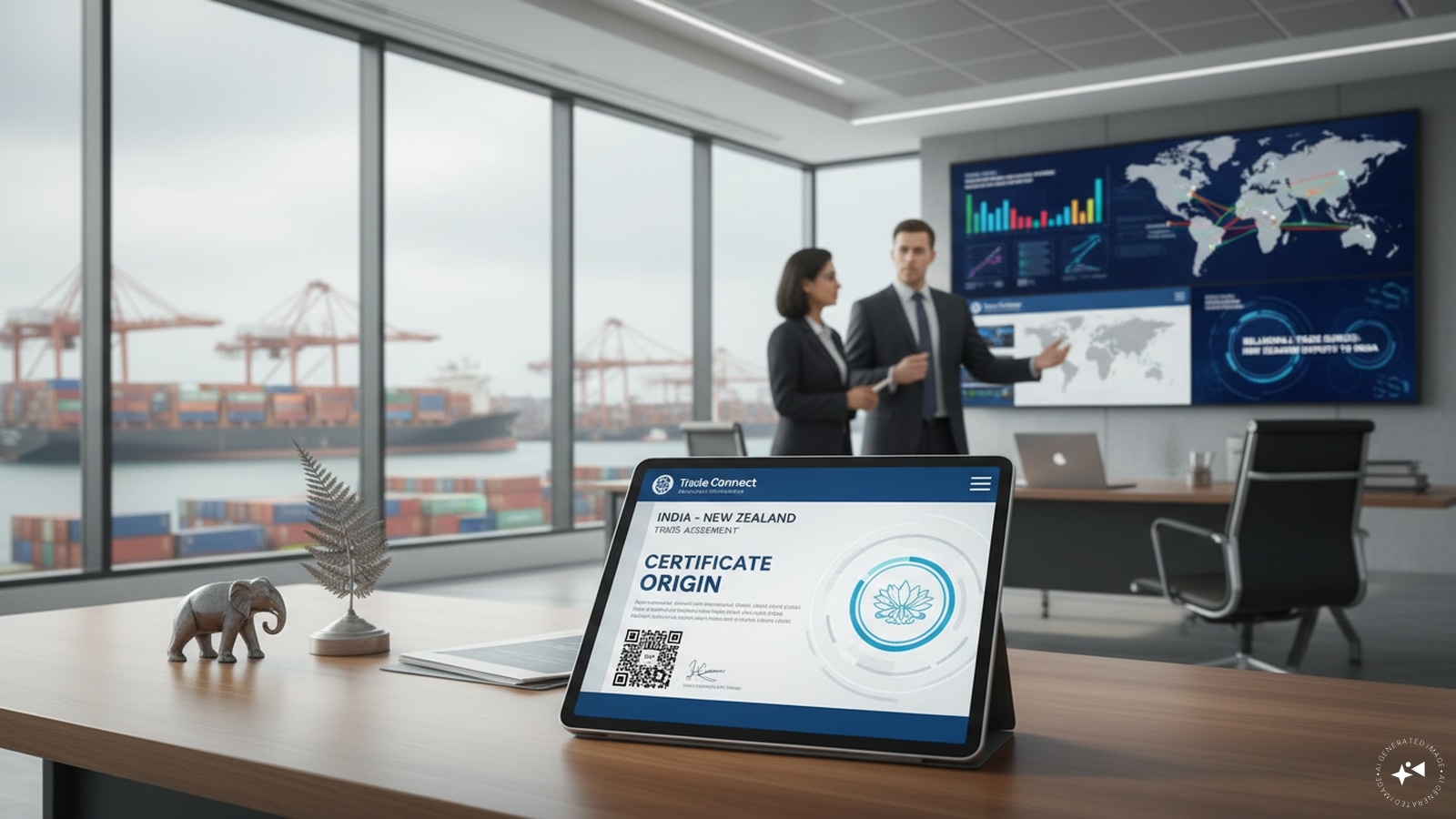
Now, the Directorate General of Foreign Trade has quietly rewritten the rules of that race against the clock. Seventeen specialized agencies across India have been officially authorized to issue Certificates of Origin under the India-New Zealand trade framework.
Seventeen. To an outsider, that number looks like dry administrative housekeeping. To anyone who has ever mortgaged a family home to fund an export order, it sounds like the unlocking of a heavy iron gate.
The Invisible Wall Between Maker and Market
Consider a hypothetical scenario that plays out every week in industrial towns from Ludhiana to Coimbatore. Picture Meera, a second-generation textile manufacturer running a mid-sized mill employing sixty workers. Her looms produce organic cotton upholstery fabrics that boutique furniture makers in Wellington want to buy. Her pricing is sharp, her quality is world-class, and the New Zealand buyer has placed a trial order worth forty thousand dollars.
The catch lies in the landed cost. Under preferential trade rules, Meera’s fabric qualifies for reduced customs duty at the New Zealand border, making her price competitive against rivals from Southeast Asia. Yet to unlock that lower duty, Meera cannot simply write "Made in India" on her invoice and hope customs officers take her word for it. If trade rules worked on the honor system, every exporter on earth would route cheap goods through a third country, slap a new label on the crate, and dodge tariffs entirely.
Think of a Certificate of Origin as a passport for cargo. Just as a human traveler cannot walk up to an immigration desk in Auckland and claim citizenship without a verified government booklet bearing watermarks and official seals, a shipping container cannot claim preferential tariff treatment without an accredited agency vouching for its birthplace.
Until recently, obtaining that passport meant funneling thousands of exporters through a narrow choke point. If your factory sat hundreds of miles from a designated issuing office, or if your specific industry lacked a dedicated certifying body empowered under that particular bilateral pact, you waited. You hired middlemen. You couriered physical folders across state lines. You lost days. And in maritime logistics, where a missed vessel departure means waiting another two weeks for the next feeder ship, losing days is indistinguishable from losing customers.
I remember the quiet panic of my first export shipment years ago, staring at a stack of commercial invoices, packing lists, and origin declarations, terrified that a single transposed digit in a Harmonized System product code would freeze my capital for months. Nobody teaches you that dread in business school. You learn it at two in the morning with a lukewarm cup of tea and a customs manual open on your lap.
Why Seventeen Doors Beat One Narrow Gate
What changes when the government clears seventeen distinct agencies to verify origin for exports heading to New Zealand?
First, geography stops being a penalty. Trade in India does not happen exclusively in gleaming towers in Mumbai or New Delhi; it happens in spice hubs in Kerala, engineering clusters in Gujarat, pharmaceutical corridors in Hyderabad, and tea estates in Assam. By authorizing seventeen agencies—spanning export promotion councils, commodity boards, and regional chambers of commerce—the certification authority moves closer to the factory floor. A spice exporter no longer has to plead with a generalist office unfamiliar with agricultural processing rules; they can turn to a body that understands their supply chain down to the harvest season.
Second, specialization speeds up verification. Determining where a product truly "originates" is rarely simple in an era of global supply chains. If an Indian manufacturer imports raw chemical compounds from Germany, refines them in Vadodara, and blends them into an industrial coating for a client in Christchurch, does that coating count as Indian? Trade agreements answer that question through strict "rules of origin"—requiring either a specific percentage of local value addition or a fundamental transformation in the product's tariff classification.
When an agency lacks deep familiarity with a sector, its officers naturally grow cautious. Caution turns into requests for extra affidavits, supplier invoices, and factory floor audits. Days bleed away. Empowering sector-specific agencies means the person reviewing Meera’s cotton weave or an engineer’s CNC-machined valve already knows the manufacturing process. Verification becomes rigorous without becoming paralyzed.
Third, redundancy kills bottlenecks. When only a handful of offices hold the stamp, a regional holiday, a localized strike, or a sudden surge in pre-holiday shipping volume brings approvals to a crawl. Spreading that authority across seventeen accredited bodies creates parallel lanes on what used to be a single-lane mountain road.
The Deeper Stakes of Southern Hemisphere Trade
To understand why clearing these administrative arteries matters right now, you have to look beyond the docks and examine the shifting map of global commerce. For decades, Indian exporters looked overwhelmingly toward North America and Europe—huge, familiar markets with well-worn shipping lanes. Yet relying on two traditional buyers leaves an economy vulnerable whenever interest rates rise in Washington or consumer spending cools in Frankfurt.
New Zealand represents something different. It is a high-income, import-reliant economy with sophisticated consumers, strict quality standards, and an appetite for diversified suppliers across the Indo-Pacific. From pharmaceuticals, textiles, and leather goods to engineering components, basmati rice, and specialty teas, Indian producers hold natural strengths that complement New Zealand’s agricultural and service-driven economy.
Yet preferential access means nothing if small and medium enterprises—the backbone of India’s export engine—cannot afford the friction of compliance. Big conglomerates maintain entire legal departments in air-conditioned suites to navigate customs treaties. A family-owned workshop in Moradabad does not. When paperwork is centralized and opaque, trade deals inadvertently become subsidies for the largest corporations while smaller makers get left on the curb.
Authorizing seventeen agencies levels that playing field. It translates diplomatic ink signed in capital cities into a practical tool usable by a forty-person factory in a tier-two town.
Navigating the New System Without Stumbling
Of course, opening seventeen doors does not mean exporters can walk through them blindfolded. Having watched countless shipments get tangled in avoidable customs disputes, I know that speed at the origin port means nothing if the paperwork fails scrutiny at the destination port.
When New Zealand customs officers inspect a Certificate of Origin, they are checking whether the exporter genuinely met the bilateral pact's local-content thresholds. If an Indian firm cuts corners—claiming forty percent domestic value addition when accounting records only support twenty-eight percent—the consequences are brutal. New Zealand authorities can reject the preferential claim retroactively, demand unpaid duties plus penalties, and flag the exporter’s tax identification number for mandatory physical inspections on every future arrival.
Exporters stepping into this expanded framework have to treat origin documentation like financial auditing, not a rubber-stamp formality. Every bill of materials, every domestic supplier invoice, and every manufacturing cost sheet needs to sit neatly in a digital archive before the application ever reaches one of the seventeen authorized agencies.
And there is still the human element of transition. Whenever regulatory authority expands across multiple institutions, consistency becomes the next challenge. Will an officer at an engineering council interpret a borderline rule of origin the exact same way as a counterpart at a regional chamber of commerce? Almost certainly, the first few months will bring minor discrepancies, heated phone calls between customs brokers and certifying officers, and circulars clarifying edge cases. Bureaucracy rarely transforms overnight; it lurches forward, smoothing its rough edges only under the pressure of real cargo moving through real ports.
What Happens When Friction Disappears
Return for a moment to Meera’s textile mill, six months after these seventeen agencies open their desks for New Zealand trade certification.
Her second container—twice the size of the first—is packed, sealed, and loaded onto a flatbed truck bound for the port. Two days earlier, her logistics manager logged into the digital portal, selected the authorized textile agency closest to their district, uploaded the cost breakdown of their local cotton yarn and dyeing process, and received the approved Certificate of Origin before lunch. No frantic couriers. No middlemen skimming three percent off the top just to walk a folder down a corridor. No wondering whether the ship would sail without their cargo.
When the vessel docks in Auckland three weeks later, the buyer’s customs broker clears the consignment electronically in hours, applying the preferential tariff rate without a single query. Meera’s margin holds. The Wellington furniture maker orders enough fabric for an entire autumn collection. Back in Coimbatore, two more looms hum to life, and three young operators take home overtime pay that pays for school fees and a new roof before the rains.
Nobody in Wellington ever sees the stamped certificate that made the price work. Nobody on the street in Coimbatore reads notices from the Directorate General of Foreign Trade.
Yet out on the water, between the cranes of Mumbai and the harbor lights of Auckland, a heavy steel container glides cleanly through customs, carrying the quiet proof that when you finally get the paperwork out of the way, people know how to build.