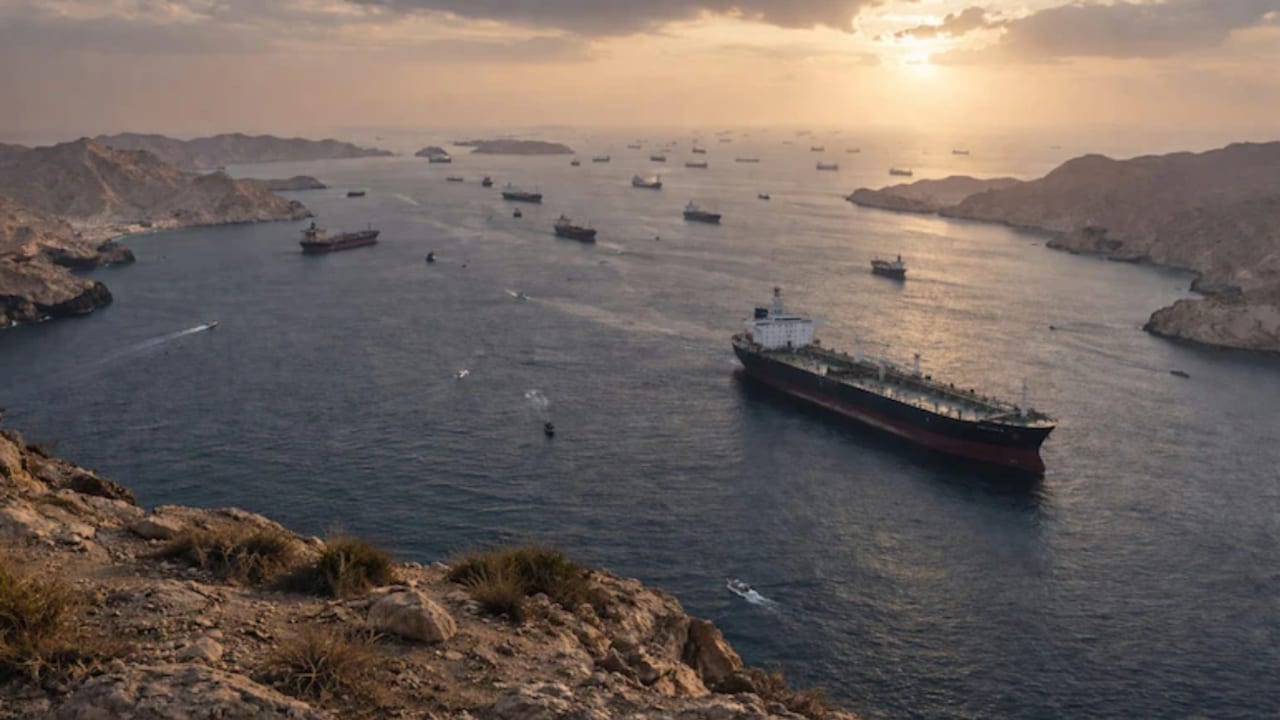
Two tankers catch fire in the Strait of Hormuz, and the financial media loses its mind. Every cable news anchor pulls up the exact same map of the Persian Gulf. Every armchair geopolitical analyst starts screaming about $150 crude and global economic collapse.
Stop falling for the script. For another view, read: this related article.
When reports surface from Iran's Islamic Revolutionary Guard Corps about burning vessels in the world’s most famous maritime chokepoint, the knee-jerk reaction is always identical. Algorithms buy Brent crude futures in milliseconds. Retail traders panic-buy energy ETFs at the top. Maritime insurers slap emergency surcharges onto every hull entering the Gulf of Oman.
Yet, if you actually sit on a physical crude trading desk or manage marine war-risk underwriting in London, you view these headlines through an entirely different lens. The mainstream coverage relies on a lazy consensus: that any kinetic incident in the Strait of Hormuz equals an imminent, catastrophic closure of the artery carrying roughly a fifth of the world's petroleum liquids. Related analysis on this matter has been shared by Reuters.
That consensus is outdated, financially illiterate, and dangerously profitable for the wrong people.
The Anatomy of a Manufactured Risk Premium
To understand why two burning ships do not equal a global supply shock, you have to understand how modern oil markets price fear versus physical scarcity.
I have watched commodity funds burn tens of millions of dollars chasing Middle East headline spikes over the last decade. They buy the rumor of a blockade, hold through the peak of television hysteria, and get crushed forty-eight hours later when physical loadings at Ras Tanura and Kharg Island continue without missing a single pump cycle.
Here is the mechanical reality that sensationalist newsrooms ignore: a burning tanker is a localized maritime emergency, not a structural supply deficit.
When an incident occurs in the narrow shipping lanes between Oman and Iran—a corridor roughly 21 nautical miles wide at its tightest point, with inbound and outbound traffic separation schemes just two miles wide—the immediate impact is psychological. Futures markets trade paper barrels, not wet barrels. High-frequency trading systems scan wire headlines for keywords like "IRGC," "tanker," "fire," and "Hormuz," triggering automated buy orders before a single human analyst has verified whether the vessel is a Very Large Crude Carrier (VLCC) laden with two million barrels of Arab Light or a regional coastal product tanker carrying condensate.
Even when a major vessel is struck or ablaze, the global oil buffer is vastly more resilient than the panic-merchants admit:
- Floating Storage and Transit Time: At any given moment, tens of millions of barrels of Middle Eastern crude are already on the water, weeks away from refineries in Rotterdam, Houston, or Ningbo. A temporary slowdown in Hormuz transit does not starve a refinery tomorrow morning.
- Strategic Petroleum Reserves (SPR): Coordinated emergency stockpiles across International Energy Agency (IEA) member states exist specifically to bridge acute, short-term logistical disruptions.
- Pipeline Bypass Capacity: Saudi Arabia’s East-West Pipeline (Petroline) and the UAE’s Habshan-Fujairah pipeline were engineered explicitly to route crude around the Strait of Hormuz directly to the Red Sea and the Gulf of Oman. While they cannot replace 100% of Hormuz volume, they strip away the binary "all-or-nothing" leverage that doom-mongers love to preach.
Why Iran Will Never Actually Close the Strait
The biggest misconception baked into every sensational article about Hormuz tanker fires is the assumption that Tehran wants to shut the waterway down.
Think about the economics for thirty seconds.
Iran’s entire economic lifeline depends on its ability to export crude oil—primarily to independent refiners in Asia—and import refined goods, food, and industrial components. Almost every drop of Iranian oil exports must pass through that exact same stretch of water. Closing the Strait of Hormuz is not a strategic weapon for Tehran; it is an act of economic suicide.
Furthermore, a full blockade would instantly trigger a unified naval coalition response that would decimate Iran’s coastal infrastructure and naval assets within days. Even China, the largest buyer of Persian Gulf crude and a frequent diplomatic counterweight to Western pressure, has zero tolerance for a prolonged closure of Hormuz. Beijing’s industrial base runs on uninterrupted energy imports.
Instead of a closure, what you are witnessing during tanker incidents is calibrated asymmetric signaling.
By maintaining a persistent state of controlled friction—seizures, limpet mine scares, drone harassment, or ambiguous fires—Tehran achieves maximum geopolitical pricing power at minimal military cost. They remind Washington, Riyadh, and London that the cost of escalation is an immediate tax on global inflation.
The headline "2 Oil Tankers On Fire" serves everyone's narrative except the truth:
- Military hardliners project regional dominance without triggering an all-out war.
- Commodity speculators harvest volatility from panicked retail capital.
- Click-driven media outlets generate massive ad impressions from apocalyptic maps.
Meanwhile, the actual physical barrels keep moving.
What the Maritime Insurance Industry Actually Watches
If you want to know whether a Hormuz incident is a genuine crisis or mere theater, stop watching cable news and start watching the Joint War Committee (JWC) in London.
Underwriters at Lloyd’s of London do not care about political speeches. They care about actuarial probability and hull replacement value. A modern VLCC costs upwards of $120 million, and its cargo can easily exceed another $150 million.
When tensions flare in the Persian Gulf, the JWC designates the region as a "Listed Area." Shipowners must then pay an Additional War Risk Premium (AWRP)—calculated as a percentage of the vessel's hull and machinery value—for every seven-day transit period through the zone.
During genuine periods of escalating maritime conflict, AWRP rates jump from a baseline of roughly 0.05% of hull value to 0.5% or higher. That translates to hundreds of thousands of dollars in extra costs per voyage. Yet, notice what happens next: the ships still sail.
Charters simply pass those war-risk premiums down the supply chain, freight rates (measured in Worldscale points) spike temporarily, and VLCC owners make a killing on spot charters. Unless war-risk insurers outright revoke coverage—which almost never happens outside of declared, full-scale naval warfare—global energy flows do not stop. They just get slightly more expensive to insure.
Dismantling the Wrong Questions
When tanker fires hit the front page, public search queries flood the internet with the exact same flawed premises. Let’s tear them apart.
"Will gas prices double next week because of the Strait of Hormuz?"
No. Retail gasoline prices are governed by regional refining capacity, seasonal blend specifications, local taxes, and crack spreads—not overnight panic spikes in Brent futures. A 5% intraday jump in crude futures rarely translates to more than a few cents at the pump, and only if that price elevation holds for weeks rather than hours.
"Can the US Navy guarantee 100% safety for every tanker in the Gulf?"
False premise. Naval escorts and maritime task forces provide deterrence and rapid-response salvage, not an impenetrable shield. The Persian Gulf is cluttered with thousands of fishing dhows, fast-attack craft, and commercial vessels operating in shallow, congested waters. Absolute security is a logistical impossibility; risk management is the only real metric.
"Is this the start of World War III?"
This is peak algorithmic clickbait. Maritime incidents in the Persian Gulf have occurred continuously since the Tanker War of the 1980s, when hundreds of commercial vessels were attacked over several years without collapsing the global economy or sparking a global superpower war. Historical illiteracy makes every modern flare-up look unprecedented.
The Contrarian Playbook for Navigating Geopolitical Energy Shocks
If you manage corporate fuel exposure, trade energy equities, or simply want to stop making terrible financial decisions every time a ship catches fire in the Middle East, throw away the mainstream playbook and execute these three rules instead:
1. Fade the Initial Futures Spike
In almost every maritime incident short of a confirmed, multi-facility attack on onshore export terminals (like the 2019 Abqaiq-Khurais drone strikes in Saudi Arabia), the initial crude price spike is pure emotional froth. Wait for the first 24 to 48 hours of news cycle saturation to exhaust itself. Watch the prompt time spreads—the price difference between front-month crude futures and deliveries six months out. If front-month prices surge while physical differentials remain flat, the rally is fake.
2. Track AIS Transponder Data, Not Press Releases
Official statements from military spokespeople and state media are weapons of information warfare. If you want the ground truth, look at Automatic Identification System (AIS) vessel tracking data. Are VLCCs turning around at the Gulf of Oman and dropping anchor off Fujairah? Or are they maintaining normal transit speeds of 12 to 14 knots straight through the Strait? Ships vote with their rudders. Trust the steel, not the spokespeople.
3. Watch Refining Margins, Not Headline Crude
If a supply disruption is genuinely starving the market of heavy or medium sour Persian Gulf grades, refiners in Asia and Europe will immediately bid up alternative grades, causing refining margins (crack spreads) to violently distort. If crack spreads stay calm while crude futures jump, you are looking at a paper-market illusion.
The Uncomfortable Caveat
Acknowledging that media panic is overblown does not mean the risk is zero. Every contrarian framework carries a tail-risk blind spot, and ignoring it will eventually wipe you out.
The danger in the Strait of Hormuz is never a deliberate, rational decision to close the waterway. The real danger is miscalculation. A localized fire, a misidentified radar signature, or a salvage operation gone wrong in a two-mile-wide shipping lane can spiral out of control faster than diplomatic backchannels can contain it.
Imagine a scenario where a burning VLCC loses propulsion directly inside the outbound traffic separation scheme while leaking heavy bunker fuel, simultaneously blocking physical navigation and forcing rival naval vessels into a tense standoff over salvage jurisdiction. In that specific, messy reality, you do not need a formal blockade to choke off 15 million barrels a day—you just have a massive, flaming maritime traffic jam that takes weeks to clear.
That is the real risk: mechanical chaos, not grand geopolitical chess.
Until physical hulls actually stop moving through the channel, treat every breathless breaking-news alert about burning tankers in the Strait of Hormuz for what it really is—a volatility tax levied on people who read headlines instead of shipping manifests.


