Out in the harsh, sun-baked landscape of Lightning Ridge, New South Wales, building materials have always been a matter of severe resourcefulness. When standard bricks or timber cost too much to haul into the remote outback, people built with what was right in front of them. In 1967, a man named Tex Moeckel looked at thousands of discarded glass bottles and saw a structural foundation.
Nearly sixty years later, that eccentric creation still stands. Known simply as the Bottle House, it operates as a localized mining museum, drawing travelers who want to see how outback ingenuity outlasted conventional modern housing.
The Story Behind the Bottle House Construction
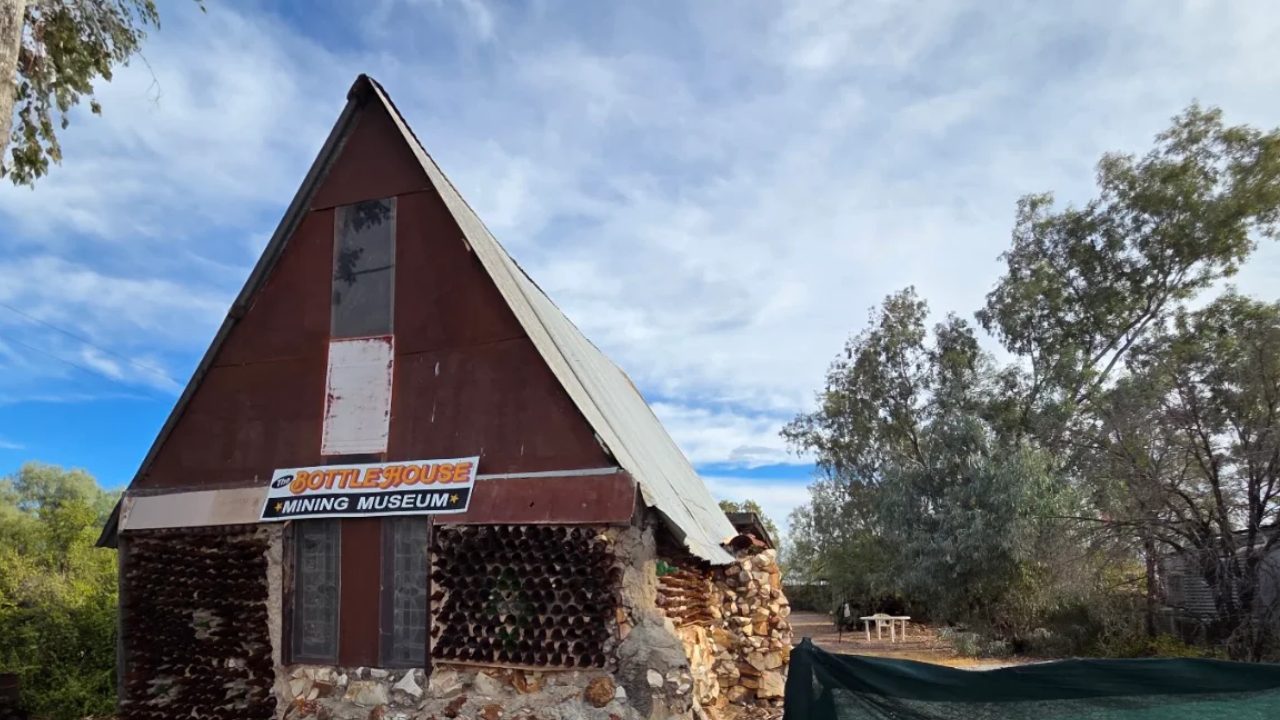
Building a home entirely out of glass required a staggering amount of raw supply. Moeckel sourced his primary building blocks from a massive stockpile outside a pub in Hebel, a tiny settlement just across the border in Queensland. Trucking thousands of empty beer and spirit bottles back to Lightning Ridge, he began laying them horizontally, cementing them together to form thick, insulating walls.
There was a steep learning curve to this unconventional style of masonry. Moeckel initially used standard cement to lock the glass in place. He soon realized that outback thermal shifts and settling earth made rigid cement problematic. When a bottle inevitably cracked or broke under pressure, rigid mortar made repairs nearly impossible. He eventually transitioned to local clay, which offered the necessary give and made swapping out damaged glass much easier.
The architecture features a steeply pitched, A-frame style roof covered in corrugated iron, designed to handle outback heat and occasional storms. Inside, the walls filter sunlight through hundreds of bottle bases, casting a soft, amber glow across the interior rooms and loft.
From Miner Camp Curio to Opal Museum
The structure began as part of a working miner’s camp in an area famous for its rare black opals. Lightning Ridge has always attracted independent prospectors willing to live rough in pursuit of fortune. Over the decades, the purpose of the Bottle House shifted away from raw shelter toward cultural preservation.
Today, visitors walking through the front door step into a cluttered archive of outback history. The interior rooms house an extensive collection of vintage bottles that stretches far beyond the structural walls. You will find old medicine flasks, novelty containers shaped like cartoon characters, and rare liquor bottles gathered from across Australia.
Beyond the glass, the museum serves as a repository for the region's mining heritage. Glass cases and wooden tables display rusted hand tools, antique scales, historical photographs, and heavy iron mining equipment used during the peak years of the opal rush. Shelves hold raw petrified wood, rough opals, and mineral specimens pulled straight from the local earth.
Visiting the Outback Landmark Today
Finding the Bottle House is straightforward if you are exploring outback New South Wales. It sits right on Opal Street in Lightning Ridge, functioning as the town's oldest continuously running tourist attraction.
Stepping inside feels like walking into a time capsule. The floors creak, the air carries the dry scent of desert dust mixed with old paper, and the ambient light shifts depending on the position of the sun outside. It stands as a testament to a time when outback residents recycled out of pure necessity long before environmentalism became a corporate buzzword.
If you make the long drive out to Lightning Ridge, skip the standard tourist traps and spend an hour walking through the glass walls. It reminds you of what happens when human stubbornness meets raw creativity in the middle of nowhere.