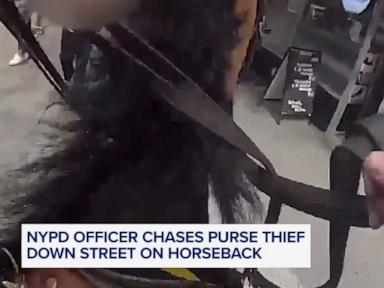
The utilization of equine units in modern urban policing is frequently dismissed as a ceremonial vestigial tail, yet the recent interception of a larceny suspect in Times Square by the NYPD Mounted Unit demonstrates a specific tactical advantage in high-density environments. This incident serves as a case study in kinetic advantage, situational height-dominance, and the psychological physics of crowd control. While a standard foot pursuit is limited by human aerobic capacity and a vehicle pursuit is constrained by gridlock, the mounted officer operates within a unique "maneuverability gap" that allows for rapid intervention in spaces where traditional assets are paralyzed.
The Physics of the Pursuit: Kinetic Energy and Obstacle Navigation
The core efficiency of a mounted pursuit rests on the horse’s ability to generate high torque from a stationary position. In the Times Square incident, the transition from a standing patrol to a gallop occurred within a spatial constraint of less than ten meters.
- Mass and Momentum: A patrol horse typically weighs between 1,200 and 1,500 pounds. When moving at an average gallop of 25 to 30 mph, the kinetic energy ($E_k = \frac{1}{2}mv^2$) far exceeds that of a human runner. This creates a "passive containment" effect; the sheer physical presence and noise of a charging animal force a suspect to prioritize self-preservation over flight.
- Non-Linear Navigation: Unlike a patrol car, which is bound by lane markers and traffic flow, the horse operates as a three-dimensional navigation tool. It can mount curbs, traverse narrow alleys between stalled vehicles, and pivot on a centralized axis. In the specific geography of Midtown Manhattan, the horse serves as a bridge between the speed of a motor vehicle and the agility of a pedestrian.
Vertical Superiority and the OODA Loop
The primary failure point in urban foot pursuits is the loss of visual contact. A suspect who rounds a corner or blends into a crowd creates a "latency gap" in the officer's decision-making process. The mounted officer disrupts this by fundamentally altering the OODA Loop (Observe, Orient, Decide, Act).
- Observation: Sitting approximately ten feet above ground level, the mounted officer possesses a 360-degree vantage point that clears the "visual noise" of a crowd. This height allows for the tracking of a suspect’s head and shoulders over the top of vehicles and pedestrians.
- Orientation: From this elevation, the officer identifies terrain bottlenecks before the suspect reaches them. This allows the officer to steer the horse toward the suspect's likely exit vector rather than trailing directly behind them.
- Action: The height also serves as a defensive platform. It is significantly more difficult for a suspect to strike upward at an officer than it is for an officer to deploy a controlled takedown or verbal command from a position of dominance.
The Crowd Psychology of Equine Deployment
Beyond the physical pursuit, the presence of the horse acts as a biological barrier. In high-traffic zones like Times Square, the arrival of a mounted unit creates an immediate "parting of the sea" effect. This is not merely a result of authority but of biological aversion. Humans possess an innate survival instinct to avoid being trampled by large mammals.
This creates a clear lane for the pursuit that a foot officer would have to fight for. While a running officer must dodge tourists and vendors, the mounted officer’s path is cleared by the crowd's reflexive retreat. This reduces the risk of collateral injury to civilians, as the horse’s presence is signaled by both visual scale and the rhythmic auditory cue of hooves on pavement, which carries further and more distinctly than a human shout.
Resource Allocation and the Cost Function of Mounted Units
Critics often point to the high maintenance costs of a mounted unit, including stabling, specialized veterinary care, and the long-term training of both animal and rider. However, a data-driven analysis suggests these costs are offset by force multiplication.
- Observation Range: One mounted officer can monitor a crowd size that would otherwise require six to ten foot patrol officers to manage with the same degree of visibility.
- Incident Response Time: In a gridlocked urban center, a horse can reach a scene 50% faster than a standard RMP (Radio Motor Patrol) vehicle during peak congestion hours.
- Deterrence Factor: The psychological footprint of a mounted unit reduces the probability of low-level opportunistic crimes (like the purse snatching in question) within a two-block radius of the unit’s location.
The "Cost per Intervention" for a mounted unit is high if viewed as a standard patrol asset, but it becomes highly efficient when categorized as a specialized rapid-response and crowd-management tool.
Training Constraints and Operational Limits
The success of such a pursuit is not a product of chance but of rigorous behavioral conditioning. Urban patrol horses must be desensitized to a battery of sensory inputs that would trigger a flight response in a standard equine.
- Acoustic Overload: Sirens, construction noise, and sudden shouts.
- Visual Volatility: Flashing LED billboards, erratic movements of street performers, and umbrellas opening.
- Surface Variability: The transition between asphalt, concrete, steel grates, and slick pavement.
A significant limitation of this asset is the risk of "animal fatigue" or injury on hard surfaces. Galloping on asphalt places extreme stress on the horse’s musculoskeletal system. This creates a tactical trade-off: the officer must balance the immediate need for apprehension against the long-term operational health of the animal. In the Manhattan pursuit, the officer utilized a controlled gallop, maintaining a speed sufficient to close the gap while minimizing the impact force on the horse's fetlocks and hooves.
The Strategic Utility of the "Visible Authority"
Modern policing strategies often struggle with the balance between community engagement and firm enforcement. The mounted unit occupies a rare space where the animal acts as a "social lubricant," lowering the barrier for positive civilian interaction while simultaneously functioning as a high-intensity enforcement tool when required. This dual-utility makes it one of the most versatile assets in a metropolitan police department's arsenal.
The arrest in Times Square was not merely a "chase." It was the execution of a high-torque maneuver within a cluttered environment where all other law enforcement vectors—cars, bikes, and pedestrians—were at a mechanical disadvantage.
The deployment of mounted units should be prioritized in high-congestion corridors where the "maneuverability gap" is widest. To optimize these units, departments must integrate real-time drone surveillance with mounted response. While the drone provides the high-altitude persistent eye, the horse provides the immediate, high-mass physical intervention that a remote asset cannot. This hybrid approach—combining 21st-century aerial data with ancient equine mechanics—represents the most effective solution for maintaining order in the increasingly dense urban landscapes of the future.