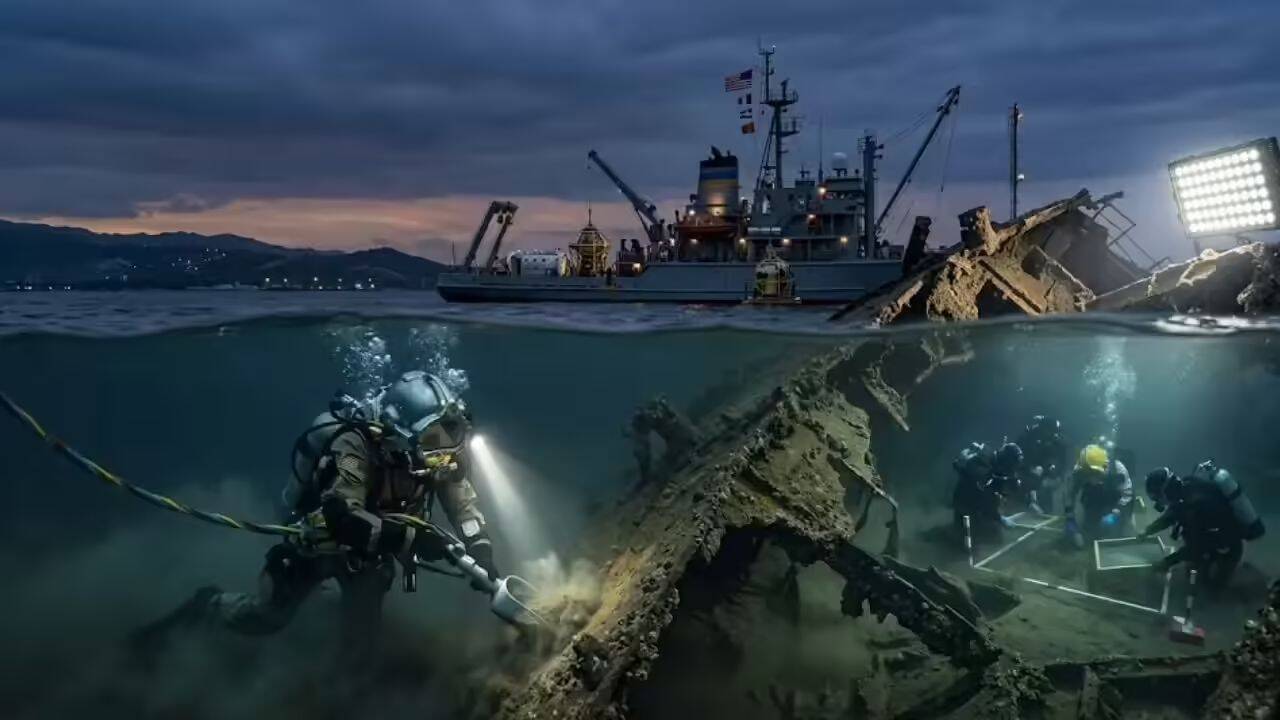
Marine salvage companies and sensationalist media outlets want you to believe that finding a World War II "Hellship" under 160 feet of water is a triumph of modern exploration. They frame these discoveries as historic milestones, wrapping them in the language of closure, honor, and technological breakthroughs.
They are lying to you. Or, at best, they are fundamentally misunderstanding what history actually requires.
The recent discovery of yet another sunken World War II transport ship—hailed by the mainstream press as a monumental achievement—highlights a deep, systemic rot in how we approach maritime archeology. We are burning millions of dollars to locate steel hulls in the mud, treating the ocean floor like a high-tech trophy room, while completely ignoring the fragile, decaying human history right above the surface.
Locating a wreck using side-scan sonar isn't history. It is expensive beachcombing. And it is time we stop celebrating it.
The 160-Foot Delusion
The lazy consensus surrounding deep-sea search operations is built on a simple premise: finding the ship means finding the truth. The media breathlessly reports the depth—160 feet, 500 feet, 10,000 feet—as if the physical difficulty of the search correlates directly with its historical value.
It doesn't.
Let's look at the mechanics of a typical modern shipwreck discovery. An autonomous underwater vehicle (AUV) runs a lawnmower pattern over a grid. A technician stares at a screen until a shadow appears. A remote operated vehicle (ROV) drops down, beams back a few eerie high-definition feeds of encrusted metal, and the press release is fired off.
What new historical data did we actually gain from seeing the collapsed deck of a 1944 transport ship?
We already knew the ship sank. We knew the coordinates of its loss within a few dozen miles. We knew the exact day, the exact torpedo configuration that struck it, and the precise bureaucratic paper trail of the tragedy from both Allied and Japanese archives. The physical hull tells us nothing new about the geo-political failures that led to the atrocities committed on those ships. It adds zero context to the human suffering of the prisoners of war packed into those cargo holds.
Imagine a scenario where a historian claims to have discovered groundbreaking new insight into the American Civil War, but their entire thesis consists solely of pointing at a rusty bayonet buried in a field. You would laugh them out of the room. Yet, when a billionaire-funded tech outfit does the exact equivalent with a boat, we give them a front-page feature.
The True Cost of Techno-Fetishism
I have spent years watching cultural preservation budgets dry up while flashy, tech-heavy salvage expeditions pull in massive private donations and corporate sponsorships. It is easy to sell a venture capitalist on a sleek ROV deployment. It is incredibly hard to sell them on funding a five-year archival translation project.
This hyper-focus on underwater hardware creates a massive misallocation of resources. The real history of the 1944 Hellships is not trapped under 160 feet of saltwater. It is dissolving in poorly air-conditioned provincial archives, rotting in untranslated diaries, and dying alongside the last remaining relatives of the survivors.
The maritime history establishment has succumbed to a form of techno-fetishism. They prioritize the tools over the narrative, the hardware over the humanity.
- The Cost Ratio: A single deep-sea expedition can easily clear $500,000 a week in ship charter fees, fuel, and specialized labor. That same budget could fund an entire university department's oral history initiative for a decade.
- The Data Yield: The expedition yields a handful of gigabytes of video files that will sit on a hard drive in an institute basement. The oral history project yields accessible, searchable human testimony that changes how we teach the conflict.
We are funding the wrong things because the tech looks cooler on television.
Dismantling the Myth of "Closure"
The most emotionally manipulative argument used to justify these multi-million-dollar sonar hunts is that they provide "closure" to the families of the victims.
This is a profound misunderstanding of grief and memory. Knowing that a relative's final resting place is at a specific set of GPS coordinates on a featureless continental shelf does not heal historical trauma. In fact, the monetization and sensationalism of these wreck sites often does the opposite.
Once a wreck is found, it becomes a target.
Despite international treaties and the United Nations Convention on the Protection of the Underwater Cultural Heritage, the reality on the water is grim. Commercial salvors and illegal metal scavengers regularly raid documented WWII gravesites in Southeast Asia. They use explosives to break apart the hulls, dragging up low-background steel and bronze propellers to sell for scrap value.
By actively hunting down and publishing the locations of these ships under the guise of "preservation," exploration groups are inadvertently providing a roadmap for grave robbers. If you truly want to respect a military grave, you leave it anonymous. The obsession with finding them is driven by ego and media clicks, not reverence.
The Wrong Questions, Asked Repeatedly
If you look at the public forums and Q&A sections regarding maritime history, the public intent is fundamentally broken. People consistently ask variations of the same flawed questions:
- When will we find the remaining missing ships of 1944?
- What is the deepest shipwreck ever discovered?
- How can we use better sonar to map the entire ocean floor?
These questions presume that the ocean is a museum waiting to be cataloged. It isn't. The ocean is an environment that dissolves evidence.
The question we should be asking is: Why are we letting the living history of these events vanish while we hunt for dead iron?
If we want to understand the horrors of the Pacific Theater in 1944, we need to understand the minds of the bureaucrats who signed the transport orders. We need to analyze the logistics of the resource scarcity that drove those brutal troop movements. We need to preserve the testimonies of the communities that witnessed these ships leaving port. None of that information is written on a corroded hull 160 feet down.
The Cold Truth of Archeology
Let's be clear about the downside of this contrarian stance: abandoning the hunt for these wrecks means accepting that some physical objects are lost forever. It means letting the ocean win the battle of attrition against human manufacturing.
That is an uncomfortable thought for an industry obsessed with total data collection. It is terrifying for tech companies who use these searches as marketing stunts to prove the capabilities of their underwater sensors.
But history is not a collection of objects. History is a discipline of interpretation.
When we celebrate the discovery of a Hellship without demanding a corresponding increase in the understanding of the human systems that created it, we are participating in a historical circus. We are applauding the camera, not the photograph.
Stop treating the discovery of sunken metal as an intellectual victory. The next time a headline tells you a lost ship from 1944 has finally been found beneath the waves, ask yourself exactly what was gained, who paid for it, and what real, living history was ignored to make that headline happen.
Turn off the sonar. Open the books.