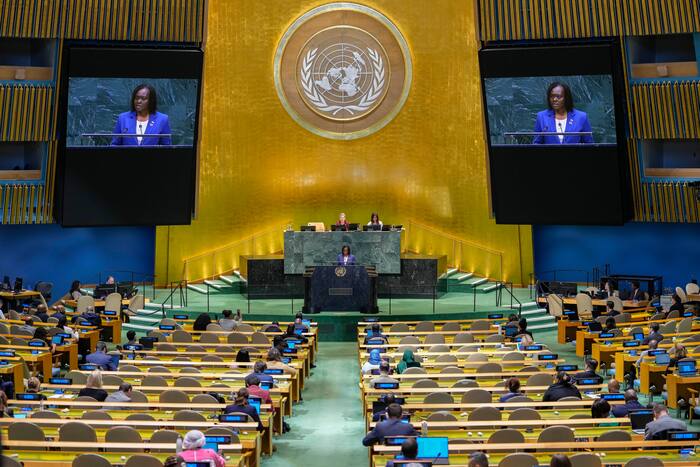
The ritual repeats every cycle. The Security Council gathers behind closed doors, a straw poll leaks, civil society groups draft petitions, and op-eds flood major newspapers demanding that the United Nations finally break its glass ceiling. The argument sounds simple, moral, and self-evident: after eight decades and nine men, it is time for a woman to hold the top diplomatic post on earth.
It is a lazy consensus. It is also a trap. For another look, see: this related article.
Obsessing over the biological identity of the next Secretary-General is a brilliant sleight of hand. It allows member states, diplomats, and international bureaucrats to perform progressive symbolism while preserving a broken structural machine. I have spent years watching institutions hide institutional paralysis behind identity milestones. When you focus entirely on who sits in the thirty-eighth floor office in Manhattan, you ignore the structural reality that the office itself has been systematically declawed by the very states that fund it.
Fixating on gender representation at the summit of the UN ignores how power actually flows in global governance. Related insight on this trend has been provided by The Guardian.
The Anatomy of a Powerless Office
Let us be brutally precise about what the Secretary-General actually is. The United Nations Charter defines the role in Article 97 as the chief administrative officer of the organization. But over time, myth-makers have cast the role as a global prime minister, a moral conscience of humanity, or a planetary peacemaker.
It is none of those things. It is a tenant farmer on land owned by the permanent members of the Security Council.
The five veto-holding powers—the United States, Russia, China, France, and the United Kingdom—do not want an independent, visionary leader who can command global moral authority. They want an efficient secretary who manages the bureaucracy without causing diplomatic friction. When a Secretary-General steps outside that administrative box and tries to independently broker peace or shame a major power, the system snaps back with brutal force. Try asking how much independent authority any recent occupant wielded when handling a conflict where a P5 member had a direct national interest. The answer is zero.
When activists and commentators demand a female Secretary-General as the ultimate fix for global diplomacy, they are treating a structural deficiency as an HR problem. They act as though a woman in the chair will somehow bypass the veto of a hostile power, magically fund peacekeeping missions starved of resources, or compel sovereign states to abide by international law.
That is not idealism. That is magical thinking.
The Mirage of Representation
Representation matters deeply in democratic institutions where leaders are accountable to voters and possess legislative power. But the United Nations is not a democracy. It is a diplomatic marketplace of sovereign autocracies, fragile democracies, and regional hegemons.
When a progressive coalition rallies around the slogan of a female UN chief, they fall into the trap of corporate feminism. We have seen this movie before in boardrooms and government cabinets: putting a woman at the helm of a fundamentally flawed institution does not disrupt the institution; it legitimizes its flaws. If a female Secretary-General presides over institutional paralysis during a famine, a refugee crisis, or a territorial invasion, what victory have we won? We have merely proven that women can be just as sidelined by geopolitical realpolitik as men.
Worse, this obsession creates a convenient shield for reactionary governments. Authoritarian regimes that systematically suppress women's rights at home can happily vote for a female diplomat to lead the UN, knowing full well that the office lacks the power to intervene in their domestic policies. It is a zero-cost public relations win for states that despise gender equality, bought with the currency of tokenism.
What the Competitor Narratives Miss
The standard narrative championed by groups like 1 for 7 Billion or various civil society caucuses rests on the premise that the selection process is opaque and male-dominated, and therefore opening it up to female candidates will inject fresh, empathetic leadership into global problem-solving.
This argument commits two fundamental errors.
First, it assumes that female leaders in international relations are inherently more pacifist, cooperative, or reform-minded than their male counterparts. History offers a sobering corrective to this essentialist fantasy. Women who rise to the pinnacle of statecraft and international diplomacy are subject to the exact same ruthless selection pressures as men. Margaret Thatcher, Golda Meir, and countless female ambassadors and heads of state have proven that realpolitik has no gender. Expecting a female Secretary-General to usher in a new era of collaborative peace simply because of her chromosomes is an insult to the strategic intelligence of female diplomats.
Second, the standard narrative completely misreads the mechanics of the appointment. The selection of the Secretary-General is not decided by an open meritocracy or public campaigning. It is a backroom bargain struck between the five permanent members of the Security Council, filtered through regional rotation rules and sealed with back-channel vetoes. A candidate can be the most qualified, visionary reformer on earth, but if Moscow, Beijing, or Washington dislikes their stance on a single geopolitical flashpoint, dead silence follows.
Focusing our political capital on demanding a female candidate within this rigged theater drains energy from fights that actually matter.
The Hard Questions Nobody Wants to Ask
If we stopped chasing symbolic victories at the glass ceiling, what questions should we actually be asking about the future of global leadership?
People often ask: Doesn't a female leader send a vital signal to girls and women worldwide?
The honest answer is that signals without power are hollow. Seeing a woman occupy an office that has been systematically stripped of its enforcement capabilities teaches a cynical lesson: you can reach the top, but you are not allowed to fix the machine.
A more rigorous inquiry focuses on institutional redesign. How do we strip the veto power from permanent members who use it to shield themselves and their allies from accountability? How do we decouple the financing of humanitarian operations from the voluntary whims of wealthy donors? How do we build parallel coalitions of middle powers and civil society that can bypass a paralyzed Security Council entirely?
These questions are messy, complex, and unsuited for a catchy hashtag. They do not fit neatly onto a placard at a protest march outside the UN headquarters. But they are the only questions that separate serious political strategy from feel-good performance art.
The Uncomfortable Trade-Off
My contrarian take comes with a heavy admission: abandoning the fight for a female Secretary-General risks alienating well-meaning advocates who view representation as a moral baseline. It feels counter-intuitive to tell people to stop campaigning for a historic first.
Here is the downside of my approach: optics matter in politics, and symbols can sometimes mobilize broader coalitions for institutional reform. If you drop the demand for a female leader, you lose an easy rallying cry that brings thousands into the streets.
Yet the trade-off is necessary. Every hour spent debating the gender of a figurehead is an hour stolen from dismantling the architecture of impotence that defines modern multilateralism.
Stop treating the United Nations like a progressive university campus waiting for its first female president. Treat it for what it is: a cartel of sovereign states guarding their own interests.
The next time a campaign starts circulating petitions for a woman to lead the UN, do not ask if she is qualified. Ask what power she will be denied the moment she steps into the office.
Then start building institutions that actually matter.