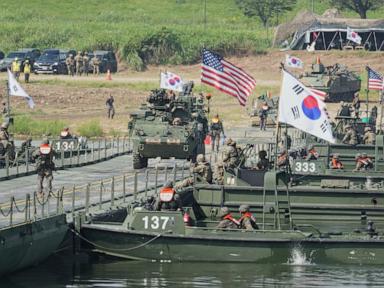
Every time Washington and Seoul roll out another massive theater-level military exercise, the script writes itself. Pyongyang issues a flurry of fire-and-brimstone condemnations. State media runs melodramatic segments about preemptive nuclear strikes. Western newsrooms spin up panic porn about the imminent collapse of the Korean Peninsula.
It is predictable. It is lazy. And it is completely wrong.
For decades, mainstream analysts have treated these cycles as dangerous escalations pushing the region to the brink of war. They buy into the narrative that North Korea is a fragile, unpredictable rogue state lashing out in genuine terror at allied defense drills. That view ignores how power actually operates in East Asia.
I have spent years tracking defense budgets, force posture shifts, and backchannel diplomatic signals in the region. The reality on the ground is far more cynical and much more stable than the headlines suggest. These military drills are not catalysts for war. They are the friction-generating gears of a well-oiled, mutual survival machine.
The Consensus Fallacy
The standard media take rests on a flawed premise. The assumption goes like this: annual exercises like Ulchi Freedom Shield provoke Pyongyang, forcing the regime to respond with missile tests to restore deterrence.
This argument treats the Kim regime as a reactive victim. It strips away agency and ignores internal political utility.
Pyongyang does not panic when American stealth fighters land in South Korea. They exploit them. For the Kim family dynasty, external military pressure is not an existential threat. It is the primary justification for domestic economic deprivation, internal security crackdowns, and permanent military mobilization. Without the American bogeyman, how does the regime justify spending nearly a third of its GDP on a bloated conventional army while citizens starve?
Conversely, Washington and Seoul use these exact same drills to justify budget allocations, test command-and-control interoperability, and signal resolve to domestic constituencies. It is a symbiotic relationship disguised as a mortal rivalry. Both sides need the tension to maintain internal discipline.
Dismantling the Deterrence Myth
Let us look at what actually happens during these high-intensity periods. We hear endless warnings about hair-trigger alerts and miscalculation risks.
Imagine a scenario where the United States and South Korea abruptly canceled all joint exercises tomorrow, permanently, out of an abundance of diplomatic caution.
Does peace break out? Do the labor camps close? Does uranium enrichment halt?
No. The entire security architecture of the region fractures. Without the structured friction of annual drills, military planners lose baseline data on allied coordination. Seoul’s conservative political base panics over perceived abandonment. Washington loses its forward-deployed justification for maintaining a permanent tripwire force in Northeast Asia.
The drills provide a controlled valve for systemic pressure. They are loud, expensive, and visually terrifying, which is precisely why they work. They substitute actual conflict with choreographed theater. Both militaries test their capabilities under a spotlight, knowing full well the red lines are clearly demarcated and fiercely respected behind closed doors.
The Real Economics of Escalation Dominance
To understand why this dance continues year after year, look past the rhetoric and follow the incentives.
Defense economists often point out that arms races are economically ruinous. That is true in a market economy. In a totalitarian command economy like North Korea, perpetual crisis is the ultimate resource allocation tool. The state survives by manufacturing perpetual urgency.
When the USS Nimitz pulls into Busan, Pyongyang gets a double benefit: free propaganda material for domestic consumption and a tangible excuse to test solid-fuel rocket boosters under the guise of an emergency response. The tests provide real-world telemetry data for their missile programs, while the allied drills provide real-world readiness data for their counterparts.
They are training partners in a strange, locked-in tango. Neither side wants a full-scale war because both sides know the math of total destruction. Seoul is thirty-five miles from the Demilitarized Zone. Pyongyang knows that the first conventional artillery barrage turns its own capital into glass within hours, regardless of how many nuclear warheads it possesses.
The threat is real, but the theatrical escalation is entirely managed.
Why Nobody Wants the Status Quo to Change
Politicians love to campaign on changing the paradigm on the Korean Peninsula. Diplomats draft sweeping denuclearization frameworks that collapse within six months because they ignore the fundamental truth of the regime: survival trumps development.
If North Korea actually denuclearized, the regime would lose its primary leverage over foreign aid donors and its domestic raison d'être. If the United States withdrew its forces, China would instantly expand its vacuum-filling hegemony across the peninsula, a geopolitical nightmare for Seoul and Tokyo alike.
Therefore, the current equilibrium, noisy and terrifying as it looks on evening news broadcasts, is the preferred outcome for every major stakeholder.
The annual exercises are not pushing us toward World War III. They are the noisy machinery keeping the peace. Stop buying the panic.