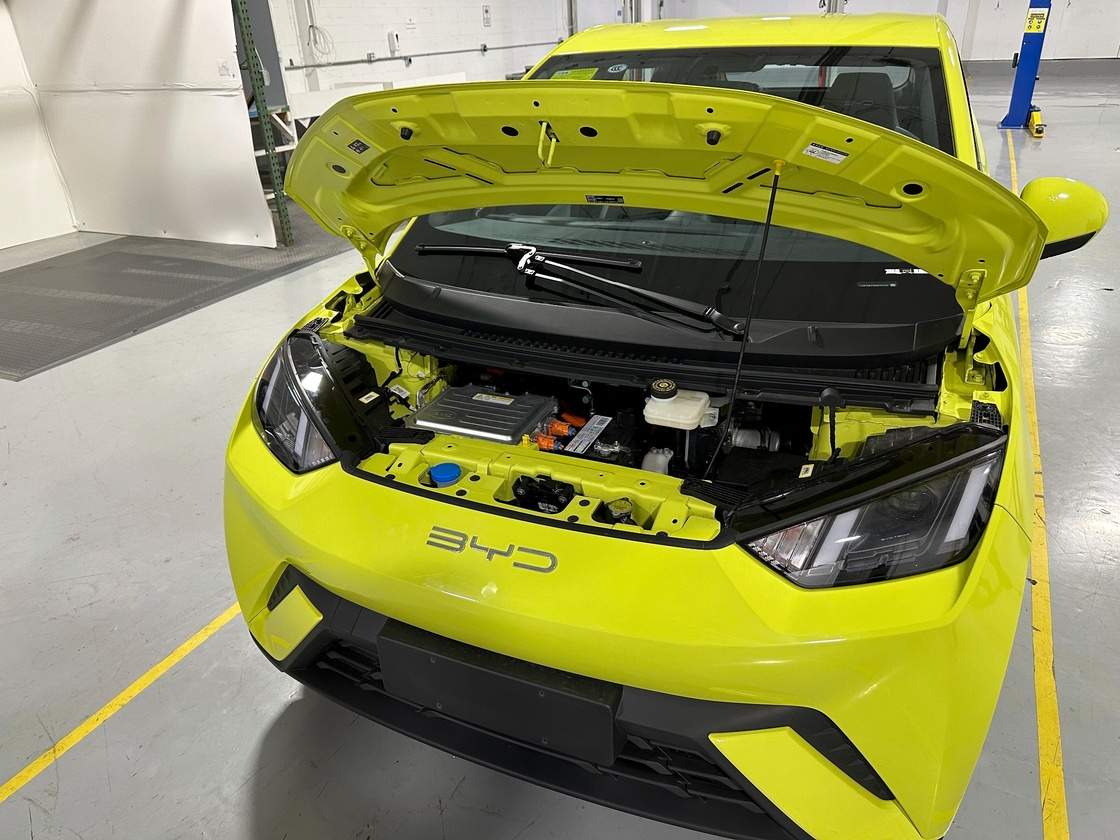
The structural integrity of the Canada-United States-Mexico Agreement (CUSMA) is breaking down under the weight of an asymmetric automotive supply chain. While public discourse focuses on high-profile trade friction and headline-grabbing tariff announcements, the operational reality is driven by a stark economic imbalance: China has achieved an unassailable cost advantage in electric vehicle (EV) production, and North America’s trade architecture was not designed to contain it.
The declaration by Mexican Foreign Secretary Roberto Velasco Alvarez that Chinese EV market penetration is now a core component of U.S. trade negotiations exposes the central vulnerability of the regional trading bloc. The United States view of the continent as a closed manufacturing fortress conflicts directly with the domestic economic priorities of its northern and southern neighbors. Resolving this tension requires analyzing the mechanics of supply chain arbitrage, the operational realities of automotive manufacturing, and the structural limitations of the treaty itself.
The Economics of Automotive Arbitrage
The primary friction in North American trade negotiations stems from a profound cost imbalance. Chinese automotive manufacturers do not merely benefit from lower labor rates; they operate within a highly integrated, state-subsidized domestic ecosystem that controls the entire battery value chain—from raw material refining to cell manufacturing. This vertical integration yields a production cost advantage that standard import duties cannot neutralize.
Faced with defensive tariff barriers in the United States, Chinese manufacturers have implemented a capital-allocation strategy focused on North American entry points. This strategy operates via two distinct mechanisms:
The Finished Vehicle Inflow
In Mexico, Chinese electric vehicles have captured roughly 20 percent of the domestic automotive market. This penetration is concentrated almost exclusively in the lowest-cost passenger vehicle segments, where domestic North American producers cannot profitably compete due to structural legacy costs and higher minimum wage requirements under CUSMA’s Labor Value Content (LVC) rules. In Canada, a policy shift under Prime Minister Mark Carney permitted the importation of up to 49,000 Chinese EVs at a preferential tariff rate of 6.1 percent in exchange for agricultural trade access. While this volume represents less than three percent of the Canadian market, it created a significant diplomatic vulnerability with Washington.
The Component and Substantial Transformation Loophole
The more complex threat to U.S. industrial policy is not the importation of fully assembled vehicles, but the flow of intermediate components. Under international trade law, the principle of substantial transformation allows components imported from a non-treaty country to acquire originating status if they undergo sufficient processing to alter their tariff classification. By establishing manufacturing and assembly platforms in Mexico, Chinese-affiliated firms can route battery cells, electronics, and sub-assemblies into the North American supply chain. Once integrated into Mexican-built components, these inputs enter the United States under preferential CUSMA terms, effectively bypassing Section 301 tariffs.
The CUSMA Renewal Trilemma
The decision by United States Trade Representative Jamieson Greer to decline a straightforward 16-year extension of CUSMA triggers a rolling annual review mechanism. This structural shift alters the investment horizon for global automotive firms. It transforms a stable legal framework into a fluid negotiation process where trade stability is conditioned on compliance with U.S. industrial policy.
                    [1] U.S. Continental Protectionism
                                   /\
                                  /  \
                                 /    \
                                /      \
                               /        \
                              /__________\
[2] Canadian & Mexican       (The Trilemma)      [3] Regional Consumer Access
Capital Diversification                           to Low-Cost Clean Tech
This structural tension creates a trilemma where regional policy makers can optimize for only two of the following three strategic objectives:
- Continental Protectionism: Absolute alignment with U.S. efforts to isolate the North American market from Chinese manufacturing and supply chain infrastructure.
- Capital Diversification: The sovereign freedom of Canada and Mexico to secure foreign direct investment, negotiate bilateral trade trade-offs, and access global supply chains.
- Consumer Affordability: Rapid regional decarbonization and vehicle electrification powered by cheap, high-quality, subsidized clean technology.
The United States has prioritized continental protectionism. This creates an immediate bottleneck for Mexico and Canada, both of which rely on the U.S. market for the vast majority of their manufacturing exports, yet face domestic pressure to keep consumer vehicles affordable.
Structural Asymmetries in the Trilateral Alliance
The current negotiation cycle highlights a fundamental divergence in how the three CUSMA signatories approach trade architecture. The U.S. position treats automotive trade through a national security lens, arguing that industrial overcapacity, state subsidies, and unfair trading practices pose a direct threat to its domestic manufacturing core.
The second limitation is Canada's shifting trade strategy. Faced with aggressive U.S. rhetoric threatening to brand the country a "drop-off port" for Chinese goods, Ottawa has attempted a delicate balancing act. While defending its limited EV import quota as a tactical concession for agricultural relief, the Canadian administration is simultaneously pursuing a broader mandate to diversify its trade away from the United States. This strategic pivot—exemplified by targets to double non-U.S. exports over the next decade—directly challenges the integrated economic perimeter envisioned by Washington.
Mexico occupies an even more exposed position. Unlike Canada, Mexico lacks the capital depth to rapidly replace foreign investment with domestic subsidies. The Mexican automotive sector relies heavily on its role as a low-cost, high-efficiency assembly hub for the North American market. While Mexico has raised its tariff rate to 50 percent for non-FTA auto imports and resisted granting state incentives to Chinese EV giants like BYD, it remains deeply dependent on Chinese intermediate inputs to maintain the cost competitiveness of its manufacturing base.
The Mechanics of Structural Alignment
The U.S. strategy for the upcoming trade reviews relies on enforcing strict regulatory harmonization across the continent. To preserve the zero-tariff benefits of CUSMA, Canada and Mexico will likely be forced to implement a series of structural adjustments designed to close the loopholes currently exploited by non-market economies.
1. Revision of Rules of Origin (ROO) Coefficients
The current CUSMA framework requires that 75 percent of a passenger vehicle's content originate within North America to qualify for duty-free treatment. Expect the United States to demand this threshold be raised to 85 percent or higher for electric vehicles, specifically isolating the battery pack, cell manufacturing, and precursor chemical processing. By redefining what constitutes an originating component, the U.S. can effectively penalize vehicles that rely on Chinese-sourced supply chains, regardless of where final assembly occurs.
2. Operationalizing Article 32.10
Article 32.10 of CUSMA permits any party to terminate the agreement with six months' notice if another member enters into a free trade agreement with a "non-market economy" (a designation that explicitly targets China). Washington is weaponizing the spirit of this clause to demand rigorous foreign investment screening mechanisms from both Ottawa and Mexico City. This will require the implementation of joint data-sharing registries to track ultimate beneficial ownership (UBO) in Greenfield manufacturing projects, effectively blocking Chinese capital from setting up shop within the free trade zone.
3. Supply Chain Tracking and Software Bans
Beyond physical components, the next phase of trade protectionism focuses on software and connected vehicle architecture. The U.S. is moving toward a total ban on Chinese-connected vehicle software and hardware due to national security risks. Because modern EV supply chains are highly integrated, Canada and Mexico will have to implement identical domestic prohibitions. Failure to align on these technological sanctions will result in immediate border frictions, as U.S. customs enforcement treats non-compliant Canadian or Mexican-assembled vehicles as systemic security risks.
Strategic Action Plan for North American Automakers
The era of predictable, rule-based continental trade has been replaced by a system of managed, transactional commerce. Corporate strategies built on the assumption of an open, friction-free North American market require immediate recalibration.
- Audit Sub-Tier Supply Chains for Non-Market Exposure: Manufacturers must map their supply chains past Tier 1 and Tier 2 suppliers down to the raw material and ingot level. Any reliance on Chinese sub-components or processing must be phased out ahead of the rolling CUSMA reviews to avoid sudden tariff exposure.
- Re-shore Battery Value Chains to the Bloc: Investment must shift away from trying to arbitrage cheap external inputs through Mexico. Companies should prioritize localized battery joint ventures within Canada or the U.S. that leverage domestic subventions, such as the U.S. Inflation Reduction Act incentives, to offset the structural cost differential with China.
- Prepare for Border Friction Friction-Mitigation Protocols: Anticipate increased customs scrutiny at the U.S.-Mexico and U.S.-Canada borders. Automakers must deploy advanced digital ledger tracking to provide instantaneous, verifiable proof of origin for every vehicle crossing the line, ensuring that compliance documentation can withstand aggressive political shifts.


:max_bytes(150000):strip_icc():focal(999x0:1001x2)/taylor-swift-albums-1-93026ca98408417097660e117a10a6a9.jpg)