Two ambulances. One narrow Edmonton apartment hallway. A radio crackling with static that sounded like any other midnight shift in March 2023.
When a paramedic steps into the back of a moving rig, the rules of their own biology change. Pulse rates drop through trained breathing. Hands steady around IV catheters and airway tubes while sirens scream a few feet above their heads. They become vessels for someone else's survival, stripping away their own names, their own fears, and their own families until the hospital doors slide open.
Nobody trains you for what happens when the stranger bleeding on your stretcher belongs to the same precinct as your husband. Nobody writes a protocol for the exact second you realize the second gunman's bullet did not stop at one badge.
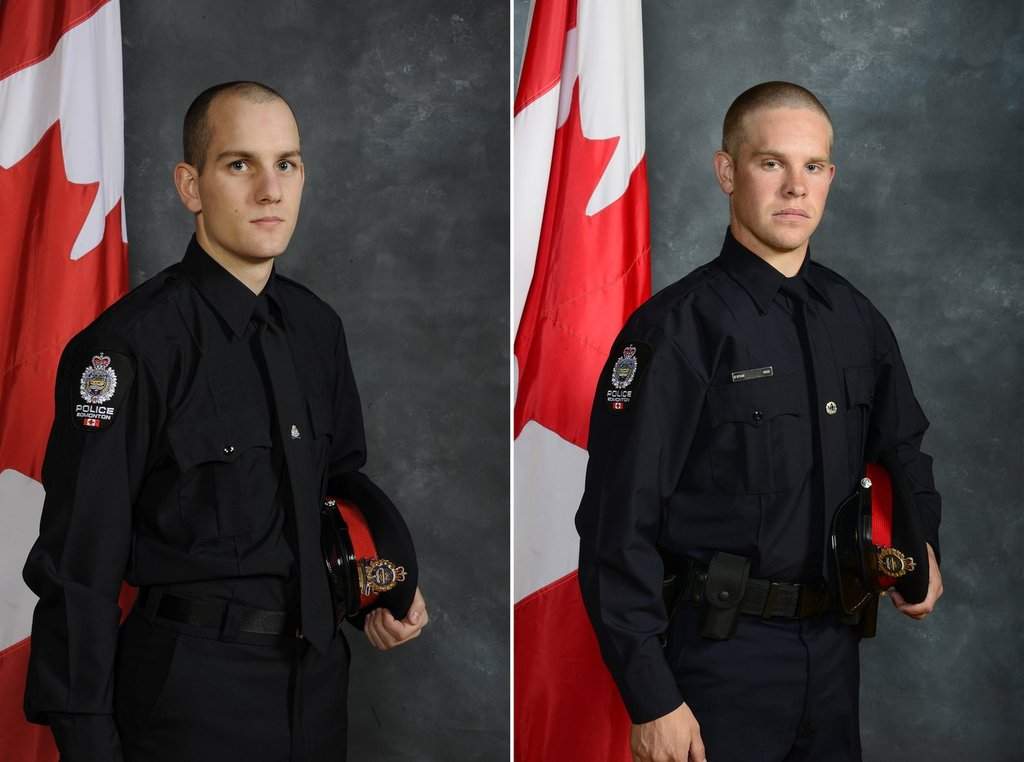
Consider what happens next in that blinding fluorescent glare of an emergency bay. On March 16, 2023, in Edmonton, Alberta, two young police officers—Constable Travis Jordan and Constable Brett Ryan—answered a routine domestic disturbance call at the Baywood Park apartments in Inglewood. Within minutes, gunfire tore through the stairwell. Both officers were hit. One of the paramedics dispatched into that chaos was Brett Ryan’s wife, Ashley, working her own overnight shift on the front lines of the city's emergency medical system.
She went in to save a life. She ended up fighting to keep a colleague breathing while the unthinkable truth closed in around her.
The Architecture of a Shared Shift
To understand the weight of that night, you have to understand how first-responder households actually breathe.
In a normal marriage, danger is an abstract concept discussed over morning coffee or watched on the evening news. In a marriage between a police officer and a paramedic, danger is a physical roommate. It sits on the kitchen counter next to duty belts, trauma shears, and half-drunk thermoses of black coffee. It dictates when you sleep, when you eat, and how tightly you hold onto a goodbye before stepping out into a sub-zero Alberta night.
People outside the emergency services often assume couples in uniform become numb to the risk. They do not. If anything, proximity sharpens the edges. When you spend twelve hours a day zipping body bags, starting chest compressions on frozen concrete, and watching families collapse in hospital waiting rooms, you know with terrifying precision how fragile a human ribcage is. You know how fast four liters of blood can leave a body.
Yet you keep going. You build an unspoken pact. You trust the dispatchers, you trust the training, and you trust the invisible wall that separates your shift from your home.
That wall is an illusion.
Inside the Hallway at Inglewood
Picture a standard multi-unit apartment corridor. Imagine the smell of stale hallway carpet, copper, and cordite hanging in air that has nowhere to escape.
When police and EMS respond to a high-priority "officer down" call, sensory overload hits before the rig even shifts into park. Red and blue strobes bounce off brick walls in violent, disorienting pulses. Dispatchers bark updates over overlapping channels—addresses, floor numbers, suspect descriptions, staging instructions.
For a paramedic entering a scene that has just turned hot, triage is ruthless and immediate. You do not look for faces first. You look for mechanics. Is the chest rising? Where is the entry wound? Is the airway clear? Is the radial pulse thready or gone?
Ashley Ryan arrived at that scene operating on pure muscle memory. She was doing what she had spent years learning to do—stepping toward gunfire while everyone else ran away, kneeling beside a wounded Edmonton police officer to fight death with gauze, tourniquets, and sheer will.
Think about the cognitive split required in that moment. One half of her brain was locked onto the physiology of the officer in front of her—monitoring vitals, preparing transport, calculating trauma-center arrival times. The other half was registering the unit numbers, the uniform patches, the unmistakable realization that two officers had been shot in the same stairwell.
Brett Ryan was thirty years old. Travis Jordan was thirty-five. Both had joined the Edmonton Police Service to build lives rooted in public service—Brett had previously worked as a paramedic himself before trading the ambulance for a cruiser. He knew the exact protocols his wife was executing in the back of that rig. He knew every move she would make to save his partner.
And somewhere in the agonizing minutes between the apartment hallway and the Royal Alexandra Hospital, the radio traffic stopped being about an unnamed officer. It became about her husband.
The Collision of Duty and Grief
There is a specific kind of silence that falls over an emergency department trauma room when one of their own rolls through the doors.
Doctors who normally bark orders speak in clipped, low voices. Nurses move with a terrifying, synchronized speed that looks almost like grief in motion. Everybody knows what is at stake, and everybody knows who is watching from three feet away.
When a civilian loses a spouse in a sudden tragedy, they are allowed to collapse immediately. Friends catch them. Counselors lead them into quiet rooms with soft chairs and tissues. They are permitted to fall apart because nobody is asking them to hold a pressure dressing on a gunshot wound at the exact same time.
First responders do not get that grace.
In the immediate aftermath of an active shooting, the machinery of emergency response cannot simply pause to accommodate heartbreak. Radios still squawk. Reports still need to be filed. Rig doors still have to close. A paramedic who has just discovered her husband was shot while she worked to save his partner occupies two incompatible universes at once—she is both the clinician on duty and the widow standing in the wreckage of her future.
This is the invisible cost that rarely makes the evening broadcast. News reports summarize the timeline in clean, chronological paragraphs: Officers responded at 12:47 a.m. Shots were fired. Both officers were transported to hospital, where they were pronounced deceased.
Clean. Sterile. Over in forty-five seconds of airtime.
What those broadcasts miss is the psychological earthquake that follows when professional duty and personal devastation collide in real time. Clinical psychologists who specialize in first-responder trauma call this dual-role shock—a condition where the brain's threat-response system is hijacked simultaneously by occupational hypervigilance and acute personal bereavement. The very neural pathways trained to suppress emotion during a crisis suddenly trap grief inside the body with nowhere to go.
Why This Story Refuses to Fade
Days after the shooting, thousands of officers, paramedics, firefighters, and ordinary citizens lined the streets of Edmonton in freezing temperatures for a regimental funeral that stretched for blocks. Bagpipes echoed off downtown glass towers. White-gloved hands snapped to foreheads in silent salute as two hearses rolled past.
Public mourning has a rhythm to it. Flags drop to half-mast. Speeches praise courage, sacrifice, and brotherhood. Then, slowly, the flags go back up, the news cycle pivots to the next election or economic report, and the city returns to its daily commute.
Except nothing returns to normal for the people who rode in those ambulances.
Look closely at what happened in that Inglewood stairwell and you see a truth most civilians prefer not to examine: our entire system of public safety rests on human beings willing to absorb trauma so the rest of us never have to see it. We ask twenty-something and thirty-something men and women to walk into domestic disputes, mental health crises, and armed ambushes at one in the morning, and we expect them to compartmentalize the horror by sunrise.
When a paramedic ends up treating one dying officer while learning her husband is the other, the compartment breaks permanently.
You cannot unhear the radio call. You cannot unsee the trauma bay lights. You cannot scrub the smell of that hallway out of your memory, no matter how many times you wash your uniform. Every siren that wails down Jasper Avenue at two in the morning carries an echo of that night. Every shift change carries a quiet question that used to have an easy answer: What if tonight is the night?
The Weight Behind the Uniform
If you have ever stood in a hospital corridor waiting for a doctor to walk through double doors with a clipboard, you know how long sixty seconds can feel. Your stomach drops into your boots. Every fluorescent bulb buzzes like a chainsaw. You try to read the expression on a nurse's face before she even opens her mouth.
Now stretch that feeling across an entire career.
That is the reality of emergency medicine and policing today. Across North America, paramedics and police officers are facing unprecedented rates of post-traumatic stress injury, moral exhaustion, and acute grief. Many carry the names of fallen colleagues on metal bracelets around their wrists—cold reminders pressing against their pulse every time they reach for a steering wheel or a stethoscope.
At Brett Ryan and Travis Jordan's memorial, Ashley Ryan stood before a sea of uniforms and spoke with a steadiness that stunned everyone in the room. She spoke about love, about the life she and Brett had built, and about the unborn child they had been preparing to welcome into the world.
Think about that detail for a second.
While she knelt in that apartment corridor fighting to save a fellow officer's life, she was carrying Brett Ryan’s child. Two generations of a family caught in the crossfire of a single midnight call.
What Remains After the Sirens Stop
We love stories about heroes because heroism feels grand, cinematic, and distant. It lets us admire courage from a safe distance without confronting the brutal arithmetic of what courage actually costs.
There was nothing cinematic about March 16, 2023. There were no dramatic swells of music, no neat resolutions, and no clean separation between the rescuers and the rescued. There was only a young woman in paramedic boots doing her job in a narrow hallway while her world quietly shattered three feet away.
The next time an ambulance screams past your car at a red light and you pull over to the curb for ten seconds before turning your music back up, remember who might be sitting in the back. Beneath the reflective stripes and the calm, practiced voice on the radio is a human being carrying an entire universe of love, fear, and memory into someone else's worst night.
Sometimes, the person they are trying to save isn't a stranger at all.