The air inside the Microsoft Theater hums with a very specific brand of Los Angeles electricity. It is an expensive, manufactured heat, fueled by dry cleaning, designer leather, cheap champagne, and the collective terror of men and women waiting to find out if their life's work matters for another twelve months.
Cameras swing on heavy jibs, their red tally lights blinking like sleepy, mechanical eyes. Learn more on a connected topic: this related article.
Then, something breaks.
Not a rulebook. Something older. Something structural. More reporting by The Hollywood Reporter explores related perspectives on the subject.
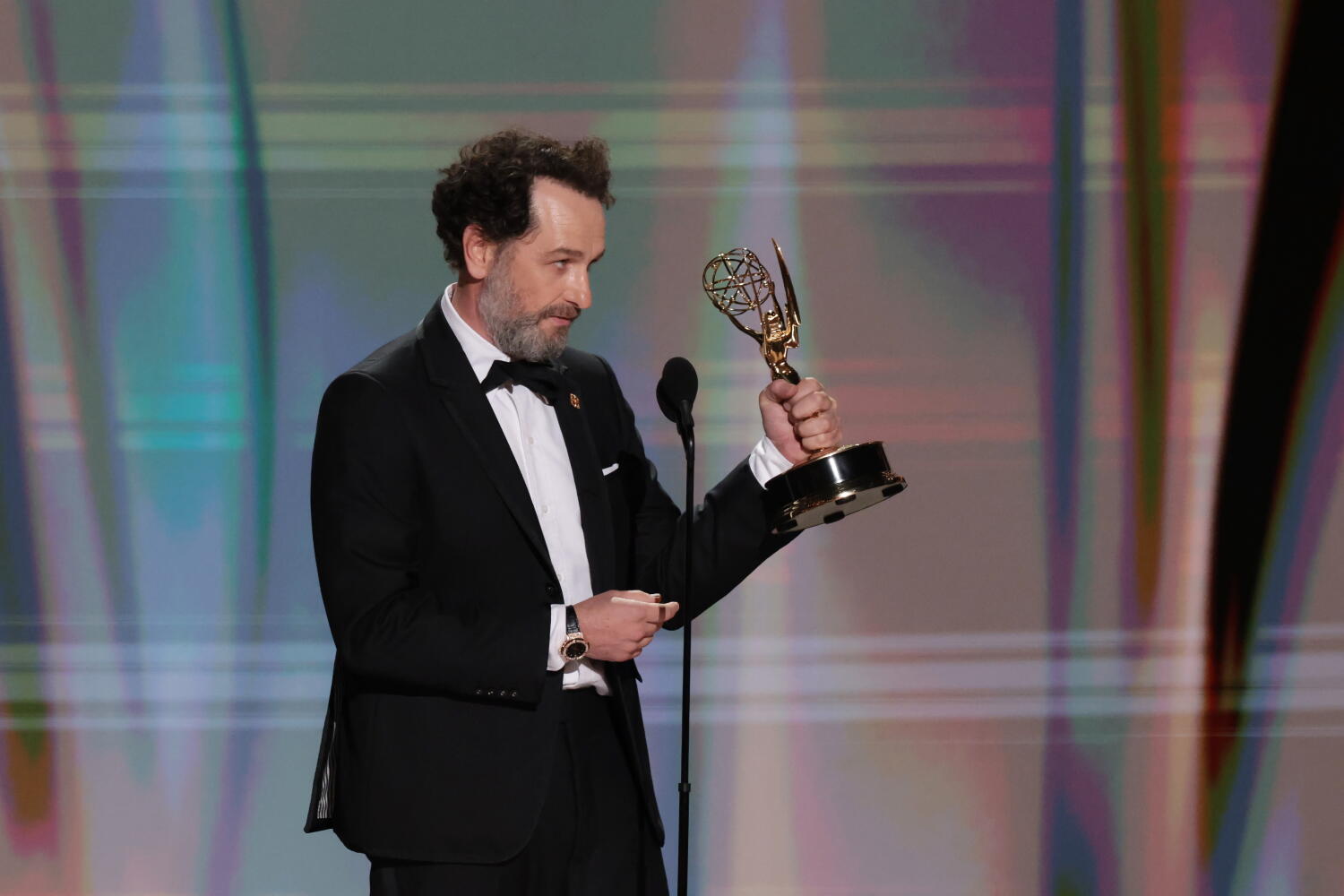
Matthew Rhys sits in the dark of the auditorium, wearing a tuxedo that fits with the effortless slouch of a man who would rather be walking a sheepdog in upstate New York. He has spent years playing Philip Jennings, a Russian spy pretending to be a travel agent in suburban Washington, D.C. He has spent six seasons wearing polyester wigs, biting into cyanide pills, hiding in trunks, and carrying the psychological wreckage of an empire that no longer exists. He knows what it feels like to live two lives simultaneously.
He is about to live two historic moments in the span of an hour.
Television has always loved a neat container. One category. One winner. One slot on the shelf. The Primetime Emmy Awards were built on the comforting fiction that art can be neatly sorted into bins like tax forms or grocery aisles. Lead Actor in a Drama Series. Limited Series or Movie. Choose your lane. Stay in your lane. Do not cross the yellow line.
Except television changed beneath their feet. The golden age of prestige cable and streaming blurred the borders. Actors began drifting across formats, sliding from multi-year sagas into self-contained cinematic events, treating television not as a serialized conveyor belt, but as a sprawling canvas.
The industry wasn't ready for what happened next.
Consider the mechanics of the ordinary win. An actor hears their name, executes a rehearsed gasp of pure, unadulterated shock, hugs the director, trips slightly on the stairs, and reads a list of thank-yous off a crumpled piece of paper while the orchestra politely tries to play them off with a brassy fanfare. It is a well-choreographed dance of validation.
Matthew's first trip to the stage that night for his work in The Americans was supposed to be the capstone. It was the long-delayed punctuation mark for a show that critics worshipped in hushed tones while millions of viewers slept. For years, the Emmys had looked right past the show's quiet, devastating psychological warfare, favoring flashier, louder neighbors. When his name was finally called for the drama series category, it felt like an apology wrapped in an award. A final bow for a masterpiece that had already wrapped its final episode.
He went up. He spoke. He thanked Keri Russell, his partner in espionage and in life, whose absence from the winner's circle alongside him remains one of the medium's great quiet tragedies. He walked back down the stairs. The machine hummed on. Commercial break. More gowns. More polite applause.
And then, the impossible happened.
Barely forty minutes later, the envelopes shifted again. The category was different. The project was different. The weight was entirely changed.
He was nominated again, this time for his searing, unblinking performance as Daniel Ellsberg in the historical drama The Pentagon Papers—or rather, the momentum of prestige television collided with his unprecedented double-nomination footprint that season. He had slipped between worlds, working on a sprawling television canvas where boundaries were dissolving in real-time.
When the announcer's voice cut through the auditorium a second time, a collective pause rippled through the room.
Not a gasp. A pause. The sort of silence that happens when a computer tries to divide by zero and the screen freezes for a split second.
He didn't move immediately. Nobody moves immediately when reality malfunctions.
In the history of the medium, winning two lead acting trophies on the exact same night is a statistical anomaly, a glitch in the matrix of awards-season architecture. It doesn't happen because the math of television production usually prevents it. Actors are exhausted by one grueling shoot; they do not typically anchor two separate, critically acclaimed defining projects that happen to land in the same eligibility window.
As he walked back up those stairs, the physical space between his seat and the microphone felt miles long.
There is a distinct kind of loneliness that comes with playing a spy. You are always watching, always calculating, always hiding the core of who you are behind a practiced smile and a fake accent. Matthew Rhys had spent a decade hiding inside other men's skins, shedding his Welsh accent, burying his own history beneath the armor of fiction.
Standing at that podium for the second time, the armor slipped.
He looked down at the heavy gold statuette in his hand. Then he looked at the second one. Two heavy chunks of winged metal, identical in weight, representing two completely different universes of human suffering and survival.
The room rose. Not with the polite, seat-filling rhythm of a mandatory standing ovation, but with the rolling, swelling roar of people witnessing something they knew they would never see again.
Awards shows are monuments to ephemera. By morning, the dresses are in dry cleaning, the red carpet is rolled up and sold for scrap, and the statuettes are sitting on a bookshelf collecting dust while agents negotiate the next percentage point. We consume culture at a relentless, terrifying velocity, scrolling past masterpieces on our phones while waiting for our coffee to brew.
Yet that night in Los Angeles felt different because it grounded us in craft.
We live in an era that demands speed. We want our entertainment digested, summarized, and served in bite-sized vertical videos. We want our actors to be brands, our shows to be algorithms, and our cultural moments to be pre-packaged for viral consumption.
Matthew Rhys is an antidote to all of that. He is an actor who works from the inside out, building characters out of silence, posture, and the terrible weight of unspoken things. He doesn't command the screen with loud monologues or high-concept gimmicks. He does it by standing still in a dimly lit kitchen, holding a glass of scotch, while his eyes betray the entire Cold War collapsing around him.
When he won those two Emmys, he wasn't just collecting metal. He was validating the slow burn. He was proving that in an age of hyper-accelerated content, deep, patient, agonizingly careful storytelling still matters.
The broadcast faded to black. The credits rolled over a stage littered with discarded cue cards and empty water bottles. The stars filtered out into the humid California night, climbing into black SUVs and heading toward afterparties where the champagne would flow until dawn.
Backstage, alone in a quiet holding room away from the flashes and the screaming producers, Matthew looked down at the two statues sitting side by side on a minimalist wooden table.
They looked heavy.
He didn't smile for a camera. He just reached out, touched the cold, golden wings of the second award, and let out a long, quiet breath that sounded suspiciously like a man who had finally finished a very long, very dangerous journey.