The air smelled of stale lager, cheap sulfur, and fear.
It was 11:42 PM on a warm European night, less than two hours after the final whistle had blown, cementing a historic Champions League victory. On paper, it was a moment of pure sporting immortality. In the streets, it felt like the collapse of a minor civilization.
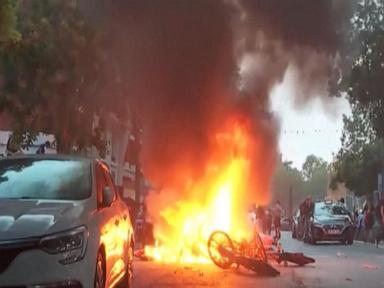
I stood pressed against the cold brick facade of a shuttered café, watching the smoke from a burning scooter drift upward into the glare of police floodlights. To my left, a father in a creased replica jersey was desperately trying to shield his teenage daughter from a sudden, chaotic surge of people. They weren’t rioting. They were just trying to run. But in a crowd of thirty thousand adrenaline-fueled bodies, running looks exactly like a stampede.
We are told that football is a secular religion, a unifying force that bridges divides. But anyone who has stood in the fracturing center of a post-match celebration knows the truth is far more volatile. Joy and violence sleep in the same bed. When the stakes are this high, the line between euphoria and total anarchy dissolves with terrifying speed.
By sunrise, the official tallies would hit the news wires with the clinical detachment of a bank statement: hundreds of arrests, dozens of injured officers, property damage in the millions. But numbers tell you absolutely nothing about how a city actually fractures.
The Chemistry of the Kinetic Crowd
To understand how a celebration turns into a war zone, you have to look at the anatomy of the crowd itself. It doesn't happen all at once. It builds in layers, like a slow-burning fever.
Early in the evening, the energy was infectious. Complete strangers were hugging in the plazas. Grown men were weeping on the steps of public monuments. This is the collective effervescence that sports fans chase—the rare, intoxicating feeling of belonging to something larger than yourself.
But as the alcohol flowed and midnight approached, the demographic of the street shifted. The families began to retreat to the subways, sensing the subtle change in temperature. The casual fans drifted toward the edges. What remained was a dense, volatile core of young men, heavily intoxicated and hyper-stimulated by a victory that felt, to them, like personal validation.
Psychologists call it deindividuation. When you place a person inside a massive, roaring collective, their individual sense of responsibility begins to erode. They stop being an accountant, a student, or a mechanic. They become the crowd. And the crowd feels invincible.
Consider a hypothetical fan—let’s call him Marc. Marc didn’t wake up that morning intending to smash a shop window or throw a glass bottle at a line of riot police. He is, under normal circumstances, a mild-mannered graphic designer. But when a group of hundred men around him begin chanting, pushing against a police barricade, and defying authority, Marc’s internal compass glitches. The collective roar acts as a powerful narcotic. The risk of consequence vanishes, replaced by a desperate need to prove his loyalty to the tribe.
It takes only a spark. A single dropped bottle. A misunderstanding at a police checkpoint. A stray firework launched horizontally instead of vertically.
Suddenly, the air pressure changes.
The Shield and the Brick
When the flashpoints occurred, the police response was immediate and uncompromising. This is where the tragedy of the modern matchday truly comes to light.
Riot policing is not an exercise in conflict resolution; it is an exercise in kinetic containment. Officers clad in heavy body armor, looking more like sci-fi soldiers than public servants, formed interlocking walls of plexiglass. From behind my vantage point near the café, the sound of batons striking shields carried a rhythmic, terrifying thud that echoed off the historic architecture.
The state has a monopoly on violence, but a crowd possesses the terrifying power of sheer mass.
Tear gas canisters arced through the air, leaving white, chemical trails before detonating with a sharp pop. Within seconds, the celebratory songs turned to coughing, gagging, and panic. The burning sensation in the back of the throat is something you never forget—it strips away every human instinct except the primal urge to escape.
But where do you go when every street is a bottleneck?
The clash became a desperate, circular dance. The police pushed forward to clear the square; the crowd surged back, leaving behind a trail of broken glass, overturned trash bins, and the discarded flags of the very club they had spent the last nine months supporting. It was a civil war played out in ninety-minute increments, fueled by a sporting spectacle that had completely lost control of its own narrative.
The Invisible Cost of the Trophy
The day after a riot, a city undergoes a eerie ritual of erasure.
By 6:00 AM, the street sweepers were out in force. The crunch of shattered Heineken bottles beneath heavy broom bristles formed the morning's soundtrack. Business owners stood outside their shops, sweeping away the remnants of broken display cases, staring blankly at the graffiti sprayed across their walls.
We rarely talk about the shopkeepers. We rarely talk about the elderly residents who spent the night huddled in their apartments, listening to the explosions of industrial fireworks outside their windows, wondering if their buildings would catch fire.
The club executives will issue a sterile press release condemning the violence, carefully distancing the organization from the "small minority of troublemakers." The politicians will call for harsher penalties and stadium bans. The media will run the dramatic footage on a loop, maximizing the clicks and views generated by the chaos.
But the systemic issue remains entirely untouched.
Football has engineered a ecosystem where fandom is no longer just a hobby; it is an identity weaponized by commercial interests. We are bombarded with marketing campaigns telling us that our club is our family, our blood, our entire existence. We are conditioned to view the opposition not as sporting rivals, but as existential enemies. Then, we act surprised when people behave as though they are at war.
The victory parade will still happen. The players will ride through the city on an open-top bus, hoisting a silver trophy into the sunlight. The silver will gleam, the confetti will fall, and the television cameras will capture a picture-perfect image of sporting glory.
But the broken glass in the side streets will still be there, swept into small, sharp piles against the curb, waiting for the next big game.