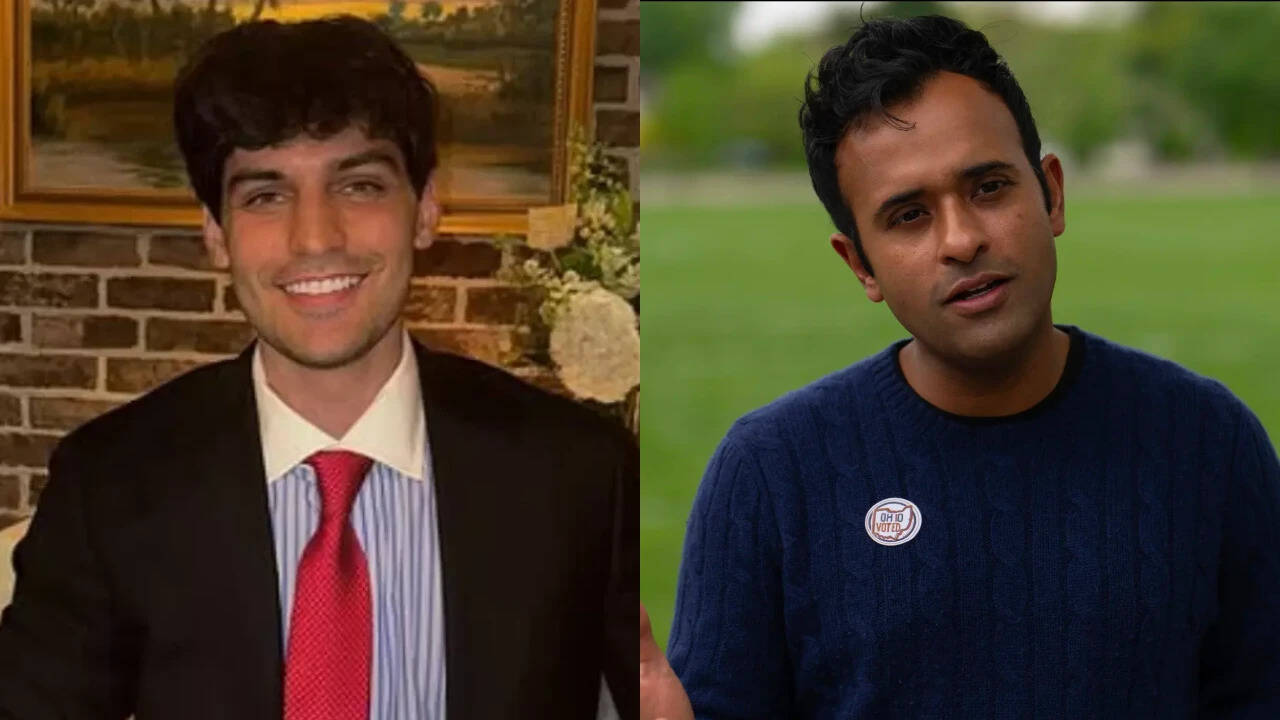
Politics makes strange bedfellows, but ideological wrestling matches within the same political wing get personal fast. When public figures start cross-examining each other's theology on national stages, sparks fly. That is precisely what happened when Nalin Haley, son of former United Nations Ambassador Nikki Haley, publicly took aim at Vivek Ramaswamy over how he discusses Hinduism and Christianity.
If you have been watching the conservative movement lately, you know identity, faith, and national values are constantly being renegotiated. Ramaswamy has frequently addressed his Hindu faith while appealing to Christian-majority audiences, arguing that both traditions share foundational overlaps in recognizing a higher moral order. Nalin Haley, who has converted to Catholicism, called out those theological bridges, arguing that trying to blend or equate distinct religious systems ends up misrepresenting both. Building on this theme, you can also read: Why Ukraine Air Defense Shortages Are Creating an Impossible Reality in Kyiv.
The Clash Over Theological Blending
The entire friction sparked after Ramaswamy answered audience questions regarding his faith at a high-profile conservative gathering. Confronted about how a Hindu worldview fits inside a predominantly Christian political coalition, Ramaswamy pointed to Advaita Vedanta philosophy, describing himself as an ethical monotheist who views various expressions as part of a single ultimate reality. He even drew loose comparisons to how different traditions reconcile the concept of the one and the many, pointing toward Christian concepts like the Holy Trinity.
For many voters, it was an interesting philosophical defense. For Nalin Haley, it crossed a line. Taking to social media, Haley argued that blurring the lines between distinct faiths does a disservice to believers on both sides. His core argument was straightforward: Hindus do not want to be Christianized, and Christians do not want to be Hinduized. In his view, pretending theological systems are interchangeable dilutes the unique truth claims each tradition makes. Observers at The Guardian have shared their thoughts on this trend.
This friction exposes a deeper identity split running through modern American conservatism. On one side, you have figures eager to emphasize a broad moral coalition based on shared Judeo-Christian cultural outcomes, regardless of a candidate's personal private theology. On the other side, purists argue that theological distinctions matter immensely and shouldn't be glossed over for political convenience.
Navigating Faith and Public Office
Religion has always played an uncomfortable role in American presidential and state-level politics. Article VI of the US Constitution explicitly bans religious tests for holding public office, yet voters care deeply about a candidate's moral compass.
When minority candidates rise within the Republican Party, they handle their cultural and religious backgrounds in vastly different ways. Some lean heavily into their immigrant heritage while adopting traditional American Christian practices. Others, like Ramaswamy, openly retain their ancestral faith while arguing that its philosophical underpinnings align with conservative American principles like individual liberty, hard work, and moral responsibility.
Critics of Ramaswamy's approach often argue that trying to map Hindu philosophical concepts onto Christian dogma confuses religious scholars and alienates conservative base voters who want explicit professions of Christian faith. Meanwhile, defenders point out that a big-tent movement requires welcoming people of various backgrounds who share core political objectives, especially regarding economic policy, border security, and constitutional governance.
The Backlash and Personal Stakes
The public spat quickly devolved into a broader internet pile-on, with online commentators dragging family histories and personal choices into the mix. Because both Haley and Ramaswamy are high-profile figures of Indian descent navigating the upper echelons of the Republican party, every statement they make about religion gets hyper-analyzed through the lens of assimilation and identity politics.
Nalin Haley faced heavy trolling from critics questioning his own background, given that his mother was raised Sikh before converting to Christianity, and he himself attended Catholic institutions and identifies as Catholic. He pushed back firmly against internet critics, stating that he is comfortable with who he is and that his theological stance has nothing to do with running away from his heritage.
At the same time, Hindu advocacy organizations weighed in on the debate, noting that explaining complex Eastern philosophies to Western audiences is inherently tricky. Scholars pointed out that Western political stages are built for Abrahamic theological frameworks, forcing Hindu-American politicians to translate ancient metaphysical concepts into language that evangelicals and traditional conservatives can digest. When those translations get sloppy, theological gatekeepers step in.
What This Means for the Future of Conservatism
This public disagreement is more than a petty squabble between political scions. It highlights an ongoing identity crisis for a political party trying to balance traditional religious nationalism with a growing, diverse coalition of non-Christian immigrants and their children.
As more second-generation Americans step into political leadership, the old scripts no longer apply. You no longer have to choose between total cultural erasure and political irrelevance. Instead, you see candidates openly debating the theological boundaries of the conservative coalition in real-time.
Whether voters care about these granular distinctions remains to be seen. Most people in the voting booth care far more about inflation, job markets, and safety than they do about Vedanta philosophy versus Western trinitarianism. Yet, for movement insiders, these ideological guardrails define who gets to speak for the future of the party.
Watch how upcoming candidates handle these exact questions. The next time a politician tries to bridge two entirely different worlds on a debate stage, expect someone in the crowd—or someone on social media—to call them out for it.
This video provides additional context on how Vivek Ramaswamy fields tough questions regarding his Hindu faith on conservative political stages.


