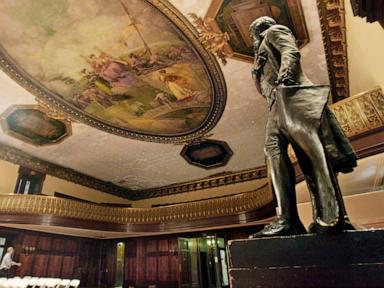
Stop treating Thomas Jefferson like a historical Rorschach test.
The mainstream intellectual consensus loves to wring its hands over what they call the "enduring contradictions" of the third president. They sketch a portrait of a man pulling the strings of history while trapped in his own hypocrisies—the slaveholder who wrote the Declaration of Independence, the small-government idealist who bought Louisiana on the executive credit card. From there, pundits spin a lazy narrative: every American era, from Abraham Lincoln to Donald Trump, simply projects its own anxieties onto Jefferson's blank canvas.
This is fundamentally wrong. It is a historical cop-out designed to shield citizens from a much harsher truth.
Jefferson was not a bundle of contradictions, nor is he a blank slate that politicians reinvent. He was an explicit, radical anti-statist whose core philosophy has remained entirely consistent throughout American history. The politicians who channel him today are not distorting his legacy. They are executing it to the letter.
The institutionalist class hates this reality because it exposes the fragility of the bureaucratic state they spent a century building.
The Lazy Consensus of the Chattering Class
Every election cycle, a fresh crop of essays emerges claiming that America needs to "reclaim" Jefferson or analyze how a new political movement has "warped" his vision. I have spent two decades analyzing political rhetoric and policy strategy, and I can tell you that this hand-wringing serves only one purpose: to make elite commentators feel sophisticated while they miss the structural mechanics of American populism.
The conventional argument goes like this: Lincoln used Jefferson’s "all men are created equal" to ground the anti-slavery movement, while modern right-wing populists use Jefferson’s distrust of centralized authority to attack the deep state. Therefore, the narrative claims, Jefferson is a mirror of whoever holds power.
This analysis is soft. It treats political philosophy like a marketing campaign where slogans are swapped out for a new target demographic.
To understand why this is a flaw, look at the actual text of Jefferson’s thought, specifically the Kentucky Resolutions of 1798. Written in secret to oppose the Alien and Sedition Acts, Jefferson argued that the federal government was merely a compact among states, and that when the federal government oversteps its bounds, nullification by those states is the rightful remedy.
This is not a moderate position. It is an explicitly decentralizing, anti-institutional doctrine designed to disrupt centralized governance. When modern political figures demand the dismantling of federal agencies, they are not twisting Jefferson's words. They are quoting his playbook.
Lincoln Did Not Adapt Jefferson He Defeated Him
The biggest historical error the mainstream consensus makes is claiming Lincoln carried the Jeffersonian torch. This is a profound misunderstanding of the structural shift that occurred during the Civil War.
In 1859, Lincoln wrote a famous letter to Boston Republicans praising Jefferson as the man who introduced the "abstract truth, applicable to all men and all times" into a merely revolutionary document. Traditional historians point to this as proof of a seamless ideological inheritance.
They ignore the structural mechanics of what Lincoln actually did.
Jefferson's vision for America was an agrarian republic, decentralized, suspicious of manufacturing, and dependent on a weak federal executive. He envisioned a society where local majorities held absolute sway. Lincoln recognized that this exact framework was what allowed the slave-holding South to justify secession under the banner of states' rights.
To preserve the Union and end slavery, Lincoln had to build the very thing Jefferson despised: a powerful, centralized nation-state. Lincoln financed the war through the first national income tax, created a national banking system, issued greenbacks, and used federal power to override local governance.
- Jefferson wanted a confederation of sovereign republics.
- Lincoln built a consolidated, industrial nation-state.
To say Lincoln was a Jeffersonian because he quoted the Declaration of Independence is like saying a corporate CEO is a Marxist because they use the word "worker." It confuses a rhetorical tool with structural reality. Lincoln did not adapt Jefferson; he built an institutional apparatus designed to contain the chaotic forces Jefferson set in motion.
The Deception of the Louisiana Purchase Argument
Whenever you point out Jefferson's rigid anti-statism, institutionalists bring up the Louisiana Purchase of 1803 as the ultimate "gotcha." They argue that by buying the territory without explicit constitutional authorization, Jefferson proved he was a pragmatist who favored executive power when it suited him.
This argument misses the entire geopolitical context of the era.
Imagine a scenario where a weak, newly formed nation is flanked by imperial superpowers—Great Britain to the north and a highly aggressive Napoleonic France to the west. Jefferson did not buy Louisiana because he suddenly fell in love with federal power. He bought it because he understood that if France controlled the Mississippi River and the port of New Orleans, the economic survival of the American agrarian populist was over.
For Jefferson, the greatest threat to human liberty was not a temporary stretch of executive authority; it was the enclosure of the American continent by European empires that would force the United States to maintain a massive, permanent standing army to defend its borders. A standing army meant high taxes, centralized bureaucracy, and the death of individual liberty.
The Louisiana Purchase was a defensive maneuver to prevent the rise of a military-industrial state on the American continent. It was an act of anti-statism funded by a real estate transaction. Calling it a contradiction shows a total lack of strategic literacy.
Why Modern Populism is Jefferson’s Purest Bloodline
The contemporary political arena frequently draws parallels between Jefferson and modern anti-establishment movements. Mainstream analysts treat this connection as an anomaly, an ironic twist where a Virginia aristocrat becomes the patron saint of working-class grievance.
Once again, the experts are asking the wrong question. They ask: "How can a wealthy elite represent populist anger?"
They should be asking: "Why does the American system inherently produce an anti-institutional rebellion every fifty years?"
Jefferson provided the foundational code for this rebellion. He was deeply hostile to what he called the "artificial aristocracy" of birth and wealth, but he was equally hostile to the institutional aristocracy of clerks, judges, and banks. In an 1816 letter to Samuel Kercheval, Jefferson explicitly argued that institutions must change and give way as the human mind becomes more developed. He famously asserted that a revolution every twenty years was a healthy sign of political vitality.
The modern hostility toward unaccountable administrative agencies, corporate-state collusion, and centralized intellectual authority is not a perversion of the founding era. It is the literal application of Jeffersonian skepticism. The current friction in American civic life is not between different interpretations of Jefferson; it is between the Jeffersonian impulse to dismantle institutions and the Hamiltonian impulse to fortify them.
The Cost of the Counter-Intuitive Truth
Admitting that Jefferson was an uncompromised, radical anti-statist comes with a severe downside that modern commentators are too cowardly to face.
If Jefferson is not a flexible symbol who can be molded to fit any moderate, unifying consensus, then the foundational ideology of the United States is inherently volatile. It means that the American system was designed to invite disruption, to challenge its own structures, and to tolerate a level of political friction that would tear other nations apart.
The institutional stability that elite commentators crave is fundamentally un-Jeffersonian. Alexander Hamilton wanted stability through financial institutions and central authority. Jefferson wanted liberty through constant, decentralized agitation.
Stop looking for contradictions in the man's character to explain away the chaos of modern politics. The chaos isn't a malfunction of the machine. It is exactly how Jefferson designed it to operate.